Making Decisions Using Sets of Probabilities: Updating, Time Consistency, and Calibration
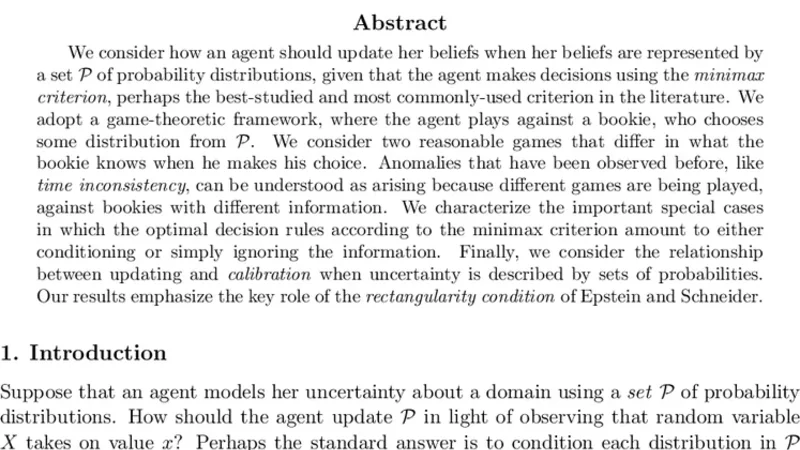
We consider how an agent should update her beliefs when her beliefs are represented by a set P of probability distributions, given that the agent makes decisions using the minimax criterion, perhaps the best-studied and most commonly-used criterion in the literature. We adopt a game-theoretic framework, where the agent plays against a bookie, who chooses some distribution from P. We consider two reasonable games that differ in what the bookie knows when he makes his choice. Anomalies that have been observed before, like time inconsistency, can be understood as arising because different games are being played, against bookies with different information. We characterize the important special cases in which the optimal decision rules according to the minimax criterion amount to either conditioning or simply ignoring the information. Finally, we consider the relationship between updating and calibration when uncertainty is described by sets of probabilities. Our results emphasize the key role of the rectangularity condition of Epstein and Schneider.
💡 Research Summary
The paper investigates how an agent should update beliefs when uncertainty is represented by a set P of probability distributions and decisions are made using the minimax criterion. The authors adopt a game‑theoretic perspective in which the agent (the decision‑maker) plays against a bookie who selects a distribution from P. Two natural games are defined, differing only in the information available to the bookie at the moment of his choice. In Game A the bookie commits to a distribution before observing the signal that the agent will later receive; in Game B the bookie first observes the signal and then chooses the worst‑case distribution conditional on that signal.
The paper shows that many paradoxical phenomena reported in the literature—most notably time inconsistency (the agent’s plan changes after the signal is observed) and failures of calibration (the agent’s predictive set does not align with observed frequencies)—can be traced back to which of these games is being implicitly played. When the bookie lacks the signal (Game A), the agent’s optimal minimax strategy is time‑consistent: the plan chosen ex‑ante remains optimal ex‑post. When the bookie knows the signal (Game B), the ex‑ante plan can be suboptimal after the signal arrives, producing the classic time‑inconsistency paradox.
A central technical contribution is the identification of the rectangularity condition (originally introduced by Epstein and Schneider) as the decisive property of the set P. Rectangularity requires that the conditional sets of distributions at each stage be independent of one another, i.e., that P can be written as a product of marginal and conditional sets. Under rectangularity, three desirable features coincide: (1) the minimax optimal decision rule can be obtained by simply conditioning P on the observed signal (or, in a degenerate case, by ignoring the signal altogether); (2) the resulting decision rule is time‑consistent across stages; and (3) the rule is calibrated, meaning that the long‑run frequencies of outcomes fall within the predictive set implied by the updated P.
When rectangularity fails, the paper proves that any conditioning‑based update will either violate minimax optimality or break calibration. In such cases the agent faces a genuine trade‑off: she can either stick with the prior set P and ignore new information (which preserves minimax optimality but yields poor calibration) or adopt a more sophisticated update that improves calibration at the cost of no longer being minimax optimal.
The authors also characterize the two extreme cases that arise under rectangularity. The first is the standard Bayesian‑like update: after observing a signal, the agent replaces P by the set of conditional distributions derived from each prior in P. The second is the “ignore‑information” rule, where the agent never updates and always acts on the original set P; this rule is optimal when the signal provides no discriminatory power across the distributions in P.
Beyond the theoretical results, the paper discusses practical implications. It suggests diagnostic tests for rectangularity that can be applied to empirical models of ambiguity, and it recommends that designers of decision‑support systems explicitly model the bookie’s information structure to avoid inadvertent time inconsistency. When rectangularity cannot be justified, the authors advocate exploring alternative decision criteria (e.g., max‑min expected utility with a different ambiguity‑aversion function, or robust Bayesian methods) that are better aligned with the desired calibration properties.
In summary, the paper provides a unified framework that explains previously observed anomalies in minimax decision‑making under ambiguity, clarifies the pivotal role of the rectangularity condition, and delineates precisely when simple conditioning, ignoring information, or more elaborate updates are warranted. This contributes both to the theoretical foundations of decision theory under sets of probabilities and to the practical design of robust decision‑making algorithms.