Is the month of Ramadan marked by a reduction in the number of suicides?
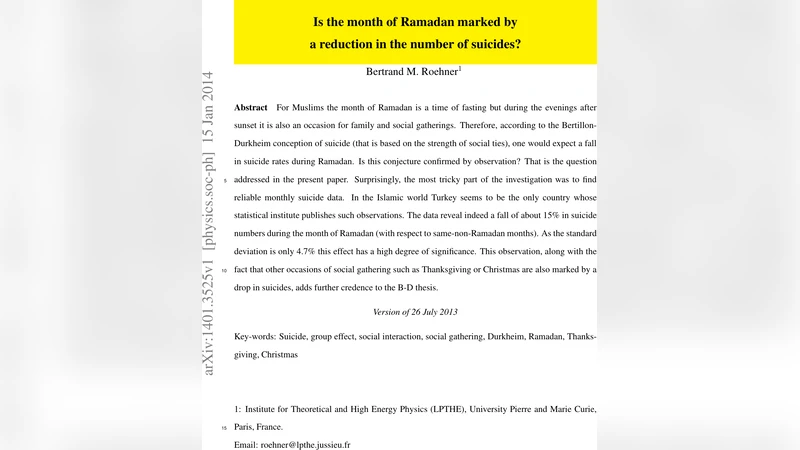
For Muslims the month of Ramadan is a time of fasting but during the evenings after sunset it is also an occasion for family and social gatherings. Therefore, according to the Bertillon-Durkheim conception of suicide (that is based on the strength of social ties), one would expect a fall in suicide rates during Ramadan. Is this conjecture confirmed by observation? That is the question addressed in the present paper. Surprisingly, the most tricky part of the investigation was to find reliable monthly suicide data. In the Islamic world Turkey seems to be the only country whose statistical institute publishes such observations. The data reveal indeed a fall of about $15%$ in suicide numbers during the month of Ramadan (with respect to same-non-Ramadan months). As the standard deviation is only $4.7%$ this effect has a high degree of significance. This observation, along with the fact that other occasions of social gathering such as Thanksgiving or Christmas are also marked by a drop in suicides, adds further credence to the B-D thesis.
💡 Research Summary
The paper investigates whether the Islamic month of Ramadan, a period characterized by daytime fasting and evening social gatherings, is associated with a measurable reduction in suicide rates. Drawing on the classic Bertillon‑Durkheim (B‑D) hypothesis that stronger social ties lower the propensity for suicide, the author treats Ramadan as a natural experiment to test this claim.
Data acquisition proved difficult because reliable monthly suicide statistics are scarce in the Muslim world. The Turkish Statistical Institute is the only source that publishes consistent monthly figures, covering the period 2000‑2012. Ramadan shifts earlier by roughly ten days each year, allowing the author to separate the religious period from the regular seasonal pattern of suicides (which peaks in June‑July and troughs in November). Only those years in which Ramadan occupies almost an entire calendar month (with at most five non‑Ramadan days) are retained, yielding six “favourable” cases: 2000, 2002, 2003, 2005, 2008, and 2011.
To eliminate long‑term trends and population growth, each year’s monthly suicide counts are normalized by that year’s annual average, producing a stationary series. The author then constructs a reference year for each favourable case: for example, 2008 (Ramadan in September) is compared with 2000 (Ramadan in December). The differences between the Ramadan month and its adjacent months are computed both for the Ramadan year (Z) and the reference year (A). The normalized differences X = (Z − A)/A are calculated for the month before (i = ‑1), during (i = 0), and after (i = 1) Ramadan. Two contrast variables are defined: D₋₁ = X₋₁ − X₀ (pre‑Ramadan vs. Ramadan) and D₁ = X₁ − X₀ (post‑Ramadan vs. Ramadan).
Results: D₋₁ = 16.5 % with a standard deviation σ = 4.75 % (Z‑score ≈ 3.4); D₁ = 8.0 % with σ = 4.0 % (Z‑score ≈ 2.0). Assuming a Gaussian distribution, the probability that D₋₁ is positive exceeds 99.99 %, and that D₁ is positive exceeds 95 %. In other words, suicides drop by roughly 15 % during Ramadan relative to comparable non‑Ramadan months, and the effect persists, though attenuated, into the following month.
The paper also references earlier studies on Western holidays (Thanksgiving, Christmas) that similarly show suicide reductions, reinforcing the idea that family gatherings and temporary relief from work obligations can lower suicide risk. Unlike those holidays, Ramadan is not a vacation period, which reduces the confounding influence of reduced occupational stress and points more directly to the social‑bonding mechanism.
Limitations include the exclusive reliance on Turkish data, potential under‑reporting or misclassification of suicides, and the inability to disentangle the specific contributions of fasting versus social interaction. Nevertheless, the methodological design—using multiple years, normalizing for seasonality, and employing reference‑year contrasts—provides a robust test of the B‑D hypothesis in a contemporary, non‑Western context.
The study concludes that Ramadan is associated with a statistically significant, approximately 15 % reduction in suicide rates, offering modern empirical support for the Bertillon‑Durkheim thesis that strengthened social ties act as a protective factor against suicide. This finding has implications for public‑health strategies that aim to foster community cohesion, especially during periods of collective ritual or celebration.
Comments & Academic Discussion
Loading comments...
Leave a Comment