The Complexity of Circumscription in DLs
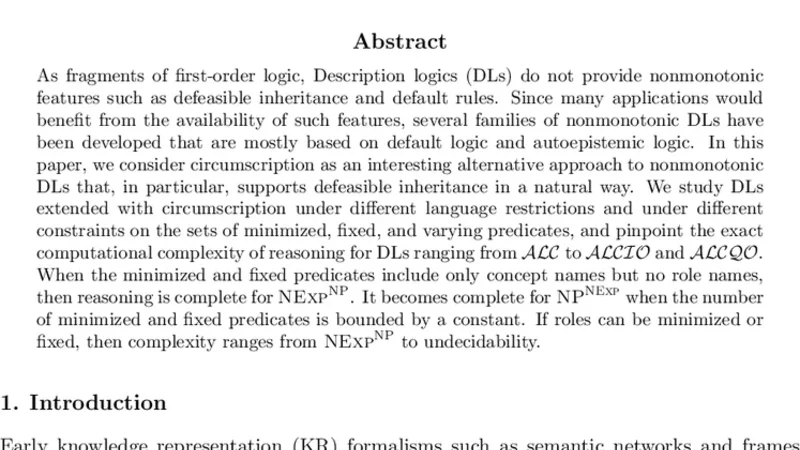
As fragments of first-order logic, Description logics (DLs) do not provide nonmonotonic features such as defeasible inheritance and default rules. Since many applications would benefit from the availability of such features, several families of nonmonotonic DLs have been developed that are mostly based on default logic and autoepistemic logic. In this paper, we consider circumscription as an interesting alternative approach to nonmonotonic DLs that, in particular, supports defeasible inheritance in a natural way. We study DLs extended with circumscription under different language restrictions and under different constraints on the sets of minimized, fixed, and varying predicates, and pinpoint the exact computational complexity of reasoning for DLs ranging from ALC to ALCIO and ALCQO. When the minimized and fixed predicates include only concept names but no role names, then reasoning is complete for NExpTime^NP. It becomes complete for NP^NExpTime when the number of minimized and fixed predicates is bounded by a constant. If roles can be minimized or fixed, then complexity ranges from NExpTime^NP to undecidability.
💡 Research Summary
The paper investigates the use of circumscription as a non‑monotonic extension of description logics (DLs). While DLs are fragments of first‑order logic that support only monotonic reasoning, many applications require defeasible inheritance and default rules. Existing non‑monotonic DLs are largely based on default logic or auto‑epistemic logic, but these approaches often lead to high computational costs or intricate semantics. Circumscription offers a model‑theoretic alternative: it selects “minimal” models according to a set of predicates that are designated as minimized, fixed, or varying. By doing so, it captures defeasible inheritance in a natural way without resorting to external rule formalisms.
The authors first formalize circumscribed DLs. A circumscription pattern consists of three disjoint sets of predicates:
- Minimized predicates (M) – the interpretation of these predicates is forced to be as small as possible.
- Fixed predicates (F) – their interpretation must stay unchanged across compared models.
- Varying predicates (V) – they may change arbitrarily.
Each predicate can be a concept name (unary) or a role name (binary). The paper studies several configurations of M, F, and V, focusing on how the inclusion of role names influences computational behavior.
The main technical contribution is a fine‑grained complexity analysis for a range of DL families: ALC, ALCIO, and ALCQO. The authors prove the following results:
-
Concept‑only minimization/fixation – When M ∪ F contains only concept names (no role names), reasoning (concept subsumption, satisfiability, and instance checking) is NExpTime^NP‑complete. This means that a nondeterministic exponential‑time algorithm with an NP oracle solves the problem, and the lower bound matches this upper bound.
-
Bounded number of minimized/fixed predicates – If the total number of predicates in M ∪ F is bounded by a constant k, the complexity drops to NP^NExpTime‑complete. The constant bound allows the exponential search space to be encoded into the NP part of the oracle, yielding a lower overall complexity.
-
Including role names in M or F – Allowing roles to be minimized or fixed dramatically raises the difficulty. The authors show a spectrum ranging from NExpTime^NP (when only a limited form of role minimization is permitted) up to undecidability (when arbitrary role minimization is allowed). The undecidability proofs reduce from known hard problems such as the tiling problem, demonstrating that the interaction between role minimization and DL constructors can encode arbitrary computation.
-
Impact of additional DL constructors – For ALCIO (which adds inverse roles and nominals) and ALCQO (which adds qualified number restrictions and nominals), the same pattern holds, but the presence of inverses and number restrictions can push certain fragments from decidable to undecidable when role minimization is unrestricted.
The paper’s methodology combines reductions from known hard problems, construction of circumscribed models that simulate Turing machine computations, and careful use of DL features to control the size of the model space. Upper bounds are obtained by designing nondeterministic exponential‑time algorithms that guess a candidate minimal model and then verify minimality using an NP oracle. Lower bounds are proved by encoding exponential‑time bounded computations into the circumscription pattern.
Beyond the theoretical results, the authors discuss practical implications. In knowledge‑base engineering, it is advisable to restrict minimized and fixed predicates to concept names and to keep their number small, thereby staying within the NExpTime^NP or NP^NExpTime regimes, which are high but still decidable. If defeasible reasoning over relationships (roles) is required, designers must either limit the form of role minimization (e.g., only simple roles, no inverses) or accept that reasoning may become intractable or even undecidable.
The paper concludes with several avenues for future work: exploring approximation techniques for the high‑complexity cases, investigating alternative non‑monotonic semantics that combine circumscription with default logic, and implementing prototype reasoners to evaluate the practical performance of circumscribed DLs on real‑world ontologies. Overall, the work provides the first comprehensive map of the computational landscape of circumscription‑based non‑monotonic DLs, offering both a solid theoretical foundation and concrete guidance for system designers.