The Computational Complexity of Dominance and Consistency in CP-Nets
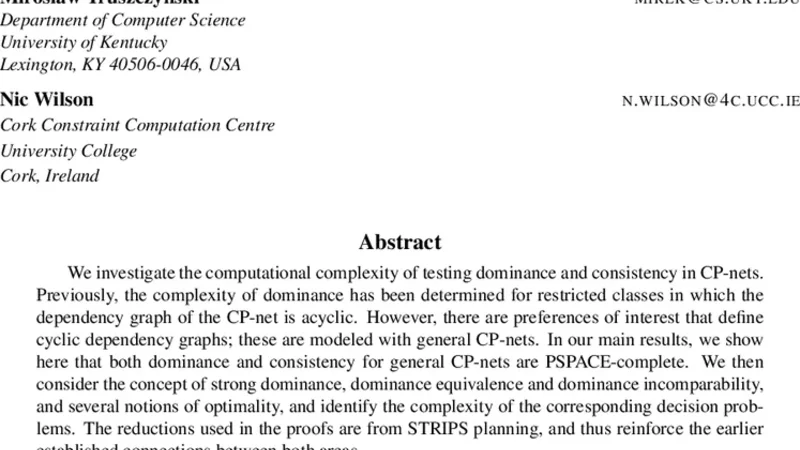
We investigate the computational complexity of testing dominance and consistency in CP-nets. Previously, the complexity of dominance has been determined for restricted classes in which the dependency graph of the CP-net is acyclic. However, there are preferences of interest that define cyclic dependency graphs; these are modeled with general CP-nets. In our main results, we show here that both dominance and consistency for general CP-nets are PSPACE-complete. We then consider the concept of strong dominance, dominance equivalence and dominance incomparability, and several notions of optimality, and identify the complexity of the corresponding decision problems. The reductions used in the proofs are from STRIPS planning, and thus reinforce the earlier established connections between both areas.
💡 Research Summary
This paper conducts a thorough computational‑complexity investigation of two fundamental decision problems in Conditional Preference Networks (CP‑nets): dominance testing and consistency checking. While earlier work had established complexity results for dominance in restricted, acyclic CP‑nets, many real‑world preference specifications naturally give rise to cyclic dependency graphs, which are captured by general CP‑nets. The authors close this gap by proving that both dominance and consistency for unrestricted CP‑nets are PSPACE‑complete.
The core of the hardness proofs is a polynomial‑time reduction from the STRIPS planning problem, a canonical PSPACE‑complete planning formalism. For dominance, each STRIPS action is encoded as a conditional preference rule, and the initial and goal states are mapped to two complete assignments of the CP‑net variables. The construction guarantees that a plan exists reaching the goal if and only if the assignment representing the goal dominates the assignment representing the start. Because STRIPS planning is PSPACE‑hard, dominance testing inherits this lower bound. Membership in PSPACE follows from the observation that a nondeterministic algorithm can guess an improving‑flip sequence (the path witnessing dominance) and verify it using only polynomial space.
For consistency, the same reduction is adapted so that an unsolvable planning instance yields a CP‑net containing a preference cycle, i.e., an inconsistent network. Thus, checking whether a CP‑net admits any cyclic preference (and therefore is inconsistent) is also PSPACE‑hard. A nondeterministic PSPACE algorithm can explore the space of possible improving flips to detect a cycle, establishing PSPACE‑membership.
Beyond the basic problems, the paper systematically classifies several related decision problems:
-
Strong dominance – asks whether one outcome strictly dominates another along every possible improving‑flip path. This is a stricter version of ordinary dominance and is shown to be PSPACE‑complete by a straightforward extension of the dominance reduction.
-
Dominance equivalence – asks whether two outcomes mutually dominate each other. Since this requires two dominance checks, it remains PSPACE‑complete.
-
Dominance incomparability – asks whether neither outcome dominates the other. Again, this is reducible to two dominance queries and inherits PSPACE‑completeness.
The authors also examine optimality notions that are central to decision‑making: Pareto optimality, strong Pareto optimality, and dominance‑optimality. In acyclic CP‑nets many of these problems are NP‑complete, but the presence of cycles forces an exhaustive exploration of the entire preference space, pushing the complexity up to PSPACE‑complete for each notion. The paper supplies explicit reductions for each case, confirming both PSPACE‑hardness and PSPACE‑membership.
A notable methodological contribution is the detailed construction of the STRIPS‑to‑CP‑net translation. The authors carefully map planning variables to CP‑net attributes, encode action preconditions as conditional preference antecedents, and represent action effects as consequent preference statements. They also show how to embed cycles deliberately without breaking the correctness of the reduction, thereby demonstrating that cyclic dependencies do not simplify the underlying computational problem.
In summary, the paper delivers a comprehensive complexity landscape for general CP‑nets: dominance testing, consistency checking, strong dominance, dominance equivalence, dominance incomparability, and several optimality decision problems are all PSPACE‑complete. These results have practical implications for the design of algorithms that operate on CP‑nets with cycles, indicating that any exact solution will, in the worst case, require space exponential in the size of the network unless P = PSPACE. Moreover, by grounding the reductions in STRIPS planning, the work reinforces the deep theoretical connection between preference reasoning and automated planning, opening avenues for cross‑fertilization of techniques between the two fields.