On visualisation scaling, subeigenvectors and Kleene stars in max algebra
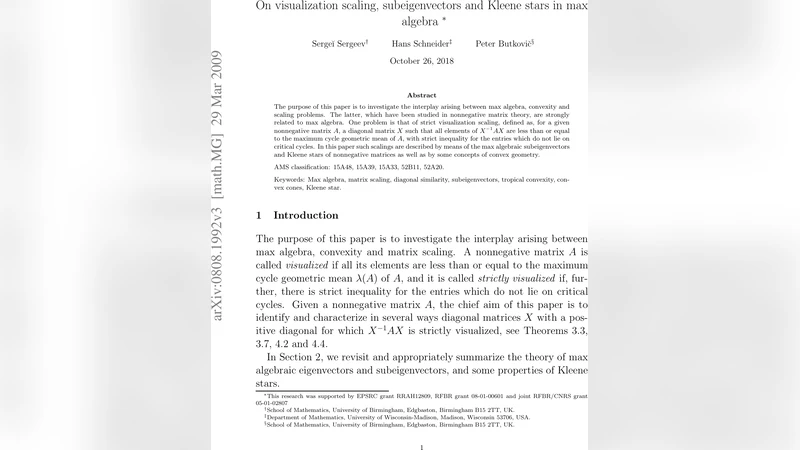
The purpose of this paper is to investigate the interplay arising between max algebra, convexity and scaling problems. The latter, which have been studied in nonnegative matrix theory, are strongly related to max algebra. One problem is strict visualisation scaling, which means finding, for a given nonnegative matrix A, a diagonal matrix X such that all elements of X^{-1}AX are less than or equal to the maximum cycle geometric mean of A, with strict inequality for the entries which do not lie on critical cycles. In this paper such scalings are described by means of the max-algebraic subeigenvectors and Kleene stars of nonnegative matrices as well as by some concepts of convex geometry.
💡 Research Summary
The paper investigates a scaling problem that lies at the intersection of max‑algebra, convex geometry, and classical non‑negative matrix theory. For a given non‑negative matrix (A) the authors seek a diagonal matrix (X=\operatorname{diag}(x)) such that every entry of the similarity‑transformed matrix (X^{-1}AX) does not exceed the maximum cycle geometric mean (\mu(A)) of (A), and any entry that does not belong to a critical cycle is strictly smaller than (\mu(A)). This requirement is called strict visualisation scaling.
The authors begin by recalling the basic operations of max‑algebra ((\oplus) for maximum, (\otimes) for ordinary multiplication) and introduce two central objects: the Kleene star (A^{*}=I\oplus A\oplus A^{2}\oplus\cdots) and the sub‑eigenvectors (or (\lambda)-sub‑eigenvectors) defined by the inequality (Av\le\lambda v) with (\lambda=\mu(A)). They show that each column of the Kleene star is a minimal sub‑eigenvector of (A); after a suitable normalisation each column yields a diagonal scaling matrix that satisfies the visualisation constraints.
A key technical step is the logarithmic transformation of the inequality constraints. By setting (y_i=\log x_i) and (\alpha_{ij}=\log a_{ij}) the condition (x_i^{-1}a_{ij}x_j\le\mu(A)) becomes a linear inequality (y_j-y_i\le \log\mu(A)-\alpha_{ij}). The collection of all such inequalities defines a convex polyhedron in the space of (y). The authors prove that the extreme points (vertices) of this polyhedron correspond exactly to the normalised columns of (A^{*}). Consequently, the set of all admissible scalings is a convex set, and any feasible scaling can be obtained as a convex combination of the extreme scalings derived from the Kleene star.
The paper provides an explicit algorithmic scheme. First, compute the Kleene star using a cubic‑time algorithm analogous to Floyd‑Warshall; this yields all maximal path weights in the associated weighted digraph. Second, extract each column, normalise it (for instance by fixing one component to 1), and form the diagonal matrix (X). Third, verify that (X^{-1}AX) meets the strict visualisation property: entries on critical cycles equal (\mu(A)) while all others are strictly smaller. The authors illustrate the procedure on a 3×3 example, showing how the visualisation polytope collapses to a line segment whose endpoints are the two extreme scalings.
Beyond the constructive results, the authors discuss several conceptual implications. The strict visualisation scaling problem is shown to be tightly linked to the critical graph of (A); the critical cycles are precisely those that survive the scaling unchanged. The convex‑geometric viewpoint connects the problem to linear programming, suggesting that additional linear constraints (e.g., bounds on specific diagonal entries) can be incorporated without breaking the theory. Moreover, the Kleene star provides a unifying tool that bridges max‑algebraic spectral theory, graph‑theoretic cycle analysis, and convex analysis.
In the concluding section the authors outline future research directions: extending the theory to time‑varying matrices, investigating stochastic max‑algebra models, and generalising the results to rectangular (non‑square) matrices or to other semirings. They also hint at potential applications in discrete event systems, tropical geometry, and network optimisation, where visualisation scalings can be used to normalise timing data or to simplify the description of system dynamics.
Overall, the paper delivers a comprehensive characterisation of strict visualisation scaling in max‑algebra, demonstrates that the set of feasible scalings forms a convex polytope whose vertices are given by the Kleene‑star columns, and supplies practical algorithms for computing such scalings, thereby linking algebraic, combinatorial, and geometric perspectives in a unified framework.
Comments & Academic Discussion
Loading comments...
Leave a Comment