Multiorder, Kleene stars and cyclic projectors in the geometry of max cones
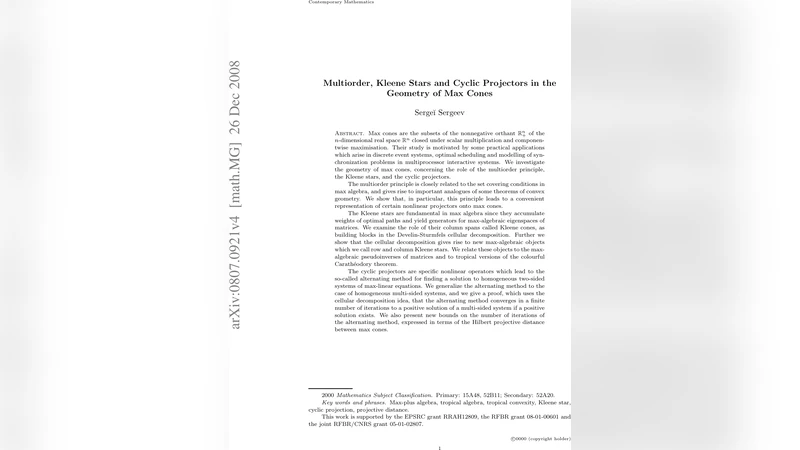
This paper summarizes results on some topics in the max-plus convex geometry, mainly concerning the role of multiorder, Kleene stars and cyclic projectors, and relates them to some topics in max algebra. The multiorder principle leads to max-plus analogues of some statements in the finite-dimensional convex geometry and is related to the set covering conditions in max algebra. Kleene stars are fundamental for max algebra, as they accumulate the weights of optimal paths and describe the eigenspace of a matrix. On the other hand, the approach of tropical convexity decomposes a finitely generated semimodule into a number of convex regions, and these regions are column spans of uniquely defined Kleene stars. Another recent geometric result, that several semimodules with zero intersection can be separated from each other by max-plus halfspaces, leads to investigation of specific nonlinear operators called cyclic projectors. These nonlinear operators can be used to find a solution to homogeneous multi-sided systems of max-linear equations. The results are presented in the setting of max cones, i.e., semimodules over the max-times semiring.
💡 Research Summary
This paper surveys a collection of recent results in the geometry of max‑cones—semimodules over the max‑times semiring—focusing on three interrelated concepts: the multiorder principle, Kleene stars, and cyclic projectors. The authors first set the stage by defining a max‑cone as a subset of (\mathbb{R}_{+}^{n}) that is closed under componentwise maximum and scaling by non‑negative scalars using the max operation. Within this framework, the multiorder principle provides a coordinate‑wise ordering that replaces the usual vector inequality in classical convex analysis. By examining the collection of coordinate‑wise order relations, one can characterize when a vector belongs to the max‑convex hull of a set, yielding max‑analogues of Carathéodory’s and Helly’s theorems. Moreover, this principle translates directly into set‑covering conditions that are central to many problems in max algebra, such as determining regularity of a matrix or the existence of a finite eigenvector.
The second major theme is the Kleene star of a non‑negative matrix (A), defined as (A^{}=I\oplus A\oplus A^{2}\oplus\cdots). In the max‑plus setting, (A^{}) aggregates the weights of all directed paths in the weighted digraph associated with (A). The paper shows that the column space of (A^{*}) coincides with the eigenspace of (A) corresponding to the maximal eigenvalue, and that each finitely generated max‑cone can be decomposed into a finite family of convex cells. Each cell is precisely the column span of a uniquely determined Kleene star built from a submatrix of the original generator matrix. This decomposition mirrors the cell decomposition of tropical convex sets and provides a concrete algebraic description of the regions where a given set of generators is “active”.
The third focus is on separation and projection. The authors prove a max‑halfspace separation theorem: any finite family of max‑cones with empty mutual intersection can be simultaneously separated by max‑linear halfspaces. This result is a max‑plus counterpart of the Hahn‑Banach separation theorem and relies heavily on the multiorder principle and Kleene‑star representations. Using the separation theorem, they introduce cyclic projectors—non‑linear operators obtained by composing the individual max‑projections onto each cone in a prescribed cyclic order. They establish that cyclic projectors are non‑expansive with respect to the natural max‑norm and that iterating a cyclic projector converges to a fixed point that lies in the intersection of all cones. Consequently, solving homogeneous multi‑sided max‑linear systems \
Comments & Academic Discussion
Loading comments...
Leave a Comment