Covering dimension and finite-to-one maps
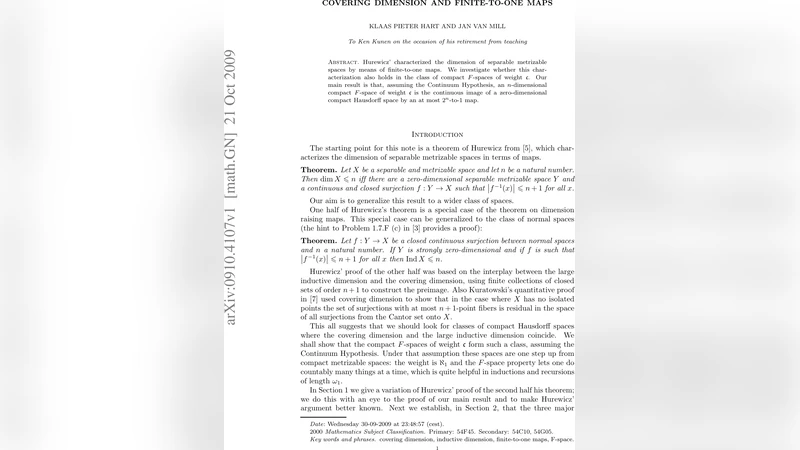
Hurewicz’ characterized the dimension of separable metrizable spaces by means of finite-to-one maps. We investigate whether this characterization also holds in the class of compact F-spaces of weight c. Our main result is that, assuming the Continuum Hypothesis, an n-dimensional compact F-space of weight c is the continuous image of a zero-dimensional compact Hausdorff space by an at most 2n-to-1 map.
💡 Research Summary
The paper revisits a classical theorem of W. Hurewicz, which characterizes the covering (Lebesgue) dimension of separable metrizable spaces in terms of finite‑to‑one continuous maps. Hurewicz proved that an n‑dimensional separable metric space X can be obtained as the continuous image of a zero‑dimensional metric space Y under a map that is at most (n + 1)‑to‑1. The author asks whether an analogous statement holds for a much broader class of spaces: compact F‑spaces of weight continuum (𝔠). An F‑space is a completely regular Hausdorff space in which every Gδ‑set is open; such spaces need not be metrizable, yet they retain enough regularity to support a robust dimension theory.
Assuming the Continuum Hypothesis (CH), the main theorem asserts: If X is a compact F‑space of weight 𝔠 and covering dimension n, then there exists a compact zero‑dimensional Hausdorff space Y and a continuous surjection π : Y → X such that each fiber π⁻¹(x) contains at most 2n points. In other words, X is the image of a totally disconnected compact space under an at‑most‑2n‑to‑1 map.
The proof proceeds in several stages. First, the author exploits the definition of covering dimension to obtain an open cover of X that can be refined into a family of basic open sets with the property that any point of X belongs to at most 2n of them. This refinement is possible because X is an n‑dimensional compact F‑space; the regularity of F‑spaces allows one to separate closed sets by open neighborhoods in a way that mimics the usual metric construction, but without any reference to distances.
Next, the author builds a Boolean algebra B generated by the chosen basic open sets. Because the weight of X is 𝔠 and CH is assumed, the cardinality of B is ℵ₁, which is crucial for the subsequent ultrafilter construction. The Stone space of B—i.e., the space of all ultrafilters on B equipped with the usual Stone topology—is a compact, zero‑dimensional Hausdorff space Y. By Stone duality, Y is precisely the “ultracompactification” of the combinatorial data encoded in the open cover.
A natural projection π : Y → X is defined as follows: for an ultrafilter 𝔘∈Y, consider the intersection of all members of 𝔘. In an F‑space, the intersection of a decreasing family of open Gδ‑sets is again open, and because the ultrafilter is maximal, this intersection reduces to a single point of X. That point is set to be π(𝔘). The continuity of π follows from the definition of the Stone topology and the fact that basic clopen subsets of Y correspond to members of B.
The crucial finite‑to‑one bound comes from the construction of the open cover. Since any x∈X lies in at most 2n basic open sets, the number of distinct ultrafilters whose associated intersection contains x cannot exceed 2n. Consequently each fiber of π has cardinality ≤ 2n, establishing the at‑most‑2n‑to‑1 property.
The paper also discusses the limitations of the result. The factor 2n is larger than Hurewicz’s original (n + 1) bound, reflecting the loss of metric structure. Whether the bound can be improved to n + 1, or even to n, for compact F‑spaces remains an open problem. Moreover, the reliance on CH is essential in the current argument to control the cardinalities of the Boolean algebra and its Stone space; removing CH or replacing it with other set‑theoretic assumptions (e.g., Martin’s Axiom) is left as a direction for future research. The author also raises the question of extending the theorem to compact F‑spaces of weight larger than 𝔠, where new combinatorial obstacles appear.
In summary, the article demonstrates that the interplay between covering dimension and finite‑to‑one continuous maps survives beyond the realm of separable metrizable spaces. By leveraging the special properties of compact F‑spaces and employing Boolean‑algebraic/ultrafilter techniques under CH, the author shows that every n‑dimensional compact F‑space of weight continuum is a continuous image of a zero‑dimensional compact space via an at‑most‑2n‑to‑1 map. This result both generalizes Hurewicz’s classical theorem and opens a line of inquiry into optimal finite‑to‑one bounds, the necessity of set‑theoretic hypotheses, and possible extensions to larger cardinalities.
Comments & Academic Discussion
Loading comments...
Leave a Comment