On a theorem of Arvanitakis
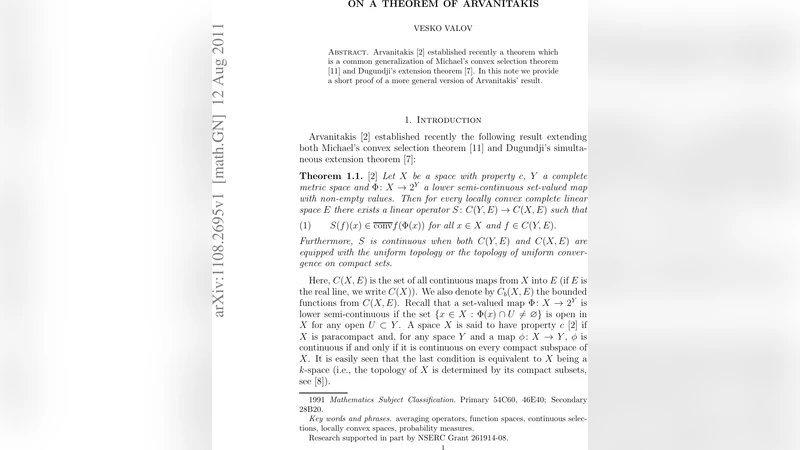
Arvanitakis established recently a theorem which is a common generalization of Michael’s convex selection theorem and Dugundji’s extension theorem. In this note we provide a short proof of a more general version of Arvanitakis’ result.
💡 Research Summary
The paper revisits a recent theorem of Arvanitakis that simultaneously generalizes Michael’s convex‑valued selection theorem and Dugundji’s extension theorem. The original result (Theorem 1.1) asserts that for a paracompact (paracompact‑k) space X, a complete metric space Y, a lower‑semicontinuous set‑valued map Φ:X→2^Y with non‑empty values, and any locally convex complete linear space E, there exists a linear operator S:C(Y,E)→C(X,E) such that for every f∈C(Y,E) and x∈X, S(f)(x)∈conv f(Φ(x)). Moreover S is continuous both for the uniform topology and for the topology of uniform convergence on compact subsets.
The author strengthens this statement in Theorem 1.2. The improvements are twofold: (i) the operator S can be defined already on bounded continuous functions, S_b:C_b(Y,E)→C_b(X,E), preserving the same inclusion property and continuity; (ii) when X is a k‑space or E is a Banach space, S_b extends continuously to an operator on all continuous functions. The proof proceeds by combining two modern tools:
-
Banach’s barycenter construction for probability measures. For a complete locally convex space E, the author defines a (not necessarily continuous) affine map b_E:P_β(E)→E, where P_β(E) denotes the space of regular probability measures on the Čech–Stone compactification βE whose supports lie in E. The map sends a measure μ to a point b_E(μ)∈conv(supp μ). When the support set is bounded, b_E∘P_β(i_M) is continuous (Proposition 2.1).
-
Averaging operators with compact supports. A perfect surjection f:X→Y is said to admit such an operator if there exists an embedding g:Y→P_β(X) with supp(g(y))⊂f^{-1}(y) for all y. This yields a linear averaging operator u:C_b(X)→C_b(Y) defined by u(h)(y)=g(y)(h). Proposition 2.2 shows that, given a complete locally convex E, one can lift u to a linear operator T_b:C_b(X,E)→C_b(Y,E) satisfying (i) T_b(h)(y)∈conv h(f^{-1}(y)), (ii) T_b(φ∘f)=φ, and (iii) continuity in the two topologies. If Y is a k‑space or E is Banach, T_b extends to an operator on all continuous maps.
Armed with these ingredients, the proof of Theorem 1.2 proceeds as follows. By a result of Repovš, Semenov and Shchepin, any paracompact space X is the continuous image of a zero‑dimensional paracompact space X₀ under a perfect map f:X₀→X that admits an averaging operator. The lower‑semicontinuous map Φ lifts to Φ̃ on X₀, and Michael’s zero‑dimensional selection theorem provides a continuous selection θ:X₀→Y with θ(f^{-1}(x))⊂Φ(x). Defining S_b(h)=T_b(h∘θ) yields the desired operator on bounded functions; continuity follows from that of T_b and θ. When X is a k‑space or E is Banach, T_b extends to T, and consequently S extends to all of C(Y,E).
The paper then demonstrates how Theorem 1.2 recovers Michael’s selection theorem (by applying S to the identity map on Y) and Dugundji’s extension theorem (by constructing a suitable Φ that is the identity on a closed subset A and constant elsewhere). It also discusses limitations: without the k‑space or completeness assumptions, extension operators may fail to exist, as illustrated by the classical Michael line example.
In summary, the author provides a concise proof that unifies two cornerstone results of selection and extension theory. The key insight is that the zero‑dimensional selection theorem, together with the machinery of probability‑measure barycenters and averaging operators, suffices to produce linear operators that both select points from lower‑semicontinuous set‑valued maps and extend continuous functions. This approach not only simplifies the original argument of Arvanitakis but also yields a more general theorem applicable to a broader class of spaces and function spaces.
Comments & Academic Discussion
Loading comments...
Leave a Comment