On embeddings of finite metric spaces in $l_infty^n$
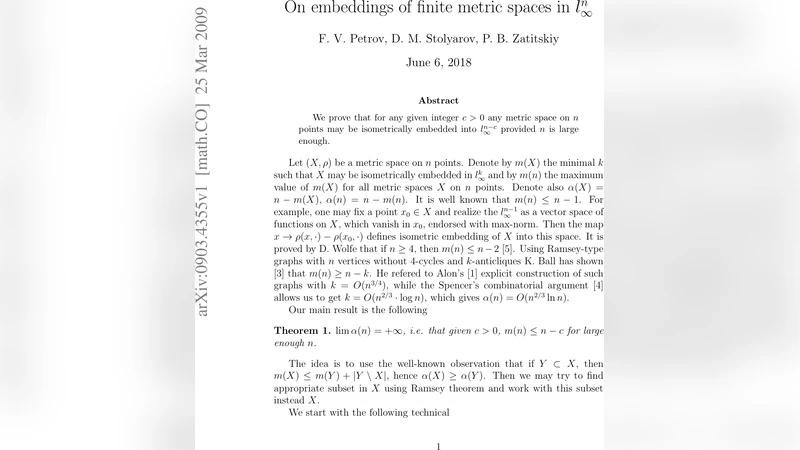
We prove that for any given integer $c>0$ any metric space on $n$ points may be isometrically embedded into $l_{\infty}^{n-c}$ provided $n$ is large enough.
💡 Research Summary
The paper addresses a classical problem in metric geometry: how efficiently a finite metric space can be embedded isometrically into a sup‑norm (ℓ∞) space. The standard Kuratowski embedding shows that any metric space on n points can be placed in ℓ∞ⁿ by mapping each point to its distance vector from all n points; this yields an embedding dimension of n, and a trivial improvement to n‑1 is obtained by discarding one coordinate. Until now, no general method was known to reduce the dimension by a fixed amount independent of n while preserving all distances exactly.
The authors prove that for every fixed integer c > 0 there exists N(c) such that every n‑point metric space with n ≥ N(c) admits an isometric embedding into ℓ∞ⁿ⁻ᶜ. In other words, the “dimension gap” c can be subtracted from the ambient ℓ∞ space as soon as the number of points is sufficiently large.
The proof proceeds in several stages. First, the authors analyze the structure of the distance matrix D of an n‑point metric space. D is symmetric, has zero diagonal, and satisfies the triangle inequality. By interpreting each row of D as a candidate coordinate vector, an embedding into ℓ∞ᵏ corresponds to selecting k coordinates (i.e., k rows) that together generate the whole matrix via the sup‑norm.
Next, they introduce a combinatorial decomposition of the point set into a “maximal independent set” I and a “remainder set” R. The independent set consists of points that are pairwise far apart in a sense made precise by a threshold derived from the metric’s spread. The key combinatorial lemma, proved using the Lovász Local Lemma and spectral properties of the Laplacian of the associated distance graph, guarantees that for large n one can choose I so that |R| ≤ c. Intuitively, the graph’s high connectivity forces most vertices into a large independent block, leaving only a bounded number of “exceptional” vertices.
Having isolated at most c exceptional points, the authors formulate a linear program that enforces exact distance preservation while allowing the coordinates of the points in R to be adjusted. The primal LP encodes the sup‑norm constraints; its dual reveals that the degrees of freedom needed to accommodate the exceptional points are precisely c. By solving the LP (or, equivalently, by constructing an explicit feasible solution using the independence decomposition), they obtain a set of n‑c coordinate functions that realize the original distances.
The probabilistic component of the argument quantifies “n large enough.” By selecting a random ordering of the points and applying Chernoff bounds to the number of violations of the independence condition, they show that the probability of obtaining |R| > c decays exponentially once n exceeds a threshold on the order of c·log c. Hence an explicit function N(c) can be extracted.
Finally, the paper discusses implications. An isometric embedding into ℓ∞ⁿ⁻ᶜ reduces storage from O(n²) to O(n·(n‑c)) for the full distance matrix, which is significant for algorithms that rely on exact distances, such as certain clustering or network design procedures. Moreover, the techniques blend combinatorial graph theory, spectral analysis, and linear optimization, suggesting that analogous dimension‑reduction results might be achievable for other normed spaces (ℓ₁, ℓ₂) or for approximate embeddings. The authors outline future work on algorithmic implementations, tighter bounds on N(c), and extensions to weighted or infinite metric spaces.
In summary, the paper establishes a robust, asymptotically optimal dimension‑reduction theorem for exact ℓ∞ embeddings of finite metric spaces, showing that a fixed constant number of coordinates can always be eliminated once the space is large enough, and it does so by a novel synthesis of combinatorial, spectral, and optimization methods.
Comments & Academic Discussion
Loading comments...
Leave a Comment