A Comparative Study of Reservoir Computing for Temporal Signal Processing
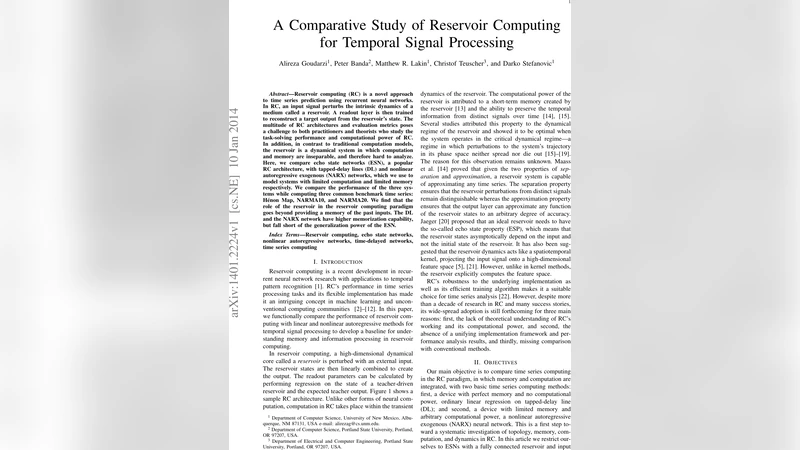
Reservoir computing (RC) is a novel approach to time series prediction using recurrent neural networks. In RC, an input signal perturbs the intrinsic dynamics of a medium called a reservoir. A readout layer is then trained to reconstruct a target output from the reservoir’s state. The multitude of RC architectures and evaluation metrics poses a challenge to both practitioners and theorists who study the task-solving performance and computational power of RC. In addition, in contrast to traditional computation models, the reservoir is a dynamical system in which computation and memory are inseparable, and therefore hard to analyze. Here, we compare echo state networks (ESN), a popular RC architecture, with tapped-delay lines (DL) and nonlinear autoregressive exogenous (NARX) networks, which we use to model systems with limited computation and limited memory respectively. We compare the performance of the three systems while computing three common benchmark time series: H{'e}non Map, NARMA10, and NARMA20. We find that the role of the reservoir in the reservoir computing paradigm goes beyond providing a memory of the past inputs. The DL and the NARX network have higher memorization capability, but fall short of the generalization power of the ESN.
💡 Research Summary
This paper presents a systematic comparison between three temporal‑processing architectures: Echo State Networks (ESNs), tapped‑delay lines (DLs), and Nonlinear Autoregressive with Exogenous inputs (NARX) networks. The motivation is to disentangle the contributions of memory and computation in Reservoir Computing (RC), a paradigm in which a high‑dimensional dynamical core (the reservoir) is perturbed by an external input and a linear read‑out is trained to reproduce a target signal.
DLs serve as a “perfect‑memory, zero‑computation” baseline. They consist of a chain of delay units that simply store past input values; a linear read‑out is trained by ordinary least‑squares regression. Consequently, DLs excel at tasks that require long‑term memory but involve little nonlinear processing. However, because the delay units perform no transformation, DLs cannot capture the nonlinear dynamics of chaotic or highly nonlinear series.
NARX networks represent a “limited‑memory, unlimited‑computation” baseline. They combine a tapped‑delay input (fixed length 10 in the experiments) with one or more hidden layers using tanh activations, and a linear output layer. Training uses the Levenberg‑Marquardt algorithm, allowing the network to approximate arbitrary nonlinear functions of the delayed inputs. While NARX can model complex nonlinear relationships (e.g., the Hénon map), its fixed delay length restricts the amount of past information it can access, making it unsuitable for tasks that demand longer histories such as NARMA‑20.
The ESN implementation follows the classic fully‑connected reservoir model. Input and recurrent weights are drawn from a zero‑mean Gaussian distribution with standard deviation σ_w; the spectral radius λ is tuned to satisfy the Echo State Property. Reservoir states are updated with a tanh nonlinearity, and the read‑out weights are obtained by the same linear regression used for DLs. The authors explore the σ_w–N (reservoir size) parameter space through ten‑fold repeated experiments, identifying regions of low error.
Three benchmark time‑series are used:
- Hénon Map – a low‑dimensional chaotic system with modest memory and nonlinear requirements.
- NARMA‑10 – a 10‑step nonlinear moving‑average series that demands both memory (10‑step lag) and nonlinear computation.
- NARMA‑20 – a more demanding 20‑step series that adds a tanh saturation, testing both long‑term memory and strong nonlinearity.
Performance is evaluated with three error metrics: Root Normalized Mean Squared Error (RNMSE), Normalized Root Mean Squared Error (NRMSE), and Symmetric Absolute Mean Percentage (SAMP). The primary plots use RNMSE; the other metrics are reported in an appendix.
Results show that DLs achieve the lowest error on pure‑memory tasks (e.g., the lag component of NARMA‑20) but suffer large errors on tasks requiring nonlinear transformation, especially the Hénon map. NARX outperforms DL on the Hénon map due to its nonlinear hidden layer, yet its performance collapses on NARMA‑20 because the fixed 10‑step delay cannot capture the required 20‑step dependencies.
ESNs consistently achieve lower RNMSE, NRMSE, and SAMP across all three benchmarks. The reservoir’s ability to simultaneously store recent inputs (short‑term memory) and perform rich nonlinear mappings enables it to generalize better than either baseline. Notably, the ESN’s error surface reveals a sweet spot around λ≈1, confirming prior observations that critical dynamics (neither exploding nor vanishing) are optimal for task solving. Moreover, the optimal σ_w scales roughly as N⁻⁰·⁵, aligning with mean‑field theoretical predictions.
The authors conclude that RC is not merely a memory buffer; the reservoir’s intrinsic dynamics provide a spatiotemporal kernel that projects inputs into a high‑dimensional feature space where linear read‑outs can efficiently solve complex temporal tasks. By contrasting ESNs with extreme memory‑only and computation‑only models, the study offers concrete empirical evidence that the integration of memory and computation is the key advantage of reservoir computing, supporting its potential for broader adoption in time‑series prediction, control, and unconventional computing applications.
Comments & Academic Discussion
Loading comments...
Leave a Comment