Aligning Software-related Strategies in Multi-Organizational Settings
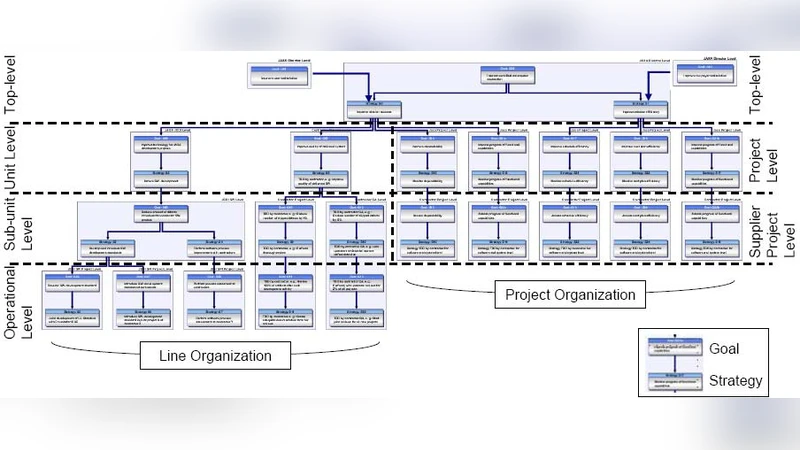
Aligning the activities of an organization with its business goals is a challenging task that is critical for success. Alignment in a multi-organizational setting requires the integration of different internal or external organizational units. The anticipated benefits of multi-organizational alignment consist of clarified contributions and increased transparency of the involved organizational units. The GQM+Strategies approach provides mechanisms for explicitly linking goals and strategies within an organization and is based on goal-oriented measurement. This paper presents the process and first-hand experience of applying GQM+Strategies in a multi-organizational setting from the aerospace industry. Additionally, the resulting GQM+Strategies grid is sketched and selected parts are discussed. Finally, the results are reflected on and an overview of future work is given.
💡 Research Summary
The paper tackles the perennial challenge of aligning an organization’s activities with its business objectives, focusing specifically on the added complexity that arises when multiple internal or external units must cooperate. In such multi‑organizational settings, the benefits of alignment—clearer contribution mapping and increased transparency—are especially valuable, yet achieving them is difficult because each participant brings its own goals, processes, and culture. To address this, the authors adopt the GQM+Strategies framework, an extension of the Goal‑Question‑Metric (GQM) approach that explicitly incorporates a strategy layer, thereby linking high‑level business goals to concrete tactics and measurable indicators.
The study is grounded in a real‑world aerospace project that involved four distinct entities: a prime contractor, a design department, a manufacturing partner, and a testing/ certification agency. The authors began by convening a series of workshops to surface a set of shared business goals—system safety, schedule adherence, and cost efficiency. Each organization then derived its own strategic objectives that would support these overarching goals. These strategies were broken down into sub‑goals, which in turn generated specific measurement questions and associated metrics. The resulting artefact, a GQM+Strategies grid, visually maps the hierarchy from business goal to metric, making the relationships transparent to all stakeholders.
Key findings from the application include: (1) the grid clarified how each organization’s work contributed to the common goals, fostering a sense of shared responsibility; (2) new collaboration‑focused metrics—such as interface change approval latency and information‑sharing frequency—were introduced, improving visibility into inter‑organizational processes; (3) the visual mapping enabled project managers to monitor goal attainment in near real‑time and to detect strategic deviations early, allowing prompt corrective actions. However, the authors also report challenges. The added strategy layer can lead to an explosion of metrics, increasing administrative overhead, and cultural differences sometimes cause divergent interpretations of the same goal. To mitigate these issues, they recommend continuous feedback loops, periodic training, and a prioritisation scheme for metrics.
In the concluding section, the paper emphasizes that GQM+Strategies proved effective for systematic alignment in a complex, multi‑organizational aerospace context. Future work will explore automated tools for goal‑strategy mapping, extend the approach to other domains such as automotive and healthcare, and investigate long‑term performance tracking through advanced data analytics. Overall, the study contributes both a practical methodology for practitioners dealing with multi‑organizational alignment and empirical evidence that enriches the academic discourse on goal‑oriented measurement frameworks.