Coding Sequence Density Estimation Via Topological Pressure
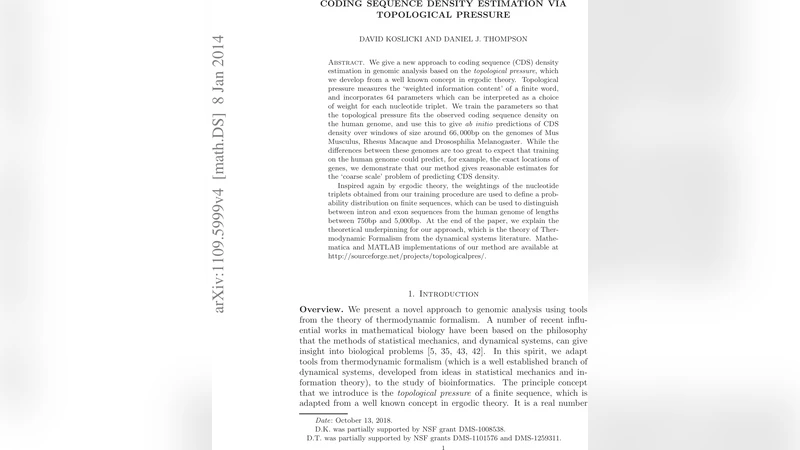
We give a new approach to coding sequence (CDS) density estimation in genomic analysis based on the topological pressure, which we develop from a well known concept in ergodic theory. Topological pressure measures the “weighted information content” of a finite word, and incorporates 64 parameters which can be interpreted as a choice of weight for each nucleotide triplet. We train the parameters so that the topological pressure fits the observed coding sequence density on the human genome, and use this to give ab initio predictions of CDS density over windows of size around 66,000bp on the genomes of Mus Musculus, Rhesus Macaque and Drososphilia Melanogaster. While the differences between these genomes are too great to expect that training on the human genome could predict, for example, the exact locations of genes, we demonstrate that our method gives reasonable estimates for the “coarse scale” problem of predicting CDS density. Inspired again by ergodic theory, the weightings of the nucleotide triplets obtained from our training procedure are used to define a probability distribution on finite sequences, which can be used to distinguish between intron and exon sequences from the human genome of lengths between 750bp and 5,000bp. At the end of the paper, we explain the theoretical underpinning for our approach, which is the theory of Thermodynamic Formalism from the dynamical systems literature. Mathematica and MATLAB implementations of our method are available at http://sourceforge.net/projects/topologicalpres/.
💡 Research Summary
The authors introduce a novel method for estimating coding sequence (CDS) density in genomes by adapting the concept of topological pressure from ergodic theory and thermodynamic formalism. Topological pressure is a weighted version of topological entropy: for a finite DNA word w, all distinct subwords of a fixed length n (chosen as 8, giving windows of 4ⁿ+n‑1 = 65 bp) are enumerated, each subword receives a weight equal to the sum of parameters v assigned to its constituent 3‑mers (triplets). The pressure P(w, v) is defined as (1/n)·log₄(∑_{subword∈Sₙ(w)} exp(weight)), where v is a 64‑dimensional probability vector (one entry per possible 3‑mer). This formulation captures a balance between combinatorial complexity (number of distinct subwords) and the frequency of high‑weight triplets.
Training proceeds on the human genome: the genome is partitioned into non‑overlapping windows of roughly 66 kb (≈40 000 windows). For each window the observed CDS density (fraction of bases belonging to annotated coding regions) is computed. The 64 parameters v are optimized to maximize the Pearson correlation between the computed topological pressure and the observed CDS density across all windows, with cross‑validation to avoid over‑fitting. The resulting v assigns larger values to triplets that are enriched in exons and smaller values to those prevalent in introns or ambiguous (N) regions.
The trained model is then applied “ab initio” to three other genomes—Mus musculus (mouse), Macaca mulatta (rhesus macaque), and Drosophila melanogaster (fruit fly)—without any retraining. Correlations between predicted pressure and actual CDS density are 0.77 for mouse, 0.73 for macaque, and 0.60 for fruit fly, reflecting decreasing predictive power with increasing phylogenetic distance but still demonstrating substantial explanatory ability.
Beyond large‑scale density estimation, the authors exploit the same parameters to construct an equilibrium (Gibbs) measure on finite DNA strings. This measure is a Markov chain whose transition probabilities are derived from the v‑weights, effectively turning the pressure into a probabilistic model for short sequences (750 bp–5 kb). When applied to human sequences of these lengths, the equilibrium measure assigns higher probabilities to exon fragments and lower probabilities to intron fragments, enabling discrimination between coding and non‑coding regions. Performance, assessed via ROC‑AUC, exceeds that of a simple topological entropy baseline, confirming that the learned triplet weights capture biologically relevant patterns.
The theoretical foundation rests on the variational principle of thermodynamic formalism: topological pressure equals the supremum over invariant measures of (entropy + expected energy), where the “energy” is defined by the triplet weights. The equilibrium measure maximizes this quantity, providing a rigorous justification for its use as a coding‑potential estimator. The authors note that extending the model to k‑mers with k > 3 offers limited benefit and risks over‑fitting, while k = 2 performs worse, supporting the biological relevance of codon‑scale (3‑mer) weighting.
Comparisons with established gene‑finding pipelines (e.g., Augustus, GeneID, GENSCAN, CONTRAST, Exoniphy) reveal that while those tools can achieve higher accuracy when extensive training data and multiple informant genomes are available, the topological‑pressure method remains competitive when such resources are lacking. It is computationally lightweight—calculating pressure for an entire genome takes seconds—whereas conventional ab initio predictors require hours and evidence‑based pipelines may need weeks.
In summary, the paper demonstrates that a mathematically grounded, parameter‑light model based on topological pressure can reliably estimate coarse‑scale CDS density across diverse species and can be repurposed as a short‑sequence coding‑potential classifier. Its speed, simplicity, and minimal data requirements make it especially attractive for newly sequenced genomes where annotation resources are scarce, and it opens avenues for further integration of dynamical‑systems concepts into computational genomics.
Comments & Academic Discussion
Loading comments...
Leave a Comment