Cortical prediction markets
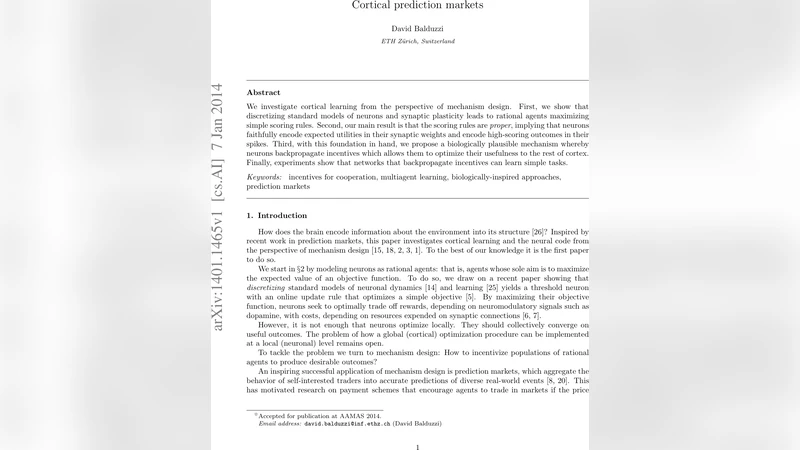
We investigate cortical learning from the perspective of mechanism design. First, we show that discretizing standard models of neurons and synaptic plasticity leads to rational agents maximizing simple scoring rules. Second, our main result is that the scoring rules are proper, implying that neurons faithfully encode expected utilities in their synaptic weights and encode high-scoring outcomes in their spikes. Third, with this foundation in hand, we propose a biologically plausible mechanism whereby neurons backpropagate incentives which allows them to optimize their usefulness to the rest of cortex. Finally, experiments show that networks that backpropagate incentives can learn simple tasks.
💡 Research Summary
The paper “Cortical Prediction Markets” proposes a novel theoretical framework that connects cortical learning with mechanism design, specifically the theory of proper scoring rules used in prediction markets. The authors begin by discretizing standard continuous models of neuronal dynamics (Gerstner’s Spike‑Response Model) and synaptic plasticity (STDP). In the discrete limit each neuron becomes a binary threshold unit: it spikes (outputs 1) when the weighted sum of its binary inputs exceeds a global threshold ϑ, otherwise it stays silent (outputs 0).
A reward function R(x,w,µ) is defined for a network state x∈{0,1}^N, weight vector w, and a utility function µ(x). The reward consists of three components: (i) an external utility term µ(x)·(h·w·x−ϑ)·f_w(x) that captures the benefit of spiking on a particular input, (ii) a selectivity term that enforces the threshold, and (iii) a regularization cost A·(w) that penalizes large or metabolically expensive synaptic weights. Three regularizers are considered: L2 (quadratic), an entropy‑based “log‑market” regularizer, and L1 (absolute value).
Gradient ascent on the expected reward yields a synaptic update rule Δw_ij ∝ µ(x)·1_i·1_j – ∂A/∂w_ij. In words, a synapse i→j is strengthened proportionally to the product of pre‑ and post‑synaptic spikes weighted by the external utility, and weakened according to the chosen regularizer. This update mirrors the classic Hebbian rule but with an explicit utility term.
The central theoretical contribution is the identification of the reward function as a proper scoring rule. Proper scoring rules are payment schemes that incentivize agents to report their true probability assessments. By defining a linear mapping ρ(x)=µ(x)·x and selecting a convex function F that corresponds to the regularizer (quadratic, log‑sum‑exp, or L1), the authors construct a Bregman‑divergence based scoring function S_F(x,w)=−D_F(ρ(x),w)−F(ρ(x)). They prove (Theorem 5) that for all three regularizers S_F is proper: the weight vector that maximizes the expected score is exactly the expected value of ρ under the true distribution of inputs. Consequently, synaptic weights encode the expected utility of pre‑ and post‑synaptic activity, and spikes represent high‑scoring outcomes.
Treating each synapse as an individual trader in a neuronal market, the paper shows that synapses “buy” binary securities (the pre‑synaptic spike) at price w_ij, and receive a payoff proportional to µ(x)·h·w·x when the post‑synaptic neuron spikes. The payoff is then split among synapses in proportion to their contribution w_ij·1_i, exactly as in a well‑designed prediction market where prices aggregate private information into public probability estimates.
A new notion of “usefulness” is introduced: the usefulness of a neuron n_j is defined as the sum of its outgoing weights Σ_i w_ij, i.e., how much it contributes to downstream activity. The authors argue that neurons can estimate this usefulness, incorporate it into their reward function, and thereby maximize their collective contribution to the cortex. This yields a biologically plausible “incentive back‑propagation” scheme: instead of propagating error gradients, neurons propagate estimates of their marginal contribution to the global utility.
Experimental validation is performed on simple tasks: (1) binary pattern classification and (2) temporal pattern memorization. Networks employing the incentive back‑propagation rule learn faster and more stably than standard perceptron learning, especially when the entropy regularizer is used, which provides smooth weight dynamics. The experiments confirm that the theoretical properness of the scoring rule translates into effective learning in practice.
In summary, the paper makes four key contributions: (1) it models neurons and synapses as rational agents maximizing a scoring‑rule based objective, (2) it proves that the resulting scoring rules are proper, guaranteeing that synaptic weights faithfully encode expected utilities, (3) it proposes an incentive‑based back‑propagation mechanism grounded in this theory, and (4) it demonstrates through simulations that the mechanism can learn simple tasks. The work opens a new interdisciplinary avenue linking neuroscience, economics, and machine learning, suggesting that cortical computation may be understood as a distributed market where agents trade on expected utility. Future work could extend the framework to richer neuronal dynamics, larger networks, and more complex cognitive functions.
Comments & Academic Discussion
Loading comments...
Leave a Comment