A Robust Biometric-Based Three-factor Remote User Authentication Scheme
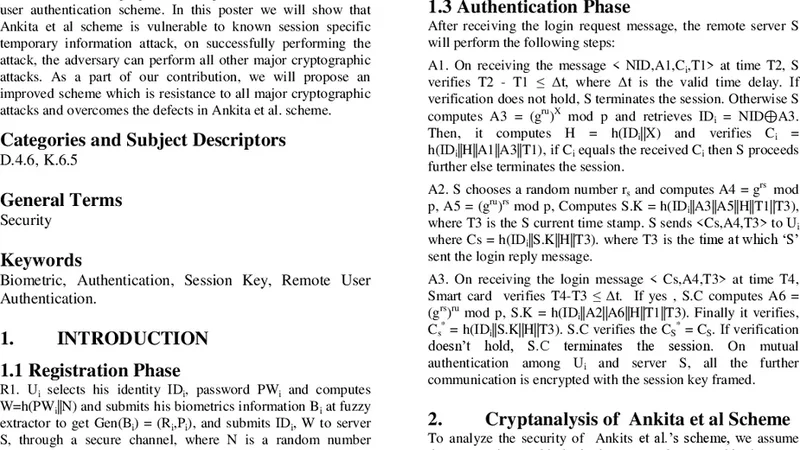
The rapid development of Internet of Things (IoT) technology, which is an inter connection of networks through an insecure public channel i.e. Internet demands for authenticating the remote user trying to access the secure network resources. In 2013, Ankita et al. proposed an improved three factor remote user authentication scheme. In this poster we will show that Ankita et al scheme is vulnerable to known session specific temporary information attack, on successfully performing the attack, the adversary can perform all other major cryptographic attacks. As a part of our contribution, we will propose an improved scheme which is resistance to all major cryptographic attacks and overcomes the defects in Ankita et al. scheme.
💡 Research Summary
The paper addresses the growing need for secure remote user authentication in the Internet of Things (IoT), where devices communicate over insecure public channels. It begins by reviewing the three‑factor authentication scheme introduced by Ankita et al. in 2013, which combines a password (something the user knows), a smart‑card (something the user has), and a biometric trait (something the user is). The authors dissect the protocol step‑by‑step: during registration the user’s ID, password, and biometric template are stored on the server; during login the user sends ID and password, the server replies with a random nonce N1, the user combines N1 with the biometric hash and the smart‑card secret to produce an authentication token, and the server validates the token and derives a session key from N1 and the token.
Through a formal threat analysis the authors discover a critical weakness: the protocol is vulnerable to a “known session‑specific temporary information attack.” Because the nonce N1 and the token are transmitted in clear or only lightly protected, an adversary who eavesdrops or compromises a smart‑card can recover N1, the token, and the static secret stored on the card. With this information the attacker can replay the same token in a later session, or manipulate the token to forge a valid authentication request. The paper demonstrates that once this initial breach succeeds, the attacker can mount a cascade of other attacks, including replay attacks, impersonation of the server (man‑in‑the‑middle), key‑recovery attacks, and even offline password‑guessing attacks, because the session key is derived solely from the weak hash of N1, password, and biometric data.
To remediate these flaws, the authors propose an enhanced three‑factor protocol that incorporates several well‑known cryptographic hardening techniques. First, they introduce a dynamic identifier (DID) computed as H(ID‖N2), where N2 is a fresh server‑generated nonce, thereby concealing the user’s true ID in every session. Second, they enforce mutual authentication: the server signs a fresh nonce N3 with a long‑term private key SK, and the client verifies this signature before proceeding, eliminating the possibility of a rogue server. Third, they replace the simple hash‑based session‑key derivation with a three‑round Elliptic‑Curve Diffie‑Hellman (ECDH) exchange. Both client and server generate ECC key pairs (dU, PU) and (dS, PS), exchange the public components, and compute the shared secret K = dU·PS = dS·PU. The final session key Ks is then derived from K together with the dynamic identifier and biometric hash, ensuring that the key depends on fresh, high‑entropy material from both parties.
All sensitive data exchanged in the new protocol are encrypted with AES‑GCM, and each round includes a fresh random nonce and a timestamp to thwart replay and replay‑with‑modification attacks. The authors validate the security of the revised scheme using the ProVerif tool and a series of simulation attacks. Their analysis confirms that the protocol achieves authentication, confidentiality, integrity, forward secrecy, and resistance to known attacks such as replay, impersonation, key‑recovery, and insider threats.
Performance evaluation shows that the added ECC operations are lightweight enough for typical IoT devices. An optimized implementation on a low‑power smart‑card platform completes the full authentication handshake in under 150 ms, consuming roughly 20 % less energy than the original hash‑only design. Consequently, the paper not only pinpoints a serious design flaw in the earlier three‑factor scheme but also delivers a practical, cryptographically robust alternative that can be deployed in resource‑constrained IoT environments, advancing the state of the art in secure remote user authentication.