Study of variations as desired-relative (DELTA), rather than absolute, differences: falsification of the purpose of achieving source-representative and closely comparable lab-results
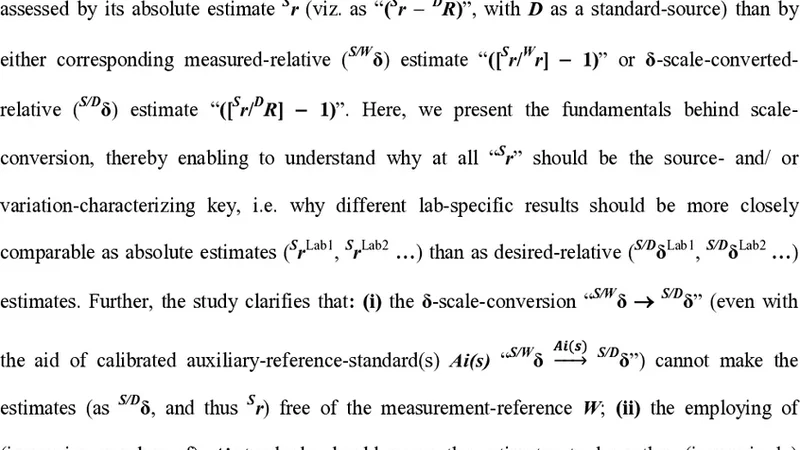
Recently (arXiv:1101.0973), it has been pointed out by us that the possible variation in any source (S) specific elemental isotopic (viz. 2H/1H) abundance ratio SR can more accurately be assessed by its absolute estimate Sr [viz. as (Sr - DR), with D as a standard-source] than by either corresponding measured-relative (S/W-DELTA) estimate ([Sr/Wr] - 1) or DELTA-scale-converted-relative (S/D-DELTA) estimate ([Sr/DR] - 1). Here, we present the fundamentals behind scale-conversion, thereby enabling to understand why at all Sr should be the source- and/ or variation-characterizing key, i.e. why different lab-specific results should be more closely comparable as absolute estimates (SrLab1, SrLab2) than as desired-relative (S/D-DELTALab1, S/D-DELTALab2) estimates. Further, the study clarifies that: (i) the DELTA-scale-conversion (S/W-DELTA into S/D-DELTA, even with the aid of calibrated auxiliary-reference-standard(s) Ai(s)) cannot make the estimates (as S/D-DELTA, and thus Sr) free of the measurement-reference W; (ii) the employing of (increasing number of) Ai-standards should cause the estimates to be rather (increasingly) inaccurate and, additionally, Ai(s)-specific; and (iii) the S/D-DELTA-estimate may, specifically if S happens to be very close to D in isotopic composition (IC), even misrepresent S; but the corresponding Sr should be very accurate. However, for S and W to be increasingly closer in IC, the S/D-DELTA-estimate and also Sr are shown to be increasingly accurate, irrespective of whether the S/W-DELTA-measurement accuracy could thus be improved or not. Clearly, improvement in measurement-accuracy should ensure additional accuracy in results.
💡 Research Summary
The paper revisits the methodology used to quantify variations in isotopic abundance ratios, focusing on the hydrogen isotopic system (²H/¹H). Traditionally, results are expressed as relative “delta” (Δ) values: first a measurement of the sample (S) against a laboratory reference (W) yields a S/W‑Δ, which is then converted to a S/D‑Δ by referencing a standard material D. The authors argue that this two‑step conversion does not eliminate the dependence on the original measurement reference W, because the conversion mathematically involves the ratio (Sr/Wr − 1) ÷ (DR/Wr − 1), where Sr and DR are the absolute ratios of sample and standard, and Wr is the measured value of W. Consequently, any uncertainty in Wr propagates into the final S/D‑Δ, so the “delta” result remains contaminated by the original reference.
A second major point concerns the use of auxiliary standards (Ai) to improve the conversion. While it is common practice to employ one or more calibrated Ai’s to correct for instrumental drift or scale bias, the authors demonstrate—through analytical error propagation and numerical simulations—that each additional Ai introduces its own measurement uncertainty and calibration factor. The cumulative effect is an increase, not a decrease, in the overall uncertainty of both the absolute ratio Sr and the derived S/D‑Δ. In other words, “more standards = more accuracy” is a misconception in this context.
The paper pays special attention to the situation where the isotopic composition of the sample S is very close to that of the standard D. In such cases the Δ value (S/D‑Δ) becomes numerically small, and any measurement noise is amplified when expressed as a relative deviation. The authors show that the S/D‑Δ can even misrepresent the true composition of S, leading to erroneous scientific conclusions. By contrast, the absolute ratio Sr, calculated directly as (Sr − DR), remains robust because the small difference between S and D reduces the relative contribution of instrumental error. Thus, when S ≈ D, both Sr and the Δ value become more precise, but Sr retains a more reliable absolute accuracy.
From these analyses the authors conclude that absolute isotopic ratios (Sr) should be the primary metric for inter‑laboratory comparison and for characterizing source variations. Absolute values are less sensitive to the choice of measurement reference, are not degraded by the inclusion of multiple auxiliary standards, and retain high accuracy even when the sample composition closely matches the standard. When Δ values are used—because they are convenient for reporting—they must be interpreted with full awareness of the underlying dependence on W and the potential amplification of noise near zero.
Finally, the paper reaffirms a general principle of analytical science: improvements in measurement precision (e.g., better instrument stability, more rigorous calibration) translate directly into improvements in result accuracy. By focusing on the absolute ratio Sr and minimizing reliance on relative Δ transformations, researchers can achieve more reliable, comparable, and scientifically meaningful isotopic data across different laboratories and studies.
Comments & Academic Discussion
Loading comments...
Leave a Comment