On arc-disjoint Hamiltonian cycles in De Bruijn graphs
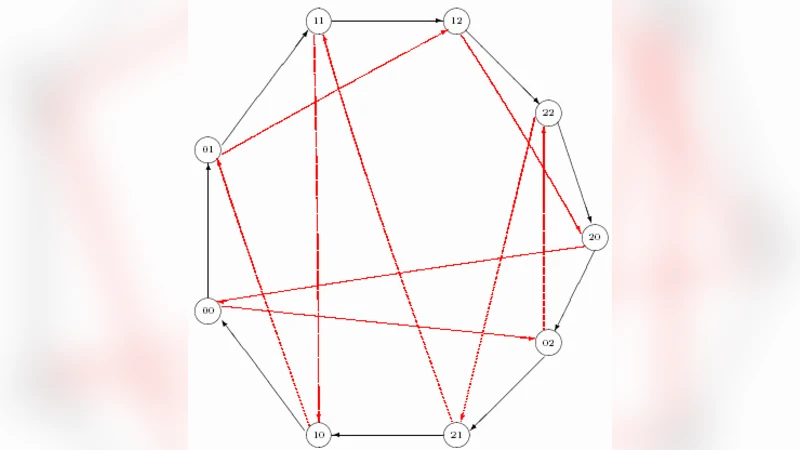
We give two equivalent formulations of a conjecture [2,4] on the number of arc-disjoint Hamiltonian cycles in De Bruijn graphs.
💡 Research Summary
The paper deals with the long‑standing conjecture that a De Bruijn graph B(q,k) (with q ≥ 2 and k > 1) contains exactly q − 1 arc‑disjoint Hamiltonian cycles. After recalling the standard definition of a De Bruijn graph—vertices are all k‑length strings over an alphabet A={0,…,q‑1}, and directed arcs correspond to (k + 1)‑length strings whose first k symbols and last k symbols overlap—the author presents two formulations that are shown to be equivalent.
Conjecture 1 is the direct statement: the maximum number of pairwise arc‑disjoint Hamiltonian cycles in B(q,k) equals q − 1. This follows from the regularity of the graph (each vertex has indegree and outdegree q) and the fact that an Eulerian circuit in B(q,k) corresponds to a Hamiltonian path in B(q,k + 1). However, no constructive proof is offered.
Conjecture 2 reformulates the problem using a cyclic morphism µ on the alphabet: µ(0)=0, µ(i)=i+1 for 1 ≤ i < q‑1, and µ(q‑1)=1. Because µ^{q‑1}=identity, applying µ repeatedly generates a family of words that are mutually equivalent under the relation v=µ^{k}(u) (1 ≤ k ≤ q‑2). Starting from a single Hamiltonian cycle H₀ (represented by a De Bruijn word w), the author applies µ^{k} to w for k=1,…,q‑2, obtaining q‑1 distinct De Bruijn words. Each word corresponds to a Hamiltonian cycle H_{k} in B(q,k), and the construction guarantees that the arcs used by H₀, H₁,…,H_{q‑2} are pairwise disjoint. Thus the existence of such an H₀ implies the existence of q‑1 arc‑disjoint Hamiltonian cycles.
The paper illustrates the idea with concrete examples: for B(3,2) the cycles H₀=0011220210 and H₁=0022110120 are obtained; for B(3,3), B(4,2) and B(5,2) analogous families of cycles are listed. These examples demonstrate that the µ‑transformation indeed produces distinct Hamiltonian cycles that do not share any arcs.
Furthermore, the author points out that the equivalence relation induced by µ partitions the whole set of De Bruijn words into q‑1 classes, each class giving rise to a set of arc‑disjoint Hamiltonian cycles. Consequently, Conjecture 2 is an equivalent restatement of Conjecture 1: “there exists a Hamiltonian cycle whose µ‑orbit yields q‑1 mutually arc‑disjoint Hamiltonian cycles.”
The manuscript does not provide a general proof, but it offers a new perspective that could be useful for future attempts. The cyclic nature of µ suggests a possible group‑theoretic approach, and the connection between Eulerian circuits in B(q,k) and Hamiltonian cycles in B(q,k + 1) hints at deeper combinatorial structures. By reformulating the problem in terms of word equivalence classes, the paper opens a pathway for algebraic or constructive techniques that may eventually resolve the conjecture.
Comments & Academic Discussion
Loading comments...
Leave a Comment