Lower Bounds for Local Approximation
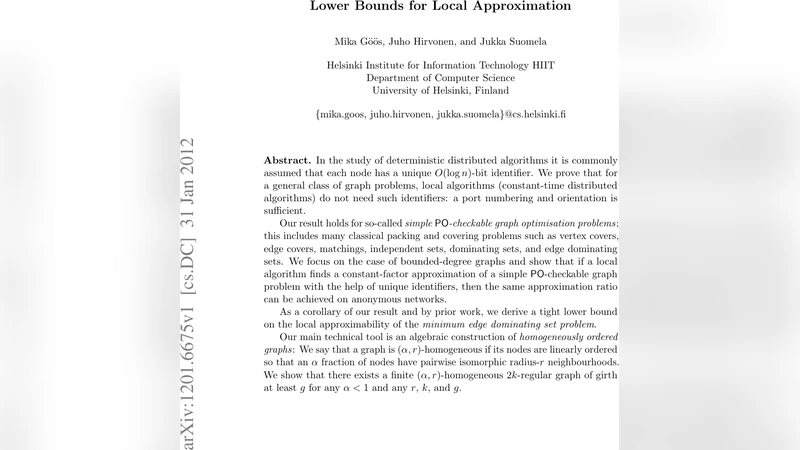
In the study of deterministic distributed algorithms it is commonly assumed that each node has a unique $O(\log n)$-bit identifier. We prove that for a general class of graph problems, local algorithms (constant-time distributed algorithms) do not need such identifiers: a port numbering and orientation is sufficient. Our result holds for so-called simple PO-checkable graph optimisation problems; this includes many classical packing and covering problems such as vertex covers, edge covers, matchings, independent sets, dominating sets, and edge dominating sets. We focus on the case of bounded-degree graphs and show that if a local algorithm finds a constant-factor approximation of a simple PO-checkable graph problem with the help of unique identifiers, then the same approximation ratio can be achieved on anonymous networks. As a corollary of our result and by prior work, we derive a tight lower bound on the local approximability of the minimum edge dominating set problem. Our main technical tool is an algebraic construction of homogeneously ordered graphs: We say that a graph is $(\alpha,r)$-homogeneous if its nodes are linearly ordered so that an $\alpha$ fraction of nodes have pairwise isomorphic radius-$r$ neighbourhoods. We show that there exists a finite $(\alpha,r)$-homogeneous $2k$-regular graph of girth at least $g$ for any $\alpha < 1$ and any $r$, $k$, and $g$.
💡 Research Summary
The paper tackles a fundamental assumption in the theory of deterministic distributed algorithms: that each node must possess a unique O(log n)-bit identifier. By focusing on a broad class of graph optimisation problems that are “simple PO‑checkable” – meaning that the quality of a solution can be verified locally using only a port numbering and an orientation (the PO model) – the authors demonstrate that identifiers are in fact unnecessary for constant‑time (local) algorithms on bounded‑degree graphs.
The central result, termed the “identifier‑free theorem,” states that if a constant‑time algorithm that has access to unique IDs can achieve a constant‑factor approximation for any simple PO‑checkable problem, then the same approximation ratio can be achieved in the anonymous PO model, which supplies only port numbers and edge directions. This equivalence is proved by constructing highly symmetric graphs, called (α, r)‑homogeneous graphs. In such a graph a linear ordering of the vertices is chosen so that an α‑fraction of the vertices have pairwise isomorphic radius‑r neighbourhoods. The authors show that for any α < 1, any radius r, any even degree 2k, and any desired girth g, there exists a finite (α, r)‑homogeneous 2k‑regular graph with girth at least g. The construction is algebraic: it uses Cayley graphs of suitably chosen groups to simultaneously enforce regularity, large girth, and a high degree of local homogeneity.
The homogeneity property is the key technical tool. Because a large fraction of vertices see exactly the same local view (up to isomorphism), any deterministic algorithm that bases its decision on the unique identifiers cannot distinguish among these vertices when identifiers are removed. Consequently, the algorithm’s behaviour on the anonymous graph mirrors its behaviour on the original ID‑rich graph, preserving the approximation guarantee. The proof proceeds by embedding the execution of an arbitrary ID‑based local algorithm into the homogeneous graph, arguing that the algorithm’s output on the homogeneous vertices must be identical to its output on the corresponding vertices in the original graph, thereby transferring the approximation ratio.
As a concrete application, the authors revisit the Minimum Edge Dominating Set (MEDS) problem. Prior work had established a tight lower bound on the approximation ratio achievable by local algorithms in the ID‑based LOCAL model. By applying the identifier‑free theorem, the paper shows that the same lower bound holds in the PO model, confirming that anonymity does not weaken the hardness of MEDS. This result, together with the earlier known O(Δ)‑approximation algorithm (Δ being the maximum degree), yields a tight characterization of the local approximability of MEDS.
The paper also situates its contributions within the broader literature. Earlier studies treated identifiers as essential for breaking symmetry and achieving good approximations; many lower‑bound constructions relied on the existence of IDs to argue about distinguishability. The present work overturns this view for a large family of optimisation problems, demonstrating that symmetry can be artificially introduced via algebraic graph constructions, rendering identifiers superfluous. Moreover, the techniques are generic enough to apply to other simple PO‑checkable problems such as vertex cover, edge cover, maximal matching, independent set, dominating set, and edge cover, suggesting a unified framework for analysing local approximability in anonymous networks.
In conclusion, the authors provide a rigorous proof that, on bounded‑degree graphs, constant‑time deterministic algorithms do not need unique identifiers to achieve the best possible constant‑factor approximations for a wide range of classic graph optimisation problems. The algebraic construction of (α, r)‑homogeneous regular graphs with large girth is a novel methodological contribution that may find further applications in distributed symmetry‑breaking, network coding, and the design of robust anonymous protocols. The work thus both deepens our theoretical understanding of locality in distributed computation and offers practical insights for building efficient, identifier‑free network algorithms.
Comments & Academic Discussion
Loading comments...
Leave a Comment