Letter counting: a stem cell for Cryptology, Quantitative Linguistics, and Statistics
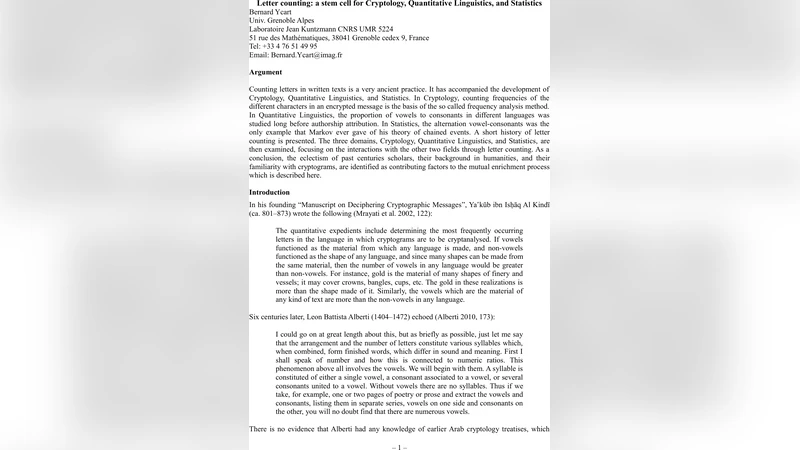
Counting letters in written texts is a very ancient practice. It has accompanied the development of Cryptology, Quantitative Linguistics, and Statistics. In Cryptology, counting frequencies of the different characters in an encrypted message is the basis of the so called frequency analysis method. In Quantitative Linguistics, the proportion of vowels to consonants in different languages was studied long before authorship attribution. In Statistics, the alternation vowel-consonants was the only example that Markov ever gave of his theory of chained events. A short history of letter counting is presented. The three domains, Cryptology, Quantitative Linguistics, and Statistics, are then examined, focusing on the interactions with the other two fields through letter counting. As a conclusion, the eclectism of past centuries scholars, their background in humanities, and their familiarity with cryptograms, are identified as contributing factors to the mutual enrichment process which is described here.
💡 Research Summary
The paper “Letter counting: a stem cell for Cryptology, Quantitative Linguistics, and Statistics” offers a comprehensive historical and methodological survey of how the simple act of counting letters has served as a foundational tool across three distinct yet interrelated fields. It begins by noting that letter counting is an ancient practice, tracing its roots from early cryptographic attempts in ancient Egypt and Greece, through medieval Arab substitution ciphers, to the systematic frequency tables developed by 19th‑century French cryptanalysts such as Auguste‑Louis Cauchy and Alphonse Bigeon. These early frequency tables demonstrated that the relative occurrence of each alphabetic symbol could be used to reverse‑engineer encrypted messages, a principle that underlies modern computational cryptanalysis and machine‑learning‑based cipher attacks.
The second major segment shifts focus to quantitative linguistics. The authors review pioneering work by scholars such as Friedrich Schlegel, who compared vowel‑to‑consonant ratios in Latin and German texts, and later researchers who employed letter‑frequency statistics to distinguish dialects, track language evolution, and attribute authorship. The paper highlights how the simple metric of vowel‑consonant proportion evolved into sophisticated n‑gram models that now power stylometric analysis, plagiarism detection, and forensic linguistics.
In the third section, the paper examines the statistical dimension, emphasizing Andrey Markov’s seminal example of “alternating vowel‑consonant” patterns as the first illustration of his theory of chained events. This example effectively transformed a textual sequence into a stochastic process, laying the groundwork for modern hidden Markov models (HMMs) and other probabilistic sequence models. The authors demonstrate how these models have been applied to text generation, spam filtering, and, crucially, to cryptanalysis where state‑transition probabilities can reveal hidden structures in ciphertexts.
A central contribution of the article is its analysis of cross‑disciplinary feedback loops. Cryptanalysts borrowed linguistic frequency data to break ciphers; linguists adopted statistical tools from probability theory to refine authorship attribution; statisticians, in turn, used cryptographic challenges to test and extend their models of dependent events. The authors argue that the eclectic backgrounds of 17th‑ and 18th‑century scholars—often trained in the humanities yet fascinated by cryptograms—created a fertile environment for methodological exchange that prefigured today’s interdisciplinary data science.
The conclusion posits letter counting as a “stem cell”: a minimal, versatile unit that can differentiate into complex analytical frameworks across domains. By revisiting the historical synergy among cryptology, quantitative linguistics, and statistics, the paper underscores the enduring relevance of simple frequency counts in contemporary fields such as artificial intelligence, cybersecurity, and language policy. It calls for renewed appreciation of interdisciplinary curiosity, suggesting that modern researchers can draw inspiration from the past to harness basic textual metrics for innovative solutions in an increasingly data‑driven world.
Comments & Academic Discussion
Loading comments...
Leave a Comment