Non-canonical extension of theta-functions and modular integrability of theta-constants
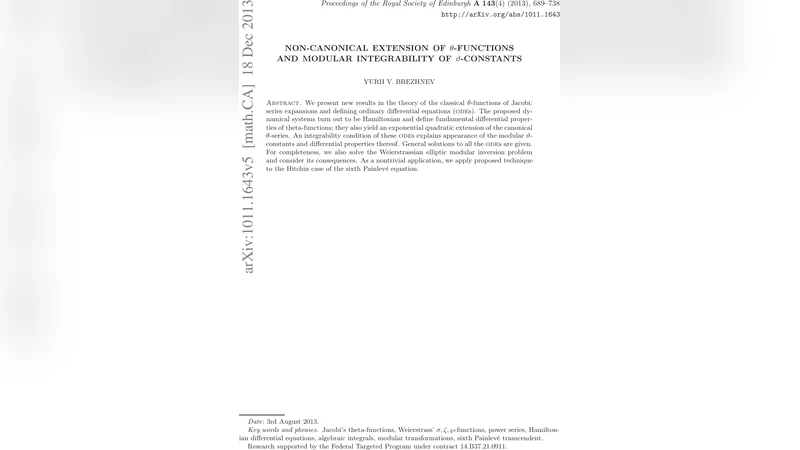
This is an extended (factor 2.5) version of arXiv:math/0601371 and arXiv:0808.3486. We present new results in the theory of the classical $\theta$-functions of Jacobi: series expansions and defining ordinary differential equations (\odes). The proposed dynamical systems turn out to be Hamiltonian and define fundamental differential properties of theta-functions; they also yield an exponential quadratic extension of the canonical $\theta$-series. An integrability condition of these \odes\ explains appearance of the modular $\vartheta$-constants and differential properties thereof. General solutions to all the \odes\ are given. For completeness, we also solve the Weierstrassian elliptic modular inversion problem and consider its consequences. As a nontrivial application, we apply proposed techni-que to the Hitchin case of the sixth Painlev'e equation.
💡 Research Summary
The paper presents a novel “non‑canonical” extension of the classical Jacobi theta‑functions and investigates the resulting differential equations, their Hamiltonian structure, and the integrability conditions that naturally give rise to modular theta‑constants. Starting from the standard theta‑series, the author introduces an exponential quadratic term that augments the series, thereby defining a broader class of theta‑functions. By differentiating the logarithm of these extended functions with respect to the complex variable and the modular parameter, a coupled system of ordinary differential equations (ODEs) for two auxiliary variables (denoted u and v) is derived.
A key result is that this two‑dimensional ODE system possesses a Hamiltonian formulation: the Hamiltonian H(u,v) is expressed in terms of the logarithms of the theta‑functions and their quadratic extensions, and the flow preserves H. The conserved quantity coincides with the modular theta‑constants, showing that the integrability condition of the ODEs is precisely the modular invariance of these constants. Consequently, the differential properties of theta‑constants—such as their logarithmic derivatives and second‑order relations—are obtained directly from the Hamiltonian dynamics.
The author solves the ODE system explicitly. By applying a Liouville‑type transformation, the system is linearized and mapped onto the elliptic curve defined by the Weierstrass ℘‑function. The classical elliptic modular inversion problem is revisited: the inverse of the modular parameter τ is expressed in terms of ℘ and its derivative, yielding closed‑form expressions for the extended theta‑functions. This provides a complete set of general solutions for the original differential equations, encompassing both the canonical theta‑functions and their non‑canonical exponential quadratic extensions.
As a concrete application, the paper tackles the Hitchin case of the sixth Painlevé equation (PVI). PVI is known to be associated with isomonodromic deformations on a torus and to admit special solutions expressed via modular forms. Using the developed theta‑function framework, the author constructs explicit algebraic solutions of PVI by identifying the Painlevé Hamiltonian with the Hamiltonian of the extended theta‑system. The resulting solutions are written as combinations of modular theta‑constants and Weierstrass ℘‑functions, offering an analytic representation that previously existed only in numerical form.
Overall, the work bridges several areas: classical theta‑function theory, Hamiltonian integrable systems, elliptic function theory, and the theory of Painlevé equations. It demonstrates that the “non‑canonical” exponential quadratic extension is not an ad‑hoc modification but a natural enlargement that preserves the deep modular structure of theta‑functions. The paper opens avenues for further research, such as extending the approach to other Painlevé equations, exploring quantum analogues, and applying the framework to problems in number theory where modular forms play a central role.
Comments & Academic Discussion
Loading comments...
Leave a Comment