Higher Dimensional Consensus: Learning in Large-Scale Networks
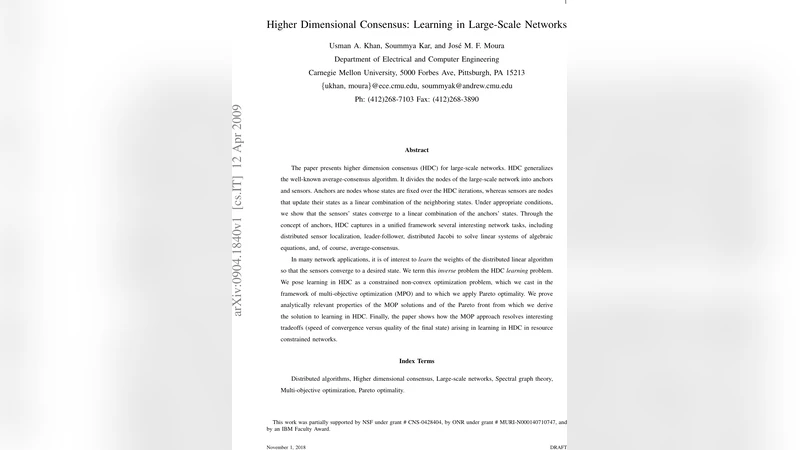
The paper presents higher dimension consensus (HDC) for large-scale networks. HDC generalizes the well-known average-consensus algorithm. It divides the nodes of the large-scale network into anchors and sensors. Anchors are nodes whose states are fixed over the HDC iterations, whereas sensors are nodes that update their states as a linear combination of the neighboring states. Under appropriate conditions, we show that the sensor states converge to a linear combination of the anchor states. Through the concept of anchors, HDC captures in a unified framework several interesting network tasks, including distributed sensor localization, leader-follower, distributed Jacobi to solve linear systems of algebraic equations, and, of course, average-consensus. In many network applications, it is of interest to learn the weights of the distributed linear algorithm so that the sensors converge to a desired state. We term this inverse problem the HDC learning problem. We pose learning in HDC as a constrained non-convex optimization problem, which we cast in the framework of multi-objective optimization (MOP) and to which we apply Pareto optimality. We prove analytically relevant properties of the MOP solutions and of the Pareto front from which we derive the solution to learning in HDC. Finally, the paper shows how the MOP approach resolves interesting tradeoffs (speed of convergence versus quality of the final state) arising in learning in HDC in resource constrained networks.
💡 Research Summary
The paper introduces Higher‑Dimensional Consensus (HDC), a unifying framework that extends the classic average‑consensus algorithm to accommodate heterogeneous node roles in large‑scale networks. Nodes are partitioned into two classes: anchors, whose states remain fixed throughout the iterative process, and sensors, which update their states as weighted linear combinations of neighboring states. Formally, for a sensor i the update rule is
x_i(k+1)=∑{j∈N_i} w{ij} x_j(k), with w_{ij}≥0 and ∑{j∈N_i} w{ij}=1.
Anchors satisfy x_a(k)=x_a(0). In matrix form the global dynamics become
x(k+1)=W x(k), W=
Comments & Academic Discussion
Loading comments...
Leave a Comment