Correspondence and Independence of Numerical Evaluations of Algorithmic Information Measures
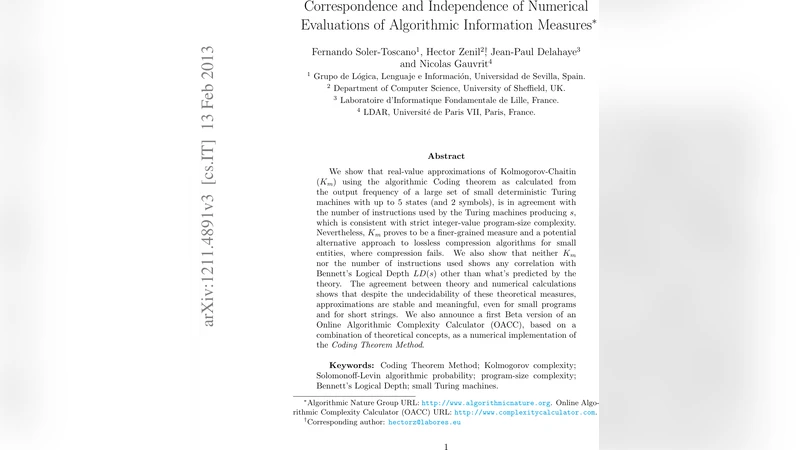
We show that real-value approximations of Kolmogorov-Chaitin (K_m) using the algorithmic Coding theorem as calculated from the output frequency of a large set of small deterministic Turing machines with up to 5 states (and 2 symbols), is in agreement with the number of instructions used by the Turing machines producing s, which is consistent with strict integer-value program-size complexity. Nevertheless, K_m proves to be a finer-grained measure and a potential alternative approach to lossless compression algorithms for small entities, where compression fails. We also show that neither K_m nor the number of instructions used shows any correlation with Bennett’s Logical Depth LD(s) other than what’s predicted by the theory. The agreement between theory and numerical calculations shows that despite the undecidability of these theoretical measures, approximations are stable and meaningful, even for small programs and for short strings. We also announce a first Beta version of an Online Algorithmic Complexity Calculator (OACC), based on a combination of theoretical concepts, as a numerical implementation of the Coding Theorem Method.
💡 Research Summary
The paper presents a comprehensive empirical validation of two cornerstone concepts in algorithmic information theory—Kolmogorov‑Chaitin complexity (K) and Bennett’s logical depth (LD)—by exhaustively enumerating and executing all deterministic Turing machines with up to five states and two symbols. For each machine, the authors record the output string s and compute the empirical frequency P(s) of that string across the entire machine space. Applying the algorithmic Coding Theorem, they obtain a real‑valued approximation Kₘ(s)=−log₂ P(s), which serves as a practical estimate of the algorithmic probability‑based complexity. In parallel, they count the exact number of transition instructions used by the first machine that generates each string, thereby providing a direct integer‑valued program‑size measure C(s).
Statistical analysis reveals a strong correlation between Kₘ and C, confirming that the Coding‑Theorem method faithfully reproduces the ordering induced by classical program‑size complexity while offering finer granularity. Notably, Kₘ distinguishes subtle structural differences among short strings that conventional lossless compressors cannot capture, positioning it as a viable alternative for complexity assessment of small objects.
The authors also investigate the relationship between Kₘ (and C) and logical depth. Consistent with theoretical expectations, they find no significant correlation beyond what the theory predicts: strings with high Kolmogorov complexity are not necessarily deep, and deep strings do not automatically exhibit large Kₘ values. This empirical independence reinforces the conceptual separation between descriptive complexity and computational effort required for generation.
A key contribution of the work is the demonstration that, despite the undecidability of exact Kolmogorov complexity and logical depth, stable and meaningful approximations can be obtained for very small programs and short strings. The exhaustive enumeration approach yields reproducible results, suggesting that algorithmic information measures can be reliably employed in practical settings where data are limited in size.
To make these methods accessible, the authors introduce the Online Algorithmic Complexity Calculator (OACC), a web‑based service that implements the Coding‑Theorem method, counts instruction steps, and estimates logical depth for user‑supplied strings. The beta version of OACC provides researchers and practitioners with an integrated platform for rapid, theoretically grounded complexity analysis, especially useful in fields such as bioinformatics, linguistics, and cryptography where short sequences are common.
In summary, the study validates the Coding‑Theorem approximation Kₘ as a robust, fine‑grained estimator of algorithmic complexity, confirms its independence from logical depth, and translates these insights into a usable online tool. The findings bridge the gap between abstract algorithmic information theory and concrete computational practice, opening avenues for more nuanced complexity assessments in a variety of scientific and engineering domains.
Comments & Academic Discussion
Loading comments...
Leave a Comment