H_2-Optimal Decentralized Control over Posets: A State-Space Solution for State-Feedback
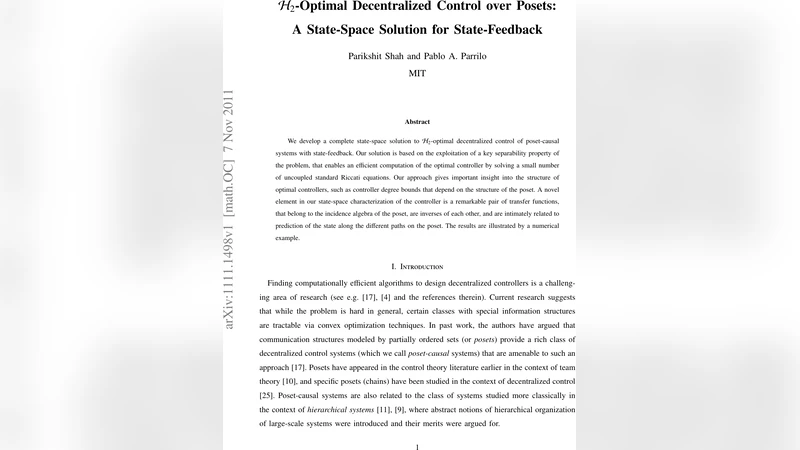
We develop a complete state-space solution to H_2-optimal decentralized control of poset-causal systems with state-feedback. Our solution is based on the exploitation of a key separability property of the problem, that enables an efficient computation of the optimal controller by solving a small number of uncoupled standard Riccati equations. Our approach gives important insight into the structure of optimal controllers, such as controller degree bounds that depend on the structure of the poset. A novel element in our state-space characterization of the controller is a remarkable pair of transfer functions, that belong to the incidence algebra of the poset, are inverses of each other, and are intimately related to prediction of the state along the different paths on the poset. The results are illustrated by a numerical example.
💡 Research Summary
The paper addresses the H₂ optimal decentralized control problem for systems whose interconnection structure is described by a partially ordered set (poset). Each subsystem corresponds to an element of the poset, and the system matrices A and B are constrained to belong to the incidence algebra of the poset, meaning that information can flow only downstream according to the partial order. The authors consider continuous‑time linear time‑invariant systems with state‑feedback and seek a controller K that respects the same sparsity pattern while minimizing the H₂ norm of the closed‑loop transfer from disturbance w to performance output z.
The central theoretical contribution is a separability property (Theorem 2). Because the incidence algebra is closed under multiplication and inversion, the global H₂ optimization can be decomposed into a collection of independent standard LQR problems, one for each node of the poset. For node i, only the local state block x_i and input block u_i appear in the Riccati equation; all cross‑terms from ancestors are either zero or already accounted for by the poset structure. Solving these uncoupled Riccati equations yields local optimal gains K_i.
The authors then assemble the global optimal controller (Theorem 3) by introducing two transfer functions, Φ (the propagation filter) and Γ (the differential filter), which both belong to the incidence algebra and satisfy Γ = Φ⁻¹. Φ propagates local state information downstream, effectively providing each subsystem with a prediction of the states of its descendants. Γ computes the correction (difference) between the predicted and actual downstream states. The optimal feedback law can be written compactly as
(u = -\Gamma K_{\text{local}} \Phi x),
where K_local is block‑diagonal, containing the gains obtained from the Riccati solutions. This representation reveals a clear prediction‑correction architecture inherent to the optimal controller.
A further contribution is a degree bound (Corollary 2). The authors define a poset‑dependent parameter σ_P (e.g., the maximum length of a chain or the width of the poset) and prove that the order of the optimal controller satisfies
(\deg(K) \le \sigma_P \max_i n_i),
where n_i is the state dimension of subsystem i. Thus the controller complexity is directly linked to the combinatorial structure of the poset.
The paper situates its results within the broader literature on decentralized control. It contrasts the state‑space approach with Youla‑parameterization methods, highlighting that the latter are computationally intensive, can produce high‑order controllers, and suffer from numerical instability. By staying in the state‑space domain, the proposed method leverages standard, numerically robust Riccati solvers and provides explicit structural insight.
A concrete numerical example with a four‑node poset (Fig. 1(d)) illustrates the entire procedure: the incidence‑algebraic decomposition, solution of four Riccati equations, construction of Φ and Γ, and synthesis of the final controller. Simulation results confirm that the controller achieves the H₂ optimum, has a lower order than a comparable Youla‑based design, and respects the prescribed sparsity pattern.
In conclusion, the paper delivers a complete state‑space solution for H₂ optimal decentralized control over arbitrary finite posets. It introduces a novel separability theorem, a pair of inverse transfer functions that expose the prediction structure, and explicit degree bounds tied to poset topology. The framework opens avenues for extensions to output‑feedback, time‑varying posets, and robust or nonlinear settings.
Comments & Academic Discussion
Loading comments...
Leave a Comment