Unity in Major Themes - Convergence vs. Arbitrariness in the Development of Mathematics
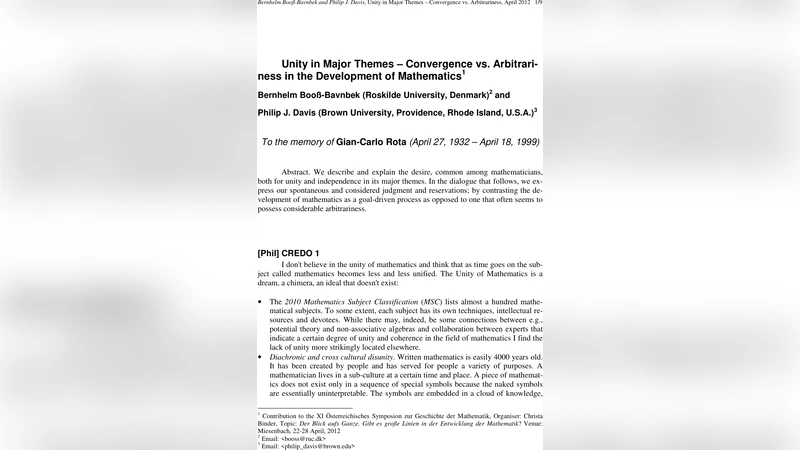
We describe and explain the desire, common among mathematicians, both for unity and independence in its major themes. In the dialogue that follows, we express our spontaneous and considered judgment and reservations by contrasting the development of mathematics as a goal-driven process as opposed to one that often seems to possess considerable arbitrariness.
💡 Research Summary
The paper investigates a fundamental paradox in the evolution of mathematics: the simultaneous drive toward unity across its major themes and the persistent emergence of independent, seemingly arbitrary developments within individual branches. Beginning with an overview of the mathematician’s innate desire for a single coherent language and structure, the authors juxtapose this aspiration against the historical reality that many breakthroughs arise from choices that appear non‑goal‑directed or contingent on cultural, philosophical, or technical contexts.
The authors trace the lineage of unifying efforts from Euclid’s axiomatic geometry, through the synthesis of calculus with physics in the works of Newton and Leibniz, to the 19th‑century emergence of Riemannian manifolds that linked geometry and analysis. They highlight the 20th‑century advent of category theory as the most ambitious attempt to place algebra, topology, logic, and other domains within a single meta‑framework, thereby maximizing conceptual efficiency and enabling the reduction of complex problems to a handful of universal principles.
In contrast, the paper presents a series of case studies that illustrate the role of “arbitrariness” or independent development. The construction of the real number system, for instance, depended on the particular limit definitions chosen by Dedekind and Cauchy—choices that could have been replaced by alternative frameworks such as non‑standard analysis. The birth of non‑Euclidean geometries is portrayed as a deliberate deviation from Euclid’s parallel postulate, opening an entirely new geometric universe. Galois theory is examined as a goal‑driven attempt to unify polynomial root structures, yet it required the seemingly arbitrary introduction of group theory, a discipline that was not originally part of algebraic investigations. These examples demonstrate that mathematical progress is not a linear march toward a pre‑ordained goal; rather, it often hinges on decisions that are shaped by the prevailing intellectual climate and the availability of new tools.
The central argument of the paper is that the “goal‑directed” and “arbitrary” strands are not antagonistic but mutually reinforcing. Unifying projects provide a common scaffold that deepens understanding and streamlines communication across fields. At the same time, the necessity of making non‑canonical choices—whether in defining new axioms, selecting among equivalent constructions, or importing concepts from unrelated areas—injects novelty and expands the frontier of mathematics. The authors illustrate this synergy with the development of homology theory: the desire to capture topological “holes” in a unified algebraic language required the introduction of chain complexes and boundary operators, choices that were not uniquely forced but ultimately led to a rich new subfield.
In the concluding section, the authors propose a “unity‑arbitrariness tension model” for the philosophy of mathematics. They argue that sustained progress depends on maintaining a dynamic balance: researchers should pursue clear, unifying objectives while remaining open to the creative, sometimes ad‑hoc, decisions that drive innovation. By recognizing the productive interplay between these forces, the mathematical community can foster both the depth of integrated theory and the breadth of exploratory diversity, ensuring the discipline’s continued vitality and relevance.
Comments & Academic Discussion
Loading comments...
Leave a Comment