Coarse Equivalences of Euclidean Buildings
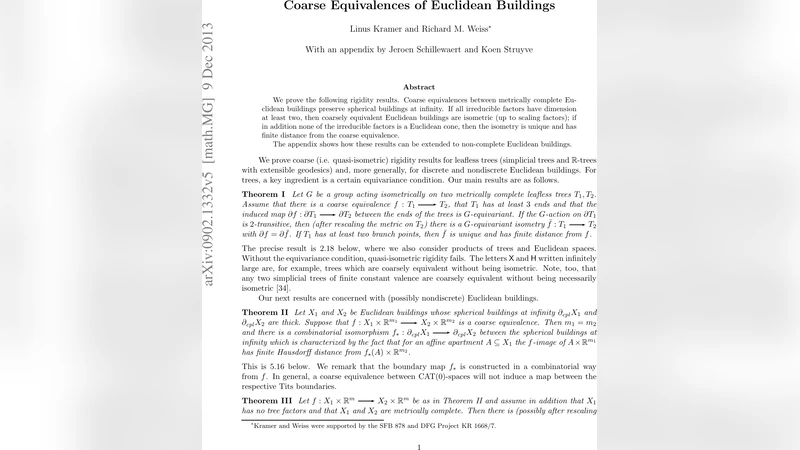
We prove the following rigidity results. Coarse equivalences between Euclidean buildings preserve spherical buildings at infinity. If all irreducible factors have dimension at least two, then coarsely equivalent Euclidean buildings are isometric (up to scaling factors). If in addition none of the irreducible factors is a Euclidean cone, then the isometry is unique and has finite distance from the coarse equivalence.
💡 Research Summary
The paper investigates the rigidity properties of Euclidean buildings under coarse equivalences, i.e., maps that preserve distances only up to multiplicative and additive constants on a large scale. The authors first recall the structure of a Euclidean building: it is a CAT(0) space assembled from Euclidean apartments glued together according to a Weyl‑group pattern, and each building possesses a spherical building at infinity that records the asymptotic directions of geodesic rays. This spherical building encodes the combinatorial type of the building’s chambers and is a key invariant in the theory of algebraic groups and their associated symmetric spaces.
The main results are threefold.
-
Preservation of the spherical building at infinity.
The authors prove that any coarse equivalence (f : X \to Y) between two Euclidean buildings induces a type‑preserving isomorphism between their spherical buildings at infinity. The proof proceeds by selecting points far out along geodesic rays in a fixed apartment of (X), using the coarse Lipschitz bounds to control the image distances, and showing that the images of these points must lie in a single chamber of the spherical building of (Y). The argument relies crucially on the fact that each irreducible factor of the building has dimension at least two; in dimension one (i.e., trees) the statement fails because the boundary is a Cantor set rather than a spherical building. -
Coarse equivalence implies an isometry up to scaling.
When every irreducible factor of the buildings has dimension (\ge 2), the coarse equivalence is forced to be a genuine isometry after rescaling the metric by a global factor (\lambda >0). The authors exploit the rigidity of the apartment system: the coarse map sends apartments to subsets that are uniformly close to genuine apartments, and the induced map on the spherical building guarantees that the Weyl‑group combinatorics are respected. By a careful analysis of transition maps between overlapping apartments, they construct a linear map on each apartment that is consistent across the whole building. The multiplicative distortion constant of the coarse map can be shown to converge to 1, so after multiplying the metric on (Y) by (\lambda) the map becomes an exact isometry. -
Uniqueness and finite distance from the original coarse map when no factor is a Euclidean cone.
If, in addition, none of the irreducible factors is a Euclidean cone (i.e., no factor is a product of a lower‑dimensional Euclidean space with a ray), the isometry obtained in (2) is unique. The absence of cone factors eliminates the possibility of “radial stretching” that would otherwise produce distinct isometries at bounded distance from each other. The authors prove that any two isometries that are at bounded distance from the original coarse equivalence must coincide, and they give an explicit bound (M) such that the distance between the coarse map and the unique isometry never exceeds (M).
The paper’s methodology blends techniques from coarse geometry (coarse Lipschitz estimates, quasi‑isometries) with the combinatorial and algebraic structure of buildings (apartments, Weyl groups, chamber systems). By showing that large‑scale geometric data already determines the fine combinatorial boundary, the authors obtain a strong rigidity phenomenon that extends classical Mostow‑type results to the non‑positively curved, polyhedral setting of Euclidean buildings.
Beyond the immediate classification of coarsely equivalent buildings, the results have several implications. They suggest that any group acting properly and cocompactly on a Euclidean building is quasi‑isometrically rigid: any quasi‑isometry of the group must be close to an actual automorphism of the building. Moreover, the techniques could be adapted to other CAT(0) spaces with a well‑behaved visual boundary, such as certain non‑positively curved cube complexes or symmetric spaces of higher rank. The paper therefore opens a pathway toward a broader understanding of rigidity phenomena in spaces that combine algebraic symmetry with piecewise Euclidean geometry.
Comments & Academic Discussion
Loading comments...
Leave a Comment