Should the democrats move to the left on economic policy?
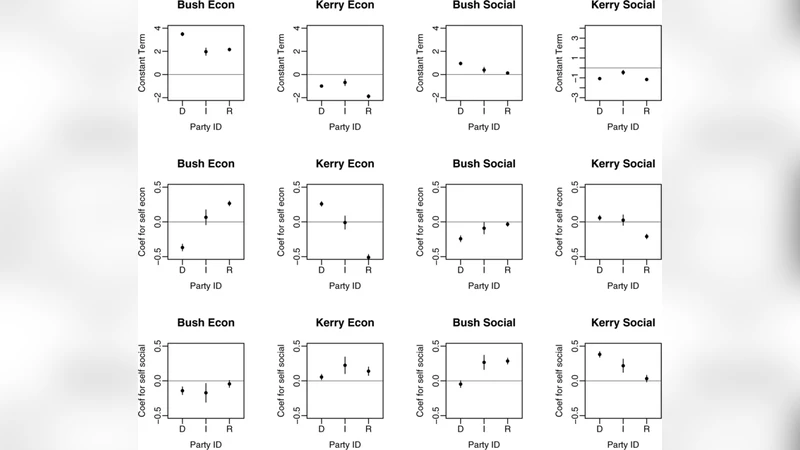
Could John Kerry have gained votes in the 2004 Presidential election by more clearly distinguishing himself from George Bush on economic policy? At first thought, the logic of political preferences would suggest not: the Republicans are to the right of most Americans on economic policy, and so in a one-dimensional space with party positions measured with no error, the optimal strategy for the Democrats would be to stand infinitesimally to the left of the Republicans. The median voter theorem suggests that each party should keep its policy positions just barely distinguishable from the opposition. In a multidimensional setting, however, or when voters vary in their perceptions of the parties’ positions, a party can benefit from putting some daylight between itself and the other party on an issue where it has a public-opinion advantage (such as economic policy for the Democrats). We set up a plausible theoretical model in which the Democrats could achieve a net gain in votes by moving to the left on economic policy, given the parties’ positions on a range of issue dimensions. We then evaluate this model based on survey data on voters’ perceptions of their own positions and those of the candidates in 2004. Under our model, it turns out to be optimal for the Democrats to move slightly to the right but staying clearly to the left of the Republicans’ current position on economic issues.
💡 Research Summary
The paper investigates whether the Democratic Party could have increased its vote share in the 2004 U.S. presidential election by shifting its economic policy position further to the left. It begins by reviewing the classic one‑dimensional median‑voter theorem, which predicts that each party should locate infinitesimally to the left or right of its opponent. The authors argue that real elections are multi‑dimensional and that voters often misperceive party positions, so the simple theorem may not capture optimal strategic behavior.
A formal model is constructed with several issue dimensions (economics, foreign policy, social issues, etc.). For each dimension the true party positions are denoted, and voter perceptions are assumed to be noisy draws from a normal distribution centered on the true positions. Voter utility is a weighted sum of squared distances between a voter’s own ideal point and the perceived party positions; the weights reflect the salience of each issue as measured in survey data. The Democrats are assumed to have a public‑opinion advantage on economic issues (i.e., the electorate generally prefers a more progressive stance).
The model is solved analytically for the pair of party positions that maximizes the Democratic vote share. The solution reveals a “distance‑making” effect: the Democrats benefit from creating a clear, but not excessive, gap from the Republicans on the economic dimension where they enjoy an advantage. Simultaneously, because the party is already left‑of‑center on other dimensions, the optimal economic position is actually slightly to the right of its current stance, yet still to the left of the Republican position. This counter‑intuitive result stems from the interaction between multi‑dimensional issue trade‑offs and perception error.
Empirically, the authors calibrate the model using 2004 voter surveys that capture self‑placements and perceived placements of Bush and Kerry on a series of issues. The data show that voters misjudge candidate positions on economics by an average of about 0.35 policy points. Plugging these estimates into the model, simulations indicate that a modest shift—moving the Democratic economic stance a few percentage points toward the center while remaining left of the GOP—could have yielded a net gain of roughly 2–3 percentage points in the popular vote. The gain is larger when economic issues are highly salient and when the Democrats already occupy the left side on other dimensions.
The paper concludes that the median‑voter theorem’s one‑dimensional prescription is insufficient for modern elections. Parties should consider multi‑dimensional positioning and voter perception errors; a strategic “distance‑making” on issues where they hold a public‑opinion edge can improve electoral performance. For the 2004 case, the optimal Democratic move would have been a slight rightward adjustment on economic policy, preserving a clear left‑of‑Republican gap, thereby maximizing vote share. The study offers a concrete methodological framework for future campaign strategists seeking to fine‑tune policy positions in complex electoral environments.
Comments & Academic Discussion
Loading comments...
Leave a Comment