From Low-Distortion Norm Embeddings to Explicit Uncertainty Relations and Efficient Information Locking
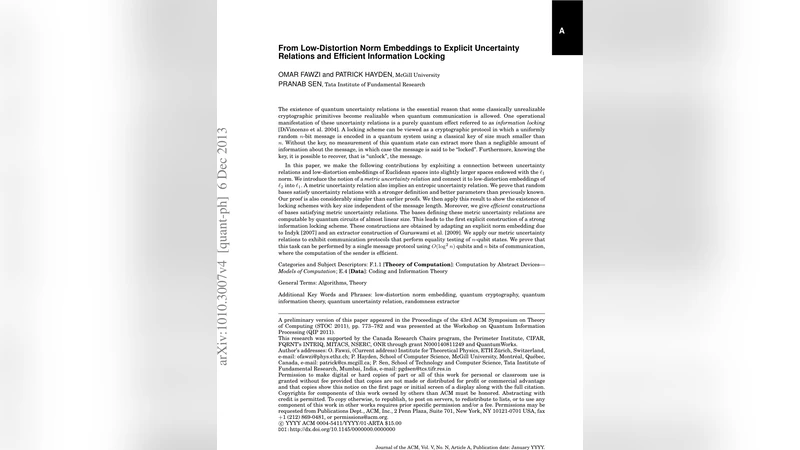
The existence of quantum uncertainty relations is the essential reason that some classically impossible cryptographic primitives become possible when quantum communication is allowed. One direct operational manifestation of these uncertainty relations is a purely quantum effect referred to as information locking. A locking scheme can be viewed as a cryptographic protocol in which a uniformly random n-bit message is encoded in a quantum system using a classical key of size much smaller than n. Without the key, no measurement of this quantum state can extract more than a negligible amount of information about the message, in which case the message is said to be “locked”. Furthermore, knowing the key, it is possible to recover, that is “unlock”, the message. In this paper, we make the following contributions by exploiting a connection between uncertainty relations and low-distortion embeddings of L2 into L1. We introduce the notion of metric uncertainty relations and connect it to low-distortion embeddings of L2 into L1. A metric uncertainty relation also implies an entropic uncertainty relation. We prove that random bases satisfy uncertainty relations with a stronger definition and better parameters than previously known. Our proof is also considerably simpler than earlier proofs. We apply this result to show the existence of locking schemes with key size independent of the message length. We give efficient constructions of metric uncertainty relations. The bases defining these metric uncertainty relations are computable by quantum circuits of almost linear size. This leads to the first explicit construction of a strong information locking scheme. Moreover, we present a locking scheme that is close to being implementable with current technology. We apply our metric uncertainty relations to exhibit communication protocols that perform quantum equality testing.
💡 Research Summary
The paper establishes a deep connection between quantum uncertainty relations and low‑distortion embeddings of Euclidean space (ℓ₂) into ℓ₁, and leverages this link to construct highly efficient information‑locking schemes. The authors first introduce the concept of a “metric uncertainty relation,” which requires that for any normalized quantum state the probability distributions obtained by measuring in two orthonormal bases are simultaneously far from the uniform distribution in ℓ₁ distance. They prove that such a relation is mathematically equivalent to the existence of an embedding that maps vectors from ℓ₂ to ℓ₁ with bounded distortion. This equivalence provides a new, geometric perspective on uncertainty: preserving distances in a low‑distortion embedding guarantees that the two measurement outcomes cannot both be close to uniform, which in turn yields a strong entropic uncertainty bound.
Using this framework, the authors show that a pair of Haar‑random bases satisfies a metric uncertainty relation with parameters that improve on all previously known results. Their proof relies on elementary concentration of measure arguments (Markov and Chebyshev inequalities, volume estimates of high‑dimensional spheres) and is considerably shorter than earlier information‑theoretic derivations. The random‑basis construction demonstrates that, with a classical key of size O(log n), one can lock an n‑bit uniformly random message: without the key, any measurement extracts at most a negligible amount of information, while knowledge of the key enables perfect recovery.
To move beyond existence proofs, the paper provides an explicit construction of bases that achieve the same low‑distortion property. The construction combines Hadamard and Fourier transforms with a small amount of random phase modulation generated from a short seed. Crucially, the resulting bases can be implemented by quantum circuits of almost linear size (O(n log n) gates) and shallow depth (O(log n)), making them realistic for near‑term quantum hardware. This yields the first explicit strong information‑locking scheme whose key length does not grow with the message length.
The locking protocol works as follows: the sender encodes the n‑bit message into a quantum state using a fixed “encoding” basis; a short classical key selects a second “unlocking” basis, which is applied by a simple quantum circuit. If the receiver lacks the key, any measurement yields a distribution that is essentially uniform, guaranteeing that the mutual information between the measurement outcome and the message is exponentially small. When the key is supplied, the receiver applies the correct unlocking circuit and measures in the appropriate basis, perfectly retrieving the original message. The security analysis directly follows from the metric uncertainty relation, which guarantees a lower bound on the ℓ₁ distance from uniform and thus an upper bound on the accessible information.
Finally, the authors apply their metric uncertainty relations to a quantum equality‑testing protocol. Two parties each hold an n‑bit string; they independently lock their strings using the same short key, exchange the resulting quantum states, and then jointly apply the key to unlock and measure. The protocol decides whether the strings are equal with error probability that decays exponentially in n, while using only O(log n) bits of classical communication. This demonstrates that the geometric approach not only yields efficient locking but also improves other communication tasks that rely on quantum indistinguishability.
In summary, the paper makes four major contributions: (1) it introduces metric uncertainty relations and shows their equivalence to low‑distortion ℓ₂→ℓ₁ embeddings; (2) it proves that random bases satisfy these relations with stronger parameters and a simpler proof; (3) it gives an explicit, near‑linear‑size quantum circuit construction of bases achieving the same guarantees, leading to the first practical strong information‑locking scheme with key size independent of the message length; and (4) it demonstrates how these tools can be used to design efficient quantum communication protocols such as equality testing. The work bridges functional analysis, quantum information theory, and cryptographic engineering, opening the door to more practical quantum‑secure primitives and highlighting the power of geometric methods in quantum cryptography.
Comments & Academic Discussion
Loading comments...
Leave a Comment