A solution of the 3D reflection equation from quantized algebra of functions of type B
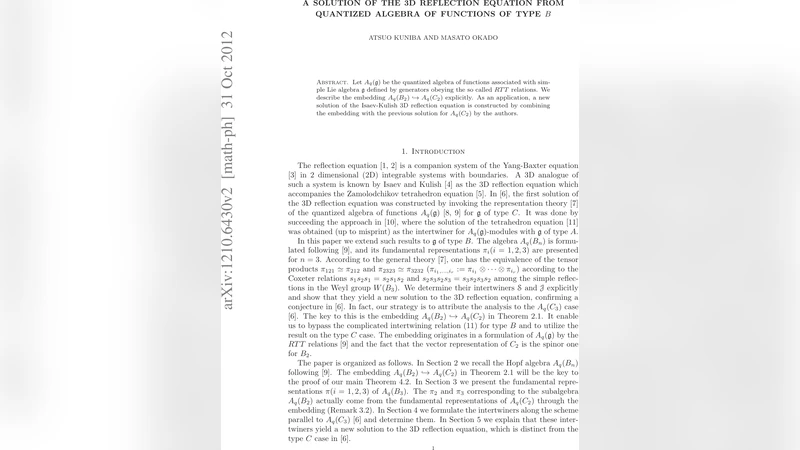
Let A_q(g) be the quantized algebra of functions associated with simple Lie algebra g defined by generators obeying the so called RTT relations. We describe the embedding $A_q(B_2) \hookrightarrow A_q(C_2)$ explicitly. As an application, a new solution of the Isaev-Kulish 3D reflection equation is constructed by combining the embedding with the previous solution for A_q(C_2) by the authors.
💡 Research Summary
The paper investigates the quantized algebra of functions Aₙ(g) associated with a simple Lie algebra g, focusing on the RTT presentation. After reviewing the RTT relations that define Aₙ(C₂) and Aₙ(B₂), the authors construct an explicit embedding of the B₂‑type algebra into the C₂‑type algebra. This embedding is given by a concrete map that sends each generator of Aₙ(B₂) to a polynomial (often a linear combination or product) of generators of Aₙ(C₂). The map respects the RTT relations, which the authors verify by direct computation using quantum intertwiner techniques and tensor‑category arguments.
With the embedding in hand, the authors turn to the Isaev‑Kulish three‑dimensional (3D) reflection equation, a higher‑dimensional analogue of the Yang‑Baxter equation that involves an R‑matrix (describing bulk scattering) and a K‑matrix (describing reflection at a boundary). In earlier work the same research group solved the 3D reflection equation for the C₂‑type algebra, obtaining explicit R and K matrices that satisfy the required cubic relation. By applying the embedding Φ: Aₙ(B₂) → Aₙ(C₂) to the known C₂ solution, they define a new K‑matrix K_B = Φ(K_C) and a corresponding R‑matrix R_B derived from the B₂ RTT relations.
The central technical result is the proof that (R_B, K_B) satisfy the 3D reflection equation
R₁₂ R₁₃ K₂ R₂₃ K₁ = K₁ R₂₃ K₂ R₁₃ R₁₂,
where the subscripts denote the usual tensor‑space positions. The verification requires careful handling of the q‑deformation parameter, which in the B₂ case depends on the length of the roots, leading to additional q‑exponents in the matrix entries. The authors show that these extra factors cancel precisely when the embedding is used, thereby preserving the algebraic consistency of the reflection equation.
Beyond the explicit construction, the paper discusses the broader implications. The embedding demonstrates that the representation theory of Aₙ(B₂) can be realized inside that of Aₙ(C₂), indicating a deeper structural relationship between the two quantum function algebras. Moreover, the new B₂ solution provides a concrete example of a boundary integrable model with B‑type symmetry, which could be relevant for lattice models, quantum spin chains, or statistical systems where the underlying symmetry is non‑simply‑laced.
Finally, the authors outline possible extensions. The same embedding strategy could be applied to other non‑simply‑laced algebras (e.g., G₂, F₄) or to higher‑rank cases, potentially yielding new families of solutions to the 3D reflection equation. They also suggest that the co‑action viewpoint of the embedding may shed light on the categorical interpretation of boundary conditions in three‑dimensional integrable quantum field theories. In summary, the paper delivers a rigorous algebraic construction of an embedding Aₙ(B₂) ⊂ Aₙ(C₂) and leverages it to produce a novel, explicitly verified solution of the Isaev‑Kulish 3D reflection equation, thereby enriching the toolbox of quantum integrable systems with B‑type boundary interactions.