Stability properties of some particle filters
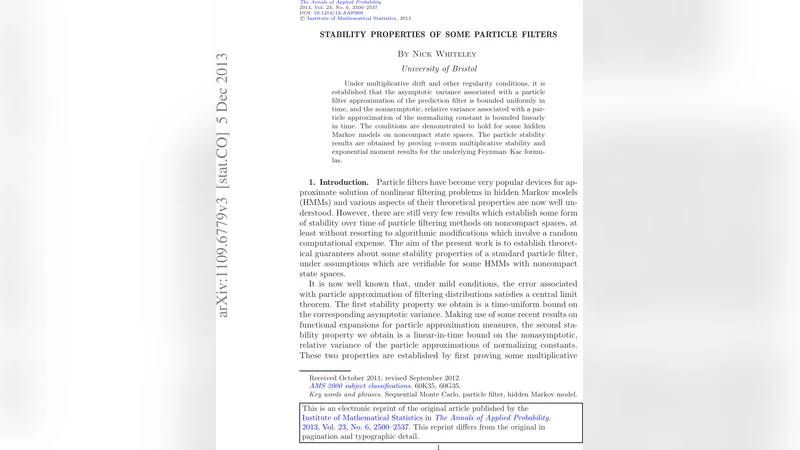
Under multiplicative drift and other regularity conditions, it is established that the asymptotic variance associated with a particle filter approximation of the prediction filter is bounded uniformly in time, and the nonasymptotic, relative variance associated with a particle approximation of the normalizing constant is bounded linearly in time. The conditions are demonstrated to hold for some hidden Markov models on noncompact state spaces. The particle stability results are obtained by proving $v$-norm multiplicative stability and exponential moment results for the underlying Feynman-Kac formulas.
💡 Research Summary
This paper addresses the long‑standing problem of establishing time‑uniform stability for particle filters (also known as Sequential Monte Carlo methods) when the underlying hidden Markov model (HMM) has a non‑compact state space. The authors introduce a novel analytical framework based on a multiplicative drift condition together with a weighted ‑norm (v‑norm) setting, which together allow them to prove two key stability results without relying on the strong mixing or compactness assumptions that dominate earlier work.
First, the authors consider the prediction filter πₙ, defined recursively by the standard Bayesian update equations for an HMM with transition kernel f and observation density g. Under a set of verifiable assumptions (labelled (H1)–(H5) in Section 4.2), they show that the asymptotic variance appearing in the central limit theorem (CLT) for the particle approximation πₙᴺ is uniformly bounded in time. More precisely, for any bounded test function φ, the variance σₙ²(y₀:ₙ₋₁) of √N(πₙᴺ(φ)−πₙ(φ)) satisfies
σₙ² ≤ Var_{πₙ}(φ) + ‖φ‖_∞² c_μ,
where c_μ depends only on the observation set Y* (a possibly compact subset of the observation space) and not on n. This result guarantees that, as the number of particles N grows, the Monte‑Carlo error does not deteriorate with the horizon, a property that is crucial for long‑run filtering applications such as tracking, finance, and signal processing.
Second, the paper studies the particle estimate Zₙᴺ of the normalising constant Zₙ (the likelihood of the observation sequence). The authors prove a linear‑in‑time bound for the relative variance:
E
Comments & Academic Discussion
Loading comments...
Leave a Comment