A Typology of Collaboration Platform Users
In this paper we present a review of the existing typologies of Internet service users. We zoom in on social networking services including blogs and crowdsourcing websites. Based on the results of the analysis of the considered typologies obtained by…
Authors: Anastasia Bezzubtseva, Dmitry I. Ignatov
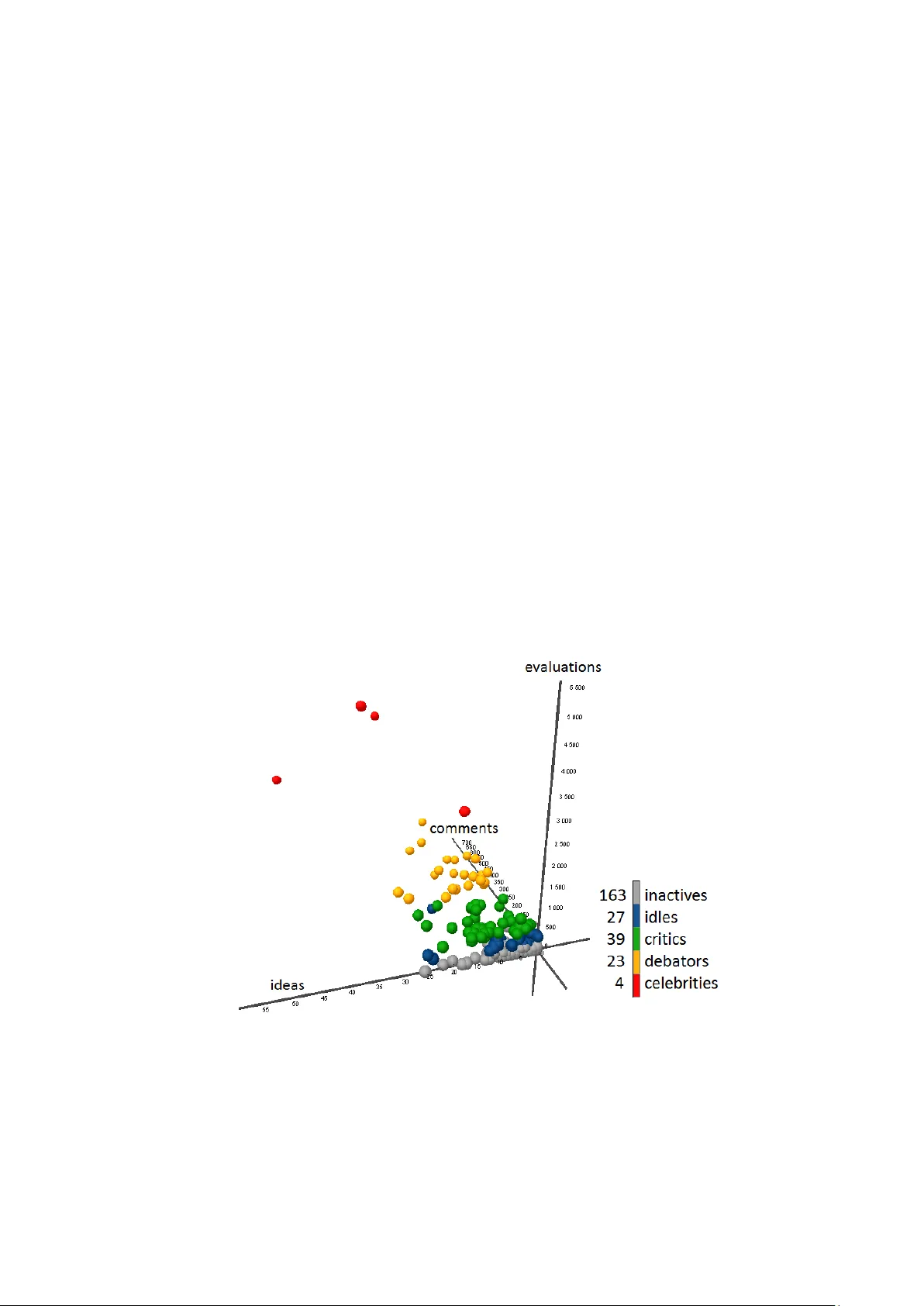
A Typology of C ollaboration Platf orm User s Anastasia Bezzubtseva 1,2 , Dmitry Ignatov 1 1 Higher School of Economics , Moscow , Russia 2 Witology, Moscow , Russia nstbezz@gmail.com, dignatov@hse.ru Abstract. In this paper we presen t a review of the existing typologies of Inte r- net service users. We zoom in on social n etworking services includ ing b logs and crowdsourcing w ebsites. Based on th e results of th e analysis of th e consi d- ered typologies obtained by means of FCA we developed a n ew user typology of a certain class of Internet ser vices, na mely a collaboratio n innovation pla t- form. Cluster anal ysis of data extracted from th e collaboration platform Witol o- gy w as used to d ivide m ore than 5 00 participants into 6 groups based on 3 a c- ti vity indicators: idea generation, commenting, and evaluation (assigning marks) The obtained groups and their percentage s app ear to follow th e “90 – 9 – 1” rule. Keywords. Crowdsourcing , typology classification , coll aborative platform , i n- novation , social network , comm unit y , blog. 1 Introduction Collaboration innovation plat forms are relatively young and less common than blogs or social networks (e.g ., co mp are [ 1 ] and [2 ]) , yet interest in their orga nization a nd audience is not decreasing. T he existing studies of co nsumer o r media behavior of Internet user s ca nnot be fully app lied to collaboration platform p articipants, while general psychological or so ciological typologies o f people miss many important fe a- tures, inherent only to networking a nd cro wdsourcing. For a certain t ype of social network services , i.e. the collab oration innovation pla t- forms, f inding user types pursues also s ome other objectives. Understanding u ser types could make a m ajor contribution in t he platform effectiveness. Fo r instance, dynamic particip ant t ype detectio n and disp laying are usef ul as a motivational game component, and the type itsel f will prob ably supple ment o r refine t he exiting rating systems. Also, infor mation about the amo unt of users o f di fferent groups could help platform moderators turn co mmunity life to a beneficial for invention direc tion. In t his study we pr esent a re view o f the existing Internet service user classific a- tions. Based on exa mined materials we atte mpted to develop a new typology of co l- laboration platform participan ts using d ata o f one of the proj ects of Russian i nnov a- tion platform Witology [ 10 ]. 10 A. Bezzubtseva et al. 2 Terminology In this paper we analyze not only collaborati on platforms, but also all other kinds o f social networking service s and Internet ser vices, as typolo gies of their users can be applied to p latform participa nts. T here is no fixed ter minology i n this area yet, but we will tr y to give so me definitio ns of the important concept s used in t he resear ch in order to clarify its subject. By Internet service we mean an y website that provides any k ind o f ser vice (e.g. blogs, file-sharing networks, chats, mu ltiplayer games, online shops) . Internet se r- vices which provide huma n interaction are referred to as Social Networking Services (SNS). The y incl ude social n etworks (Facebo ok, MySpace, last.fm, Linked In, Or kut), blogs (LiveJour nal, Tumblr, Twitter), wiki ( e.g., Wi kipedia), media hosting sites (Flickr, Picasa, Yo uTube) , etc . [ 3], [4]. Social networking services of ten generate online commu nities, i.e. groups of people, who share si milar interests a nd commun i- cate via a certain Internet ser vice. Some scientists [5], [ 6], [7] understand co mmunity in a wider sense as t he entire audience of so me social networking service , which is wrong, according to Michael Wu [8] . We kept the original author voca bularies when describing the typologies, in o ther cases the first d efinition of communit y was used. Crowdsourcing p latforms are social networking services which are used to o btain the neces sary services, id eas or content fro m platfor m p articipants, i .e. platfor m community, a s o pposed to regular staff o r vendor s [9 ] . Crowdsourcing (collabor a- tion) innovation platforms are the o nes which f ocus on idea generation. Activities on collaboration platfor ms often include message (idea or comment) posti ng, message reading and mes sage e valuation. The winning solutions and true e xperts are identified on the basis of the a mount a nd quality of suc h act ivities. W ork on the plat form usua l- ly goes as a certain time - limited pr oject, devoted to so me compan y’s pr oblem. Wito l- ogy [ 10 ], I maginatik [ 11 ], BrightIdea [ 12 ] and some other platforms are organized this way; though, there are many collab oration sites which are not alike (see li st [ 13 ] ). 3 Research objectives To begin a classification o f collaboratio n innovation platfo rm user s, we plan to pe r- form the following tasks: 1. Study of th e existing Internet service user typ ologies. The discovered user t ypes and data mining techniq ues might be helpful i n developing another t ypology. 2. Develop ing o f a n ew typolo gy o f co llaboration innovation platform. B y means of mathematical methods we plan to analyze data of one of the collaboratio n platfor m project and identify disti nct user types. 3. Comparison of the ob tained percentages with the o nes from existing studies. This might help to understand whether the co mmunity under an alysis is t ypical and to find out, w hether it can be improved (for example, by calculating community health index [ 14 ]) . A Typology of Collaboration Platf orm Users 11 4 Review of the existing typologies Despite the fact that th e online community bei ng a relati vely you ng phenomenon, te ns of attempts in clas sifying inter net users ha ve been undertaken. Some of the studies [ 15 ], [ 16 ], [ 17 ] explore o nly children ’s media -behavior, others [ 18 ] investigate beha v- ior in ter ms of o nline shopping. A signi ficant part of ear ly typolo gies (e.g. [ 19 ], [ 20 ] ) is developed based on frequency and variety of web and ne w gadgets use, which r e- sulted in rather tr ivial and sim ilar typologies (generall y p eop le were divided into “a d- vanced”, “average” and “non - users”, the three types were occasionally interspersed w ith “entertainment” a nd “functional” users). Almost half of the encountered researches used cluster anal ysis as means of e x- tracting user types, factor ana lysis appear ed to be the second m ost p opular method. Much more uncommon were regressio n analysis, qua litative in-depth a nalysis, graph mining, statistical analysi s, etc . Very fe w authors based on some so ciological or psychological theories or r eferred to the exis ting typologies when classifying internet ser vice users ( it can be explain ed by their desire to take a new look on the d ifferences in human behavior ). One of the studies (Nielsen, 2006) [7] is not o nly descriptive, but is considered informal, and in spite of that the classification and the “90 – 9 – 1” r ule are highly respected and po p u- lar. As for the user t ypologies of the communities, which organization is close to that of innovation p latforms, a no table p art of pap ers is devo ted to social network user behavior analys is, but t here are also so me studies o f beha vior o f blog and forum vi s i- tors. Since infor mation co ncerning be havior o f collabor ation platform participants has not b een found y et, several o f social network and blog studies might b e in teresting and useful as a basis for dev elopment of an o riginal class ification o f collabor ation platform users. F urther we describe those relevant typologies . 4.1 Describing user typ ologies Brandtz ᴂ g a nd H eim (201 0) . T he stud y [ 5] is a descriptive one, thou gh the li st o f existing theories and research p apers is gi ven in one of i ts sections. The results o f online survey of 4 No rway social networks users were subjected to cluster analysis. Spora dics visit social network fro m ti me to time, mainly to check if so mebody contacted them. Lurkers is the lar gest group, th ey do not create any co ntent, but consume and spread the content created by other groups. They are also notable for a pr opensity to time-killing. Socializers use social networks to co mmunicate, make new friends, comment o n photos of the old ones, po st congratulation messages on walls etc. Debaters ar e a mo re mature a nd educated version of sociali zers. Besides co mm u- nication, less shallow than i n the previous case, t hey are interested in co nsumption and discussion of news and o ther infor mation available in social networks. 12 A. Bezzubtseva et al. Actives are engaged with all possible types of activity: communication, reading, creating, watching, establis hing groups. Budak, Ag rawa l, Abbadi ( 2010) . T his paper [ 13 ] descr ibes the three t ypes o f p eople (presented in 2002 by Malcolm Gladwell [ 21 ]) in terms of graph theor y in context o f modern online communities (especiall y blogs). The p resence o f those peo ple, i n Gladwell’s opinion, is the main ca use of the reso unding popularit y o f so me in nov a- tions. Authors also introduce a new type (the T ranslat ors), which, along with the Sellers, more than other groups influences idea spr ead and success. Connecto rs are peo ple who easily make friends and, t hus, have a lot of them. Mavens are very informed due to their curiosity and like to s hare their knowledge. Salesmen , – it is natural for them to convince people and establish an e motional contact with them. Translators are “bridges” b etween different i nterest groups. T hey have the ab ility to in terpret ideas in a different way, so that more peo ple could understa nd and a c- cept them. Li, Bernoff , Fiorentino, and Glass (2007 ) present anothe r classification [ 25 ] wit h- out theoretical basis. Groups were extracted with the help of cluster anal ysis o f the poll values. Creators blog, publish video, maintain t heir o wn web -sites; usually belong to t he young generation. Critics select and choose useful media content; typicall y older than the pr evious group. Collectors are known for their ad diction to saving book marks on special ser vices. Joiners spend much time in so cial networks; the youngest group. Specta tors read blogs, watch video, listen to podca sts; main consumers of user - generated content. Inactives are not active in social services. Nielsen (200 6). In the stu dy [ 7 ] it is assu med that ac tive m embers of lar ge co mmun i- ties are very fe w. No spec ial mat hematical i nstruments were used to d evelop the t y- pology, althoug h the a uthor mentions that user acti vity follo ws Po wer law (in the Zip f curve variant). Lurkers (90 %) are those who only consume. Intermittent/spora dic contributor s (9%) are those wh o contribute rarely, occasio n- ally. Heavy co ntributors/active participants (1%) are responsib le for up to 9 0% o f community materials. Jepsen (2006) . T his is one of the few clas sifications [ 23 ] with a theoretical found a- tion (Kozinetz, 1999 ) [ 22 ]). The members o f Danish newsgroups were classified a c- cording to mean and median survey values. A Typology of Collaboration Platf orm Users 13 Tourists are not very interested in co mmunity content. Minglers are sociable people, who prefer not to consume the site’s content, but to communicate with o ther members. Devotees ar e compared to minglers more interested i n newsgro up materials than i n communication. Insiders b oth communicate an d consume information. Golder and Do nath (20 04). This is o ne m ore descriptive stu dy [ 24 ] which exa mined 16 unmoderated Usenet newsgroups. T he taxonomy was built after in -dep th analysis of the message posti ng frequency and message content. Celebrities ar e central co mmunity figures, contribute more than others. Newbies are new member s, which ask many que stions an d do not know ho w to act and communicate appr opriately. Lurkers are t hose who read d iscussions, but do not take par t in them. Flamers, Trolls, Ra nters – three subgroup s, members of which ar e notable for t heir negative behavior and love to conversatio n spoili ng. 4.2 Comparing user typ ologies Analysis of the me ntioned typologies resulted in an a ssumption that , despite so me significant differences in social networking ser vices, there is a universal set of user types. T hough, some sources claim that there could be no such a meta -typology [ 23 ], when others [6] make attempts in developi ng one. The resemblance of user types ca n be seen more clearly from table 1. Also so me insights could b e pro vided by a formal concept lattice, derived from the table (fig. 1). Rows o f the table represent th e user types described previo usly ( objects), columns are the releva nt t ypologies (attrib utes). Si milar classes were merged: thus, cla ss Activ e s of the table includes Active s ( Brandtzaeg & Hei m, 20 10), Active participants (Nie l- sen, 2006), I nsiders (Jepsen, 2006) , and Celebrities (Golder & Donath, 200 4). Table 1. Formal context (types as objects, typologies as attributes) Brandtzaeg & Heim (2010) Budak et al. (2010) Li et al. (2007) Nielsen (2006) Jepsen (2006) Golder & Donath (2004) Inactives 1 0 1 0 1 0 Lurkers 1 0 1 1 1 1 Socializers 1 1 1 0 1 0 Debators 1 0 1 0 0 0 Actives 1 0 0 1 1 1 Salesmen 0 1 0 0 0 0 Translators 0 1 0 0 0 0 14 A. Bezzubtseva et al. Collectors 0 0 1 0 0 0 Creators 0 1 1 1 0 0 Newbies 0 0 0 0 0 1 Negatives 0 0 0 0 0 1 Fig. 1. Formal concept lattice of user typologies (built in ConExp [ 24 ]) It ca n be assumed from t he picture that the three general classes of u sers at the bo ttom (Lurkers, Creators an d So cializers) and, perhaps, two or three impor tant, b ut less general classes (co ncepts) abo ve (Actives, Inactives, Deb ators) form a universal classification of social networking ser vice u sers. It can also be seen that three studies introduced fiv e ori ginal u ser classes (Negatives, Newbies, Collectors, Translators, Salesmen), which are less lik ely to b e found in a co mmunity. As for the typo logies, the one of Brandtzae g & Heim (2010) appears to be the most common. We built Duquenne-Guigues base for the co ntext and se lected the implications with support greater than 4: 1. supp = 4, Actives ==> Lurkers; 2. supp = 3, Inactives ==> Lurke rs Socializers; 3. supp = 3 , Lurkers Socializers ==> Inactives; 4. supp = 2, Debators == > Inactives Lurkers Socializer s. E.g., implication 1 can be read as “Each user t ypology wh ich contains Actives also contains Lurkers an d it is valid in 4 ca ses out of 6”. A Typology of Collaboration Platf orm Users 15 5 Typology construction and analysis 5.1 Data sa mple We used data o btained i n o ne of t he proj ects [ 25 ] of the coll aboration platform W ito l- ogy. It i ncludes q uantitative indicator s o f eac h of participan ts’ activity: the n umber of generated ideas, the number o f p osted co mments and the number of sub mitted evalu a- tions.There were also so me other types o f acti vities on t he platfor m, b ut t he me n- tioned ones are the most basic and easy to interpret. The project administrators and moderators were not co nsidered as a p art of a crowdsourcing community, so only 5 04 of all 519 registered platform users were sampled. 5.2 Analysis Initially we detected th ose participants, who never commented, evaluated or genera t- ed idea s. These 248 users were clearly not interested in the project (165 of the m nev er logged on the platform a fter the third da y of its work); thu s, they could be excluded from the further analysis. Then w e used clusteri ng algorithm (k -means [ 26 ]) to divide the sample based on several para meters. The results o f cluster analysis o f 256 objects are presented in fig.1 (we used XLST AT 20 11 [ 27 ] for t he anal ysis, and XLSTAT -3DPlot package for vi s- ualization). Fig. 2. Sample clustering (the nu mber of objects in each cluster is displayed to the le ft to the color scale) 16 A. Bezzubtseva et al. The first cluster (grey) rep resents t he par ticipants, wh o did not sho w much activit y in evaluation and co mmenting. Beca use of the difference i n orders of nu mbers of created ideas, co mments a nd evaluat ions, the participant s w ho seem to b e pro minent idea generators (created more than 10 ideas) ended up in this group. The seco nd cluster (b lue) differs from the first with slig htl y higher evaluatio n a c- tivity o f users. I t can be assumed that those people were interested in proj ect, but lacked m otivation for message posting. I t is reasonable to merge a certain part of t his cluster with the previous o ne. The third cluster (green) a s a wh ole is hard to char acterize. Its members are les s passive: the y may s kip id ea generation o r comment posting, but they al ways eval uate something. The fourth cluster ( yellow) is not far from the previous one in ter ms of evaluation activity, but the number of co mments is quite differen t. The last cluster (red ) is th e smalle st one. It consists of fo ur ab solute project lea d- ers, who to gether with some of the y ellow participants turned out to be win ners or winning ideas authors. For greater classification veracity the obtained cluster s wer e modified: some of the gre y, blue and gree n balls formed a new cla ss of creators, the rest of the blue joined the grey cluster; also, s ome minor rearr angements were made. 6 Results Table 2 represents the resulting user t ypes, t heir perce ntages, descriptions a nd equi v a- lents in other studies. Table 2. Types of collaboration platform W itology particip ants User type Number / % of objects Description User types of previous studies Celebrities 4 1% Outstanding users, champions. Actives [5], mavens [ 13 ], active participants [ 7], insiders [ 23 ], celebr ities [ 24 ] Debators 21 4% Those wh o co mment and evaluate activel y. Debators/socializer s [5], connectors/salesmen [ 13 ], active participants [7], minglers [ 23 ] Creators 20 4% Idea generators. Could be divided into t wo groups: energetic cre a- tors (6 users), who not only create, and soci o- pathic ones (14 users), Mavens [ 13 ], crea tors [ 25 ], active partic i- pants/sporadic contrib u- tors [7], insi d- ers/devotees [ 23 ] A Typology of Collaboration Platf orm Users 17 who comment or eva l- uate many times less. Critics 34 7% Those wh o evaluate b ut don’t meddle in discu s- sions. Critics/spectators [ 25 ], sporadic co ntributors [7] , lurkers [ 24 ] Tourists 177 35% Those wh o rarel y mak e attempts to participate . Sporadics/lurkers [5 ], spectators [ 25 ] , lurkers [7], tourists [ 23 ], ne w- bies/lurkers [ 24 ] Inactives 248 49% Those wh o do abs o- lutely nothing. Sporadics/lurkers [5 ], inactives[ 25 ], lurkers [7] , tourists [ 23 ] The developed typology and t ype perce ntages ca n be co mpared with two rather general typologies f rom the to p of the lattice ( fig. 1). T able 3 shows how t he si x cla s- ses of this research cor respond to their classes. Table 3. Comparison of different typologies class percentages Nielsen % Brandtz ᴂ g % This study % Active partic i- pants 1% Actives 18% Celebrity 5% Debators Sporadic co n- tributors 9% Debators 36% Creators 11% Socializers Critics Lurkers 90% Lurkers 46% Tourists 84% Sporadics Inactives Interestingly, the percentages in th e obtained typology are very close to th e ones in Nielsen typo logy. Brandtzᴂ g e xplains the di screpancy with t he “90 – 9 – 1 ” rule b y a relatively low popularit y o f Nor way social net works compared to YouTube o r Wi k- ipedia and b y smaller content creation barrier s, but such a n explanation i s n ot likely to be relevant for the given co ll aboration projec t. Nearly 9 0% of lurkers could be a c- counted for b y initiall y a sma ll interest of participant s to the work itsel f and a great curiosity to a ne w for Russia phenomenon, crowdsourcing, as means of some co mp a- ny’s gro wth and develop ment. Other reaso ns may also take place, but it seems to be difficult to identify the m witho ut several projects o r platforms comparison. 7 Conclusions During the pro cess of literatu re exploration it ap peared tha t there is no generally a c- cepted SNS user classificatio n or any spec ific collab oration platform p articipant t y- 18 A. Bezzubtseva et al. pology. B ased on the existing r elevant t ypologies of soci al net works, blog s, ne w s- groups users by m eans of cluster a nalysis we developed an o riginal collaboration platform t ypology. The six classes are so far not expecte d to b e suitable for other crowdsourcing communities. The percentages of classes follow the r ule “ 90 – 9 – 1”, according to which only a minor par t of the community is really active. Thus, all the research ob jectives were mainl y attained. 7.1 Future Wor k The d eveloped typology is f ar f rom being co mplete and fin al. On ly a s mall sample o f one o f the project w as analyzed, while dif ferent pro jects data comparison is expected to specify the classification greatly. Possible future work also includes the follo wing: Involving more d iverse i nformation on the project ( e.g. logs, qualitative values of user evaluations) . Using other methods (factor a nalysis, graph mining, mean analysis) of gro up dete c- tion or other clustering algor ithms . Finding special users (e. g. tro lls, flamers, flooders [ 24 ] ). Developing a class ification algorithm. Testing co nnection betwee n group members hip and de mographical factors (a ge, sex) or psychological test s results. Using special metrics to deter mine community healt h [ 14 ]. Judging b y the n umber of possible work improvement directions it can b e co n- cluded that t his paper is only a sm all test sally into the in vestigation of collaboration platform p articipants’ behavior, which d escribes only a static snapshot o f one pr oject and does not clai m to be indisputable and fundame ntal. Acknowledge ments . T his work was partiall y done during the mutual research pr oject between Witology an d Higher School of Economics (Project and s tudying group “Data Mining algorithms f or analysing Web forums of inno vation projects discussion” ). We would like to thank Jonas Po elmans for his suggestions for improving the paper. References 1. Prediction Markets, http ://wiki.witology.com/index.php/ Р ынки_предсказаний (in Ru s- sian) 2. The Growth of Social Media: An Infographic, http://www.searchenginejournal.com/the - growth- of -social-me dia- an -infograph ic/32788/ 3. Kelsey, T.: Social Networking Spaces: F rom Facebook to Twitter and Everyth ing In B e- tween. Springer-Verlag, 2010. 4. Boyd, D. M., El lison, N. B.: Social Network Sites: Definitio n, History, and Scholarship. Journal of Computer- Me diated Communication, 13 (1) (2007) (http://jcmc.indiana.edu/vol13/issue1/boyd.ellison.htm l ) A Typology of Collaboration Platf orm Users 19 5. Brandtzᴂg, P . B., Heim, J. A Typo logy of So cial Networking Sites Users. Interna-ti onal Journal of Web Based Communities 2011, 7 (1) . 6. B randtzᴂg, P. B. : Towards a unified m edia-user t ypology (MUT): a meta-analysis and re- view of the res earch literature on media-u ser typologies. Computers in Human Behaviour, 26 (5), 2010. 7. Nielsen, J. : Participation Inequality: En couraging More Users to Con tribute. Jakob Nie l- se n’s Alertbox, 9 October 2 006 ( 2006 ) (http://www.useit.com/alertbox/participation_inequality.html) 8. Community v s. Social Network , http://lithosphere.lit hium.com/t5/Building-Community- the-Platform/Community- vs -Social-Network/ba-p/5283 9. Crowdsourcing, http://wiki.witology.com/index.php/ Краудсорсинг 10. Witolo gy, http://witology.com/en (in Russian) 11. Imaginatik, htt p://www.imaginatik.com / 12. BrightId ea, http://www.brightidea.com/ 13. Open Innovation Cro wdsourcing Examples, http ://www.openinnovators.net/list-open- innovation-crowdsourcing-examples/ 14. Measurin g Community Health fo r Onlin e Communities. Commu nity Health Index White Paper. Lithium (2011) (http://pages.lithium.com/community-health-index.html) 15. Joh nson, G. M., Kulpa, A.: Dimensions of online behavior: Toward a user typology. C y- berPsychology & Behavior, 10 (6) (2007) 16. Hei m, J., Brand tzæg, P. B., Endestad, T., Kaare, B. H., Torgersen, L.: Children’s u s -age of media technologies and psychosocial factors. New Media & Society, 9(3) (2007) 17. Livingstone, S., Helsper, E.: Gradations in digital inclusion: Children, youn g people and the digital divide. New Media & Society, 9(4) (2007) 18. Barnes, S. J., Bauer, H., Neumann, M., and Huber, F.: Segmenting cy berspace: A cus to mer typology for the Internet. European Journal of Marketing, 41(1) (2007) 19. Selwyn, N., Gorard, S., Furlong, J.: Whose In ternet is it anyway? Explorin g adults (non)use of the internet in ev eryday life. European Journal of Communication, 20(1) (2005) 20. Hei m, J., Bran dtzæg, P. B. : Patterns of Media Usage and th e Non-Pro fessional Users. In Proc. o f the SIGCHI Co nference on Hu man factors in computing systems (CHI 200 7), San Jose, California, USA (2007) 21. Gladwell, M. The T ipping Po int: How L ittle Things Can Make a Big Diffe ren ce. — B ack Bay Books (2002) 22. Kozin ets, R. V. : E-Tribalized Marketing? The Strategic Implications of Virtual Commun i- ties of Consumption. European Management Journal, 17 (3) (1999) 23. Angeletou, S., Row e, M., A lani, H. : M odelling and A nalysis of User Behaviour in Online Communities. In .: P roc. of International Semantic Web Conf. (I SWC 2011), Bonn, Ge r- many (2011) 24. Co ncept Explorer, http://conexp.sourceforge.net/index.html 25. Sb erbank-21, http://sberbank21.ru/ 26. K-Means Clustering, http://home.dei.polimi.it/matteucc/Clustering/tutorial_html/km eans. html 27. X LSTAT , http ://www.xlstat.com/en/
Original Paper
Loading high-quality paper...
Comments & Academic Discussion
Loading comments...
Leave a Comment