Universal computably enumerable sets and initial segment prefix-free complexity
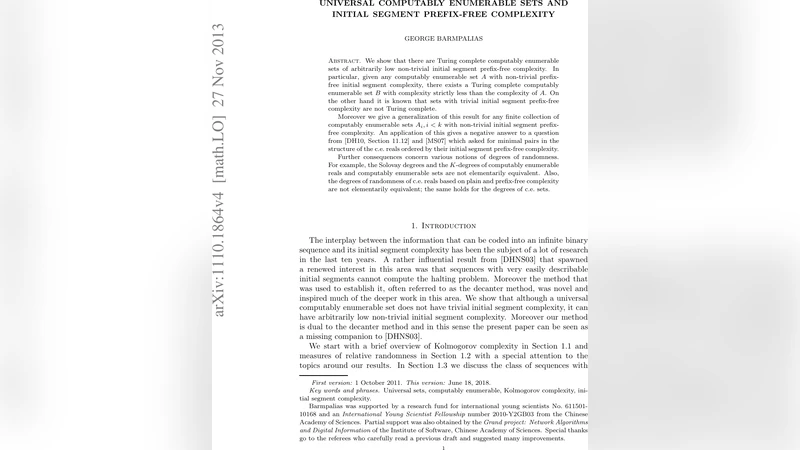
We show that there are Turing complete computably enumerable sets of arbitrarily low non-trivial initial segment prefix-free complexity. In particular, given any computably enumerable set $A$ with non-trivial prefix-free initial segment complexity, there exists a Turing complete computably enumerable set $B$ with complexity strictly less than the complexity of $A$. On the other hand it is known that sets with trivial initial segment prefix-free complexity are not Turing complete. Moreover we give a generalization of this result for any finite collection of computably enumerable sets $A_i, i<k$ with non-trivial initial segment prefix-free complexity. An application of this gives a negative answer to a question from \cite[Section 11.12]{rodenisbook} and \cite{MRmerstcdhdtd} which asked for minimal pairs in the structure of the c.e.\ reals ordered by their initial segment prefix-free complexity. Further consequences concern various notions of degrees of randomness. For example, the Solovay degrees and the $K$-degrees of computably enumerable reals and computably enumerable sets are not elementarily equivalent. Also, the degrees of randomness based on plain and prefix-free complexity are not elementarily equivalent; the same holds for their $\Delta^0_2$ and $\Sigma^0_1$ substructures.
💡 Research Summary
The paper investigates the relationship between initial‑segment prefix‑free Kolmogorov complexity (K‑complexity) and Turing completeness within the class of computably enumerable (c.e.) sets. Building on earlier work that showed K‑trivial c.e. sets (those whose initial segments satisfy K(A↾n) ≤ K(n)+O(1)) cannot compute the halting problem, the author asks how low the K‑complexity of a Turing‑complete c.e. set can be if the set is not K‑trivial.
The first main theorem states that for any non‑K‑trivial c.e. set A there exists a c.e. set B such that B ≡_T ∅′ (i.e., B is Turing‑equivalent to the halting problem) and B is strictly lower than A in the K‑degree ordering (B <_K A). The construction uses a novel “complexity‑absorption” technique that is dual to the decanter method of earlier papers. While the decanter method exploits low complexity to prove limitations, here the author exploits the high complexity of A to encode the complete information of ∅′ into B in a way that keeps B’s initial‑segment complexity uniformly below that of A. The construction interleaves the enumeration of A with the requirements for coding ∅′, employing a priority argument that guarantees each requirement is eventually satisfied while the extra bits added to B never raise its K‑complexity beyond the bound set by A.
The second theorem generalises the result to any finite collection of non‑K‑trivial c.e. sets A₁,…,A_k. It shows that there is a single c.e. set B, again Turing‑equivalent to ∅′, that is simultaneously lower than each A_i in the K‑degree ordering. The proof must synchronise the “complexity spikes’’ of the various A_i’s; the author achieves this by assigning separate priority requirements for each A_i and resolving conflicts by favouring the set whose complexity currently exceeds the others. This ensures that at the moments when any A_i’s complexity rises, B can absorb the extra information without exceeding the current bound for any other A_j.
These theorems have several important consequences. First, they settle an open question (raised in Downey–Hirschfeldt’s book and by Merkle–Stephan) concerning the existence of minimal pairs in the structure of K‑degrees of c.e. reals. The paper proves that no such minimal pair exists: for any two c.e. reals there is a third c.e. real that is K‑below both, contradicting the definition of a minimal pair. Consequently, the K‑degree structure of c.e. sets (or c.e. reals) is dense in a strong sense.
Second, the results separate several degree structures. The Solovay degrees (based on Solovay reducibility) and the K‑degrees of c.e. reals are shown not to be elementarily equivalent; likewise the C‑degrees (based on plain Kolmogorov complexity) differ from the K‑degrees. Moreover, randomness notions derived from K‑complexity and from plain complexity are not elementarily equivalent even when restricted to Δ⁰₂ or Σ⁰₁ objects.
Third, the paper connects with recent work on “low‑initial‑segment complexity relative to an oracle” (the K_A complexity studied by Herbert). The constructions illustrate that one can obtain reals A for which K(n) ≤ K_A(n)+f(n)+c with f a slowly growing function, extending the notion of K‑triviality.
Methodologically, the paper introduces a priority‑based coding scheme that carefully balances two competing goals: (i) ensuring that B computes ∅′, and (ii) keeping K(B↾n) ≤ K(A↾n)−c (or ≤ min_i K(A_i↾n)−c_i) for all n. The key technical device is the function g_A(n)=K(A↾n)−K(n), which measures the excess complexity of A over the trivial lower bound. Although g_A(n) is unbounded, it returns arbitrarily close to zero infinitely often; the construction exploits these “trivial windows’’ to insert coding bits with negligible impact on K‑complexity. By arranging the coding to occur precisely during such windows, the author guarantees the desired uniform bound.
In summary, the paper demonstrates that high‑complexity c.e. sets can be harnessed to produce Turing‑complete c.e. sets of arbitrarily low non‑trivial K‑complexity, that this phenomenon extends to any finite family of c.e. sets, and that the resulting degree‑theoretic landscape is richer and more intricate than previously known. The work resolves longstanding open problems about minimal pairs in K‑degrees of c.e. reals and clarifies the separations between various randomness‑related degree structures.
Comments & Academic Discussion
Loading comments...
Leave a Comment