The non-Urysohn number of a topological space
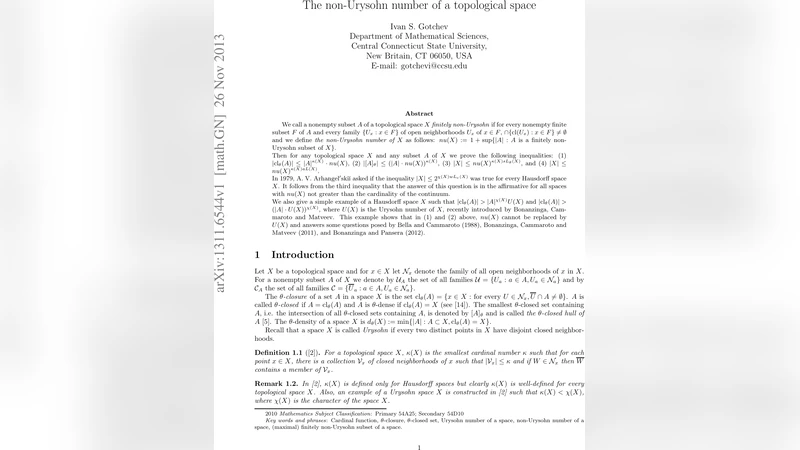
We call a nonempty subset $A$ of a topological space $X$ finitely non-Urysohn if for every nonempty finite subset $F$ of $A$ and every family ${U_x:x\in F}$ of open neighborhoods $U_x$ of $x\in F$, $\cap{\mathrm{cl}(U_x):x\in F}\ne\emptyset$ and we define the non-Urysohn number of $X$ as follows: $nu(X):=1+\sup{|A|:A$ is a finitely non-Urysohn subset of $X}$. Then for any topological space $X$ and any subset $A$ of $X$ we prove the following inequalities: (1) $|\mathrm{cl}\theta(A)|\le |A|^{\kappa(X)}\cdot nu(X)$, (2) $|[A]\theta|\le (|A|\cdot nu(X))^{\kappa(X)}$, (3) $|X|\le nu(X)^{\kappa(X)sL_\theta(X)}$, and (4) $|X|\le nu(X)^{\kappa(X)aL(X)}$. In 1979, A. V. Arhangelskii asked if the inequality $|X|\le 2^{\chi(X)wL_c(X)}$ was true for every Hausdorff space $X$. It follows from the third inequality that the answer of this question is in the affirmative for all spaces with $nu(X)$ not greater than the cardinality of the continuum. We also give a simple example of a Hausdorff space $X$ such that $|\mathrm{cl}\theta(A)|>|A|^{\chi(X)}U(X)$ and $|\mathrm{cl}\theta(A)|>(|A|\cdot U(X))^{\chi(X)}$, where $U(X)$ is the Urysohn number of $X$, recently introduced by Bonanzinga, Cammaroto and Matveev. This example shows that in (1) and (2) above, $nu(X)$ cannot be replaced by $U(X)$ and answers some questions posed by Bella and Cammaroto (1988), Bonanzinga, Cammaroto and Matveev (2011), and Bonanzinga and Pansera (2012).
💡 Research Summary
The paper introduces a new cardinal invariant of a topological space, called the non‑Urysohn number (nu(X)), and uses it to obtain sharp cardinal bounds for (\theta)-closures, (\theta)-closed hulls, and the whole space.
A non‑empty set (A\subset X) is defined to be finitely non‑Urysohn if for every non‑empty finite subset (F\subset A) and every choice of open neighbourhoods ({U_x:x\in F}) one has (\bigcap_{x\in F}\operatorname{cl}(U_x)\neq\varnothing). A maximal such set is called a maximal finitely non‑Urysohn subset. The non‑Urysohn number is then
\
Comments & Academic Discussion
Loading comments...
Leave a Comment