On Lobachevskys trigonometric formulae
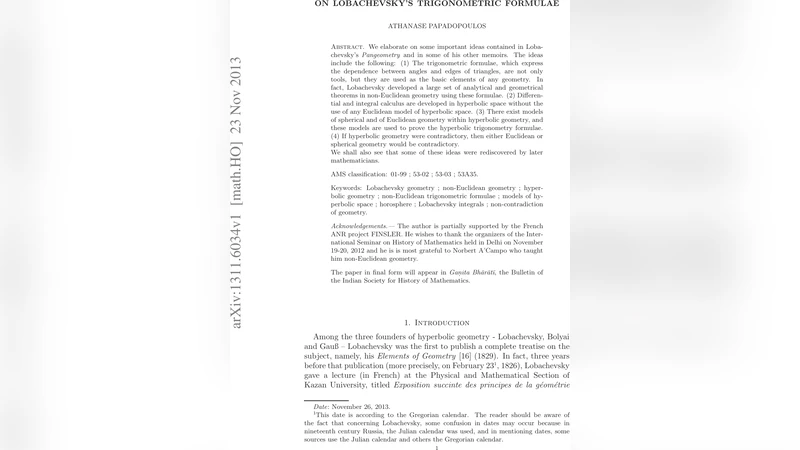
We elaborate on some important ideas contained in Lobachevsky’s Pangeometry and in some of his other memoirs. The ideas include the following: (1) The trigonometric formulae, which express the dependence between angles and edges of triangles, are not only tools, but they are used as the basic elements of any geometry. In fact, Lobachevsky developed a large set of analytical and geometrical theorems in non-Euclidean geometry using these formulae. (2) Differential and integral calculus are developed in hyperbolic space without the use of any Euclidean model of hyperbolic space. (3) There exist models of spherical and of Euclidean geometry within hyperbolic geometry, and these models are used to prove the hyperbolic trigonometry formulae. (4) If hyperbolic geometry were contradictory, then either Euclidean or spherical geometry would be contradictory. We shall also see that some of these ideas were rediscovered by later mathematicians.
💡 Research Summary
The paper provides a comprehensive historical and mathematical analysis of Nikolai Lobachevsky’s trigonometric formulae and their central role in the development of non‑Euclidean (hyperbolic) geometry. Beginning with Lobachevsky’s 1826 lecture at Kazan University and his 1829 “Elements of Geometry,” the author traces the evolution of Lobachevsky’s ideas through later memoirs such as the “New Elements,” “Imaginary Geometry,” and the culminating “Pangeometry.”
A key thesis is that Lobachevsky treated the trigonometric relations among the three sides and three angles of a triangle not merely as computational tools but as foundational axioms from which all other results in hyperbolic geometry can be derived. The paper shows how he derived the basic hyperbolic cosine law, (\cosh c = \cosh a \cosh b - \sinh a \sinh b \cos C), and then used these identities to develop a full differential and integral calculus entirely within hyperbolic space, without invoking any Euclidean model. In particular, Lobachevsky defined distances and angles intrinsically, obtained area elements such as (dA = \sinh r,dr,d\theta), and computed volumes of hyperbolic polyhedra, anticipating later work on curvature integrals and convexity.
The paper also details Lobachevsky’s construction of spherical and Euclidean models inside hyperbolic space. By embedding a geometric sphere in three‑dimensional hyperbolic space and defining “great‑circle” arcs as intersections with hyperbolic planes through the sphere’s centre, he showed that the usual spherical trigonometric formulae (e.g., (\sin a \sin B = \sin b \sin A), etc.) hold unchanged. This provides an intrinsic proof that spherical geometry can be realized as a sub‑geometry of hyperbolic geometry, a model‑theoretic insight that predates Beltrami’s 1868 model.
A further philosophical point is Lobachevsky’s claim that if hyperbolic geometry were contradictory, then Euclidean or spherical geometry would also be contradictory. This argument, based on the existence of Euclidean and spherical models within hyperbolic space, anticipates modern notions of relative consistency in axiomatic systems.
The author then surveys how these ideas were rediscovered and expanded by later mathematicians. Beltrami introduced the first explicit Euclidean model of hyperbolic geometry; Klein’s projective model unified Euclidean, spherical, and hyperbolic geometries; Poincaré’s disk model gave an analytic representation. In the 20th century, Coxeter revived Lobachevsky’s volume formulas for hyperbolic polyhedra, and Thurston employed them in his work on three‑manifolds, confirming the lasting relevance of Lobachevsky’s integral identities.
Finally, the paper emphasizes Lobachevsky’s linguistic and cultural challenges—writing in Russian, French, and German—to reach a Western audience, and argues that his trigonometric‑centric approach constitutes a structural shift in mathematical thinking. The trigonometric formulae are presented not as peripheral calculations but as the core logical engine of hyperbolic geometry, influencing modern differential geometry, topology, and even theoretical physics (e.g., models of spacetime with constant negative curvature). The paper concludes that Lobachevsky’s work remains a living foundation rather than a historical curiosity.
Comments & Academic Discussion
Loading comments...
Leave a Comment