Langevin Thermostat for Rigid Body Dynamics
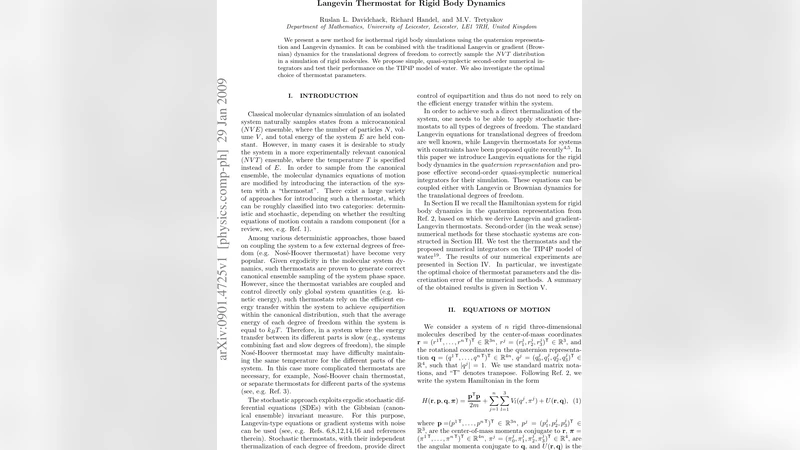
We present a new method for isothermal rigid body simulations using the quaternion representation and Langevin dynamics. It can be combined with the traditional Langevin or gradient (Brownian) dynamics for the translational degrees of freedom to correctly sample the NVT distribution in a simulation of rigid molecules. We propose simple, quasi-symplectic second-order numerical integrators and test their performance on the TIP4P model of water. We also investigate the optimal choice of thermostat parameters.
💡 Research Summary
The paper introduces a novel Langevin thermostat specifically designed for rigid‑body molecular dynamics, employing quaternions to represent rotational degrees of freedom. Traditional approaches that use Euler angles or rotation matrices suffer from singularities and numerical instability, especially when coupled with stochastic temperature control. By formulating the rotational dynamics directly in quaternion space, the authors avoid these pitfalls and embed both friction and Gaussian white‑noise terms into the quaternion differential equations while preserving the unit‑norm constraint. The stochastic forcing obeys the fluctuation‑dissipation relation σ² = 2 γ kBT, ensuring that the combined translational and rotational dynamics sample the canonical NVT ensemble exactly.
Two quasi‑symplectic second‑order integrators are derived: an “ABOBA” scheme (friction‑noise → translational/rotational update → half‑step drift) and a “BAOAB” variant (friction‑noise split before and after the drift). Both schemes explicitly renormalize the quaternion after each stochastic step, preventing drift of the norm and maintaining the geometric structure of the underlying Hamiltonian flow. The integrators retain the favorable energy‑conserving properties of symplectic methods for the deterministic part while treating the stochastic part in a time‑reversible fashion, which reduces bias in configurational sampling.
The methodology is validated on the TIP4P water model, a standard benchmark for rigid‑molecule simulations. A systematic parameter sweep over the friction coefficient γ (and consequently σ) is performed. Key observables—temperature fluctuations, radial distribution functions, angular distribution, and diffusion coefficients—are compared against results obtained with a conventional Langevin thermostat applied only to translational motion. The quaternion‑based thermostat reproduces structural and dynamical properties with comparable or improved accuracy, while exhibiting faster convergence of temperature and reduced high‑frequency noise in the energy trajectory. When combined with a gradient (Brownian) dynamics scheme for translation, the approach still yields correct NVT statistics, demonstrating its flexibility.
A practical guideline for choosing γ emerges from the analysis. The authors find that a friction coefficient slightly larger than the critical damping value (γ ≈ 2√(k/m)) provides the best trade‑off between rapid equilibration and efficient phase‑space exploration. Larger γ values overly damp the dynamics, leading to sluggish sampling, whereas smaller γ values allow excessive kinetic energy fluctuations and slower temperature relaxation. Because σ is linked to γ through the fluctuation‑dissipation theorem, only γ needs to be tuned in practice.
In summary, the work delivers a theoretically sound and computationally efficient framework for stochastic temperature control of rigid bodies. By leveraging quaternion algebra, the proposed Langevin thermostat eliminates singularities, preserves geometric structure, and integrates seamlessly with existing translational thermostats. The quasi‑symplectic second‑order integrators ensure high accuracy and stability, making the method attractive for a wide range of applications, from aqueous solutions and biomolecular complexes to coarse‑grained materials where rigid‑body approximations are common. The paper’s thorough performance assessment and clear recommendations for thermostat parameters provide a ready‑to‑use tool for researchers seeking reliable NVT sampling of rigid‑molecule systems.
Comments & Academic Discussion
Loading comments...
Leave a Comment