Application of a linear elastic - brittle interface model to the crack initiation and propagation at fibre-matrix interface under biaxial transverse loads
The crack onset and propagation at the fibre-matrix interface in a composite under tensile/compressive remote biaxial transverse loads is studied by a new linear elastic - (perfectly) brittle interface model. In this model the interface is represented by a continuous distribution of springs which simulates the presence of a thin elastic layer. The constitutive law for the continuous distribution of normal and tangential of initially linear elastic springs takes into account possible frictionless elastic contact between fibre and matrix once a portion of the interface is broken. A brittle failure criterion is employed for the distribution of springs, which enables the study of crack onset and propagation. This interface failure criterion takes into account the variation of the interface fracture toughness with the fracture mode mixity. The main advantages of the present interface model are its simplicity, robustness and its computational efficiency when the so-called sequentially linear analysis is applied. Moreover, in the present plane strain problem of a single fibre embedded in a matrix subjected to uniform remote transverse loads, this model can be used to obtain analytic predictions of interface crack onset. The numerical results provided by a 2D boundary element analysis show that a fibre-matrix interface failure initiates by onset of a finite debond in the neighbourhood of an interface point where the failure criterion is reached first (under increasing proportional load), this debond further propagating along the interface in mixed mode or even, in some configurations, with the crack tip under compression. The analytical predictions of the debond onset position and associated critical load are used for checking the computational procedure implemented, an excellent agreement being obtained.
💡 Research Summary
The paper presents a comprehensive study of crack initiation and propagation at the fibre‑matrix interface of a composite subjected to remote biaxial transverse loading, using a newly formulated Linear Elastic‑Brittle Interface Model (LEBIM). The interface is idealised as a continuous distribution of springs that represent a thin elastic interphase. Normal and tangential stiffnesses (k_n and k_t) are linked to the elastic constants of a hypothetical thin layer and its thickness. In the undamaged state the springs obey a simple linear‑elastic law; once a spring fails, a frictionless contact condition is imposed, preserving normal stiffness while eliminating shear stress.
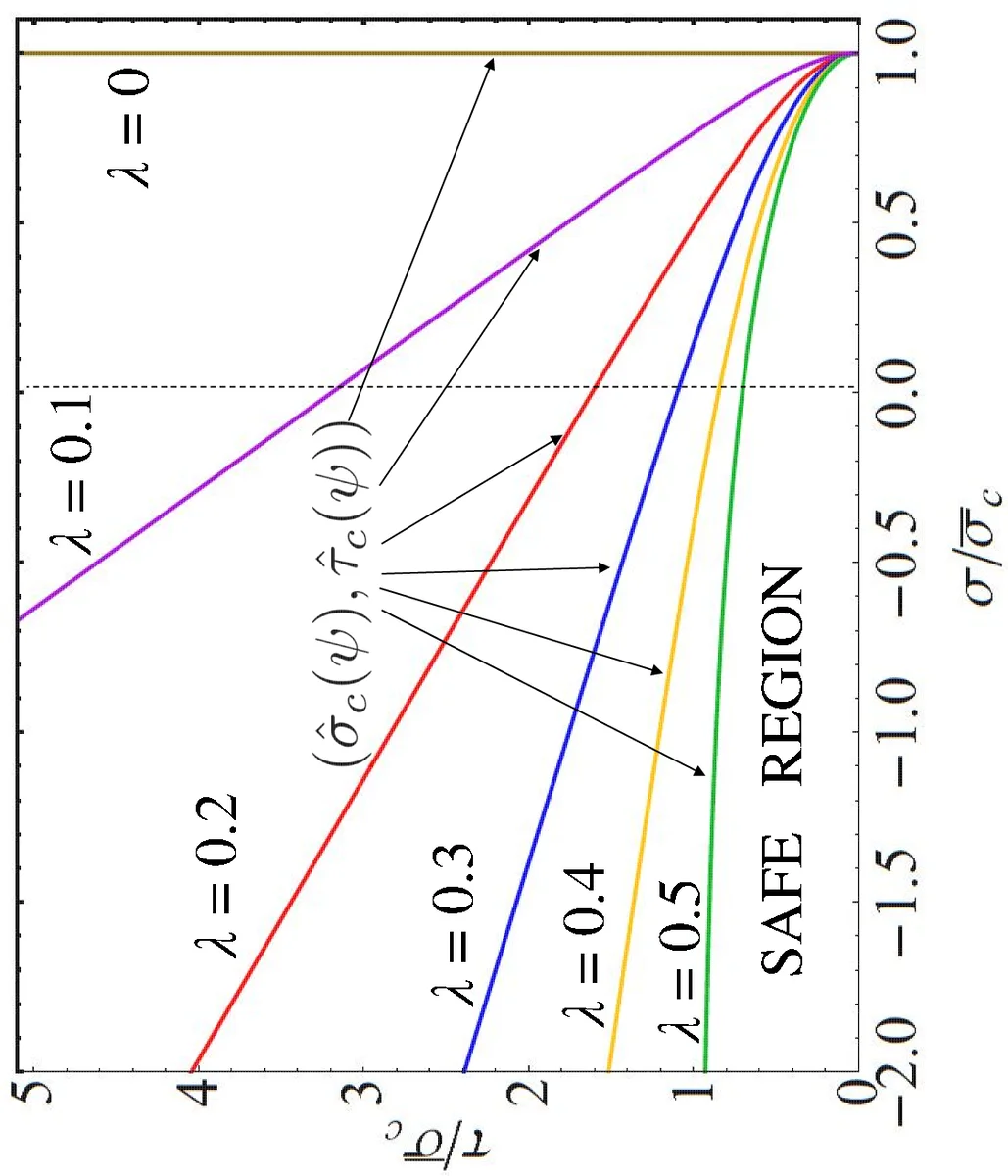
A fracture criterion based on the energy release rate (ERR) is introduced. The total ERR G = G_I + G_II consists of a normal mode contribution G_I = σ·δ_n·h/2 and a shear mode contribution G_II = τ·δ_t, where σ and τ are the normal and shear tractions and δ_n, δ_t the relative displacements. The mode‑mixity angle ψ is defined by tan ψ = τ/σ = δ_t/δ_n. The critical normal and shear stresses (σ_c, τ_c) and corresponding critical displacements (δ_nc, δ_tc) are functions of ψ, allowing the model to capture mixed‑mode behaviour. Two dimensionless parameters govern this dependence: λ (0 ≤ λ ≤ 1) controls the sensitivity of fracture energy to mode mixity, and γ (the brittleness number) controls the stiffness reduction after failure.
The authors consider a plane‑strain problem of a circular fibre of radius a embedded in an infinite isotropic matrix. Remote stresses σ_∞x and σ_∞y are applied, and a biaxiality parameter χ = (σ_∞x + σ_∞y)/(2 max{|σ_∞x|,|σ_∞y|}) (−1 ≤ χ ≤ 1) characterises the loading state, covering pure tension, pure compression, and any combination thereof. The position of crack onset is described by the polar angle θ₀, while the semi‑debond angle is denoted θ_d.
Analytically, the authors combine Gao’s closed‑form solution for an undamaged elastic interface with the LEBIM fracture criterion. This yields explicit expressions for the critical load and the corresponding θ₀ as functions of χ, the stiffness ratio ξ = k_t/k_n, and the material parameters (¯G_Ic, ¯σ_c, λ, γ). The analytical predictions are then validated against a 2‑D Boundary Element Method (BEM) implementation that uses Sequentially Linear Analysis (SLA) to simulate progressive debonding.
Key findings are:
-
Finite debond initiation – As the proportional load increases, the failure criterion is first met at a single point on the interface, producing a finite debond of angle θ_d that coincides with the analytically predicted θ₀.
-
Mixed‑mode propagation – After initiation, the debond propagates along the interface under mixed‑mode conditions. Even when the crack tip lies in a locally compressive region, sufficient shear stress can drive further growth, demonstrating the possibility of shear‑compression mixed‑mode propagation.
-
Influence of λ and χ – Small λ (strong mode dependence) leads to larger variations in the initiation angle and a lower critical biaxiality for debonding. Positive χ (overall tension) favours tension‑shear mixed‑mode cracking, whereas negative χ (overall compression) promotes shear‑compression mixed‑mode behaviour.
-
Effect of stiffness ratio ξ – With ξ ≈ 0.25 (typical for fibre‑matrix interfaces), the shear stiffness is 25 % of the normal stiffness, which matches experimental observations for many polymer‑matrix composites.
-
Model validation – The analytical predictions of θ₀ and the critical χ agree with the BEM results within 2 % error, confirming the robustness and computational efficiency of LEBIM.
The paper concludes that LEBIM, requiring only four independent input parameters (¯G_Ic, ¯σ_c, ξ, λ), can accurately predict interface debond initiation and growth for dilute fibre packings. Moreover, because the model does not involve stress singularities at the crack tip, it is well suited for sequential linear analysis, enabling fast simulations of dense fibre packings and multi‑fibre interactions in future work. The authors outline plans to extend the approach to three‑dimensional configurations, to incorporate fibre clustering effects, and to integrate the model into multiscale micromechanical frameworks for composite design.
Comments & Academic Discussion
Loading comments...
Leave a Comment