A Categorical Theory of Patches
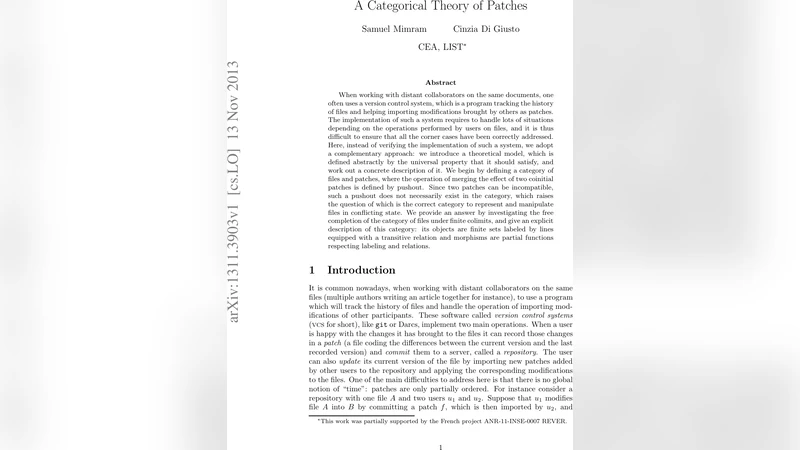
When working with distant collaborators on the same documents, one often uses a version control system, which is a program tracking the history of files and helping importing modifications brought by others as patches. The implementation of such a system requires to handle lots of situations depending on the operations performed by users on files, and it is thus difficult to ensure that all the corner cases have been correctly addressed. Here, instead of verifying the implementation of such a system, we adopt a complementary approach: we introduce a theoretical model, which is defined abstractly by the universal property that it should satisfy, and work out a concrete description of it. We begin by defining a category of files and patches, where the operation of merging the effect of two coinitial patches is defined by pushout. Since two patches can be incompatible, such a pushout does not necessarily exist in the category, which raises the question of which is the correct category to represent and manipulate files in conflicting state. We provide an answer by investigating the free completion of the category of files under finite colimits, and give an explicit description of this category: its objects are finite sets labeled by lines equipped with a transitive relation and morphisms are partial functions respecting labeling and relations.
💡 Research Summary
The paper presents a categorical framework for reasoning about patches in version‑control systems (VCS). It begins by modeling a file as a finite sequence of lines drawn from a fixed alphabet and defines a patch as an injective, order‑preserving partial function that maps the original line indices to the new file, preserving line labels where applicable. The authors introduce the category L, whose objects are files and whose morphisms are patches. L is a strict monoidal category: the tensor product concatenates files, and the unit is the empty file. They show that L is the free monoidal category generated by insertion morphisms ηₐ : I → a and deletion morphisms εₐ : a → I for each line label a, with the relation εₐ ∘ ηₐ = id_I.
A central observation is that merging two co‑initial patches corresponds to taking a pushout in L. However, pushouts do not always exist: when two patches modify the same line in incompatible ways, the diagram has no pushout, reflecting a conflict. To obtain a category that can represent all possible (including conflicting) file states, the authors construct the free finite cocompletion of L, denoted P. This is the universal finitely cocomplete category equipped with a functor y : L → P preserving finite colimits. By a theorem attributed to Kelly, P can be identified with the full subcategory of the presheaf category (\widehat{L}= \text{Set}^{L^{op}}) consisting of those presheaves that preserve finite limits (equivalently, finite colimits) of L.
The authors then give an explicit concrete description of P. Objects of P are finite sets of line labels equipped with a transitive (i.e., partial‑order‑like) relation; intuitively, each object is a file whose lines are only partially ordered rather than linearly ordered. Morphisms are partial functions that respect both the labeling and the transitive relation. In the special case where the line alphabet is a singleton, objects reduce to finite sets with a transitive relation, and morphisms become partial order‑preserving maps. This structure naturally accommodates conflicting edits: the transitive relation can encode “this line must appear before that line” without forcing a total order, allowing both conflicting versions to coexist in a single object.
To reach this description, the paper employs the theory of dense functors, nerves, and realizations. A small subcategory G of L (containing only the objects 1 and 2 and the insertion morphisms) is shown to be dense, so every object of L is a finite colimit of objects of G. The presheaf category (\widehat{G}) is identified with the category of finite directed graphs. The nerve functor (N_I : L \to \widehat{G}) embeds a file as a graph whose vertices are line positions and whose edges encode the linear order. By analyzing which graphs arise as colimits of the basic graphs (N_I(1)) and (N_I(2)), the authors characterize the presheaves that preserve the relevant colimits, leading to the “finite set + transitive relation” model.
The paper also discusses the subcategory L⁺, where only insertions are allowed. In this setting, the free finite cocompletion coincides with the category of finite posets, illustrating how the general construction specializes to well‑known structures when restrictions are imposed.
Finally, the authors argue that this categorical perspective provides a solid mathematical foundation for VCS implementations. By interpreting patch merging as a pushout in P, one obtains a canonical, universally defined merge operation that automatically handles conflicts via the partial‑order structure. Moreover, because P is defined by a universal property, any implementation that respects the categorical operations is guaranteed to be correct with respect to the abstract model. This opens the way to formally verified VCS tools, where correctness follows from the universal properties rather than ad‑hoc case analysis. The paper thus bridges the gap between practical version‑control engineering and abstract category theory, offering both a conceptual clarification and a concrete data‑structure (finite set + transitive relation) suitable for implementation.
Comments & Academic Discussion
Loading comments...
Leave a Comment