Topological constraints on magnetic field relaxation
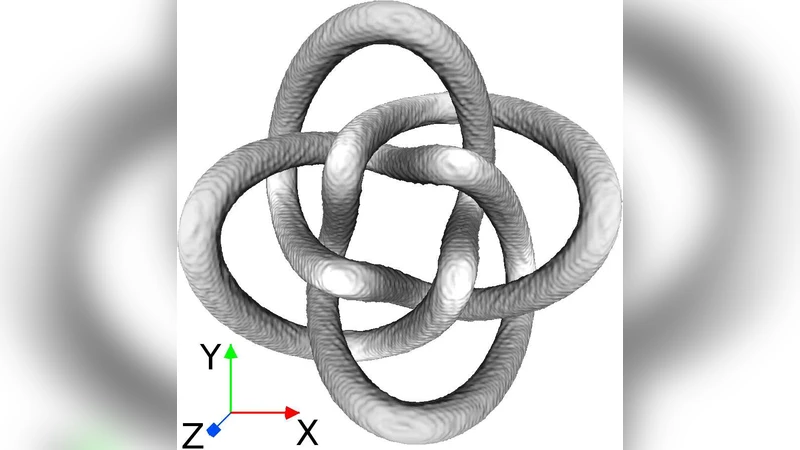
Magnetic field relaxation is determined by both the field’s geometry and its topology. For relaxation processes, however, it turns out that its topology is a much more stringent constraint. As quantifier for the topology we use magnetic helicity and test whether it is a stronger condition than the linking of field lines. Further, we search for evidence of other topological invariants, which give rise to further restrictions in the field’s relaxation. We find that magnetic helicity is the sole determinant in most cases. Nevertheless, we see evidence for restrictions not captured through magnetic helicity.
💡 Research Summary
The paper investigates how the topology of a magnetic field constrains its relaxation, focusing on magnetic helicity as the primary quantitative measure of topology. The authors begin by reviewing the traditional view that geometric properties such as field‑line linking and twist influence relaxation, but they argue that these geometric descriptors are not conserved in resistive magnetohydrodynamics (MHD) and therefore cannot serve as robust constraints. Magnetic helicity, defined as H = ∫ A·B dV, is a global invariant in ideal MHD and encapsulates both linking between distinct flux tubes and self‑linking (twist) of individual tubes. The central hypothesis is that helicity imposes a stricter, more universal restriction on the final relaxed state than the simple linking number.
To test this hypothesis, the authors design a series of three‑dimensional resistive MHD simulations with varied initial topologies. Four families of initial conditions are employed: (a) a high‑helicity, high‑linking toroidal knot; (b) a configuration with the same helicity but low linking, achieved by redistributing twist among multiple tubes; (c) a low‑helicity, highly tangled random field; and (d) a near‑zero helicity field with a complex knot structure. For each case, resistivity (η) and viscosity (ν) are systematically varied to explore different dissipation regimes. The simulations track magnetic energy, helicity, linking number, and a set of higher‑order topological invariants (e.g., chain complexity, higher‑order linking numbers) throughout the relaxation process.
The results fall into two clear regimes. In the non‑zero helicity runs, the final magnetic energy and large‑scale structure are dictated almost exclusively by the initial helicity value. Even when the linking number changes dramatically during the evolution, the system settles into a relaxed state that preserves the initial helicity and exhibits a toroidal geometry reminiscent of the original configuration. This demonstrates that helicity is a more powerful constraint than the linking number alone. Conversely, in the near‑zero helicity runs, the authors observe that certain knot features persist despite the lack of helicity conservation. These residual structures correlate with non‑trivial values of higher‑order topological invariants, suggesting that additional, helicity‑independent constraints can influence relaxation. The paper discusses possible interpretations, including the role of magnetic reconnection pathways that are sensitive to the detailed knotting of field lines.
In the discussion, the authors extrapolate their findings to astrophysical and laboratory contexts. For solar coronal dynamics, the results imply that helicity injection by photospheric motions largely determines the energy release in flares, but complex braiding may introduce secondary constraints that affect reconnection rates. In magnetic confinement fusion devices, controlling helicity (for example, through current drive) emerges as a primary strategy for achieving stable relaxed states, yet the presence of high‑order knotting could necessitate additional diagnostics and control schemes. The paper also acknowledges limitations: the simulations employ relatively simple resistivity models, and direct experimental measurement of higher‑order invariants remains challenging.
Finally, the authors outline future directions: (1) development of diagnostic techniques capable of measuring helicity and higher‑order topological quantities in laboratory plasmas; (2) extension of the numerical study to more realistic geometries and turbulence spectra; (3) analytical work to derive scaling laws linking energy decay to the spectrum of topological invariants. In summary, the study confirms that magnetic helicity is the dominant topological invariant governing magnetic field relaxation in most scenarios, but it also uncovers evidence for supplementary constraints arising from more intricate knotting structures that are not captured by helicity alone. This dual insight advances both the theoretical understanding of magnetotopology and the practical design of plasma experiments and astrophysical models.
Comments & Academic Discussion
Loading comments...
Leave a Comment