A Comparison of Tram Priority at Signalized Intersections
We study tram priority at signalized intersections using a stochastic cellular automaton model for multimodal traffic flow. We simulate realistic traffic signal systems, which include signal linking and adaptive cycle lengths and split plans, with different levels of tram priority. We find that tram priority can improve service performance in terms of both average travel time and travel time variability. We consider two main types of tram priority, which we refer to as full and partial priority. Full tram priority is able to guarantee service quality even when traffic is saturated, however, it results in significant costs to other road users. Partial tram priority significantly reduces tram delays while having limited impact on other traffic, and therefore achieves a better result in terms of the overall network performance. We also study variations in which the tram priority is only enforced when trams are running behind schedule, and we find that those variations retain almost all of the benefit for tram operations but with reduced negative impact on the network.
💡 Research Summary
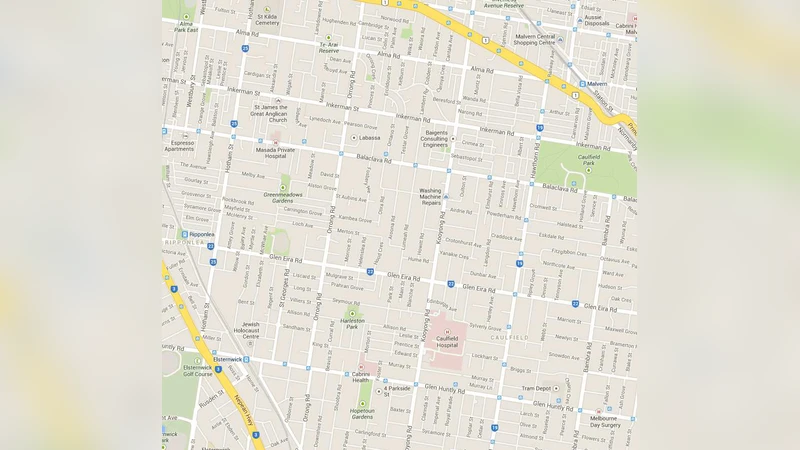
This paper investigates the impact of tram priority schemes at signalised intersections using a stochastic cellular automaton (CA) model that captures multimodal traffic flow. The authors implement realistic traffic‑signal features—signal linking, adaptive cycle lengths, and split plans—within an 8 × 8 square‑lattice network that mimics a typical suburban road layout in Melbourne. Two vehicle classes are modelled: private cars (cells of 7.5 m, vmax = 3) and trams (cells of 22.5 m, vmax = 2). Random deceleration is introduced to reproduce average free‑flow speeds of roughly 60 km/h for cars and 45 km/h for trams. Each tram link contains three stops (one at the intersection, two mid‑link), and tram stops block the entire lane for the duration of passenger loading (30 s at the intersection, 20 s at mid‑link).
Four tram‑priority strategies are examined, all belonging to the “active” category (priority is triggered when a tram is detected). They are: (1) Absolute (full) priority – the signal turns green for the tram immediately and stays green until the tram clears the intersection; (2) Conditional absolute priority – the same as (1) but only when the tram is behind schedule; (3) Partial priority – a less disruptive scheme that adds a clearance phase and a short green extension; (4) Conditional partial priority – the partial scheme activated only when the tram is delayed. The current VicRoads practice corresponds to unconditional partial priority; the other three are under trial.
Traffic demand is generated with open‑boundary conditions, following an AM‑peak inflow profile. Two demand levels are considered: an over‑saturated (OS) case where the network operates near or beyond capacity, and an under‑saturated (US) case close to capacity. Trams are injected deterministically (12 per hour per direction during peak, 9 in the opposite direction). The simulation runs for four hours, discarding the first hour as a warm‑up, and each configuration is replicated 100 times to obtain statistically robust estimates.
Performance metrics include vehicle and tram throughputs (Oc, Ot), average travel times (Tc, Tt), travel‑time variability for trams (σt), person‑based throughput (Op), person‑average travel time (Tp), and person‑based variability (σp). Occupancy is assumed to be 1 for cars, 80 passengers per tram in the peak direction and 20 in the off‑peak direction.
Key findings:
- Absolute priority dramatically reduces tram travel time and σt, guaranteeing service quality even under saturated conditions. However, it imposes severe penalties on private‑vehicle flow, inflating overall person‑travel time (Tp) and σp.
- Partial priority cuts tram delays by roughly 30‑40 % while leaving car throughput and person‑level performance almost unchanged. The added clearance phase prevents tram blockage of the intersection without monopolising the green phase.
- Conditional schemes (both absolute and partial) achieve almost the same tram‑benefit as their unconditional counterparts when the tram is delayed, but they avoid unnecessary priority activation when the tram is on schedule. Consequently, conditional partial priority delivers the best overall network performance: it retains most of the tram‑delay reduction while minimising the impact on other users.
- The benefits of partial and conditional priority are evident in both OS and US scenarios, but the trade‑off becomes more pronounced under OS conditions where any green‑time taken away from cars quickly translates into larger person‑delay penalties.
The authors argue that tram‑specific characteristics—lane blocking at kerbside stops, inability to change lanes, and slower acceleration—make bus‑priority literature insufficient for tram applications. Their CA model, being mesoscopic, balances computational efficiency with sufficient fidelity to capture these effects on a city‑scale network.
Policy implications:
- Full (absolute) priority should be reserved for situations where tram reliability is paramount and the cost to other users is acceptable (e.g., during special events or dedicated tram corridors).
- Partial priority, especially in its conditional form, offers a pragmatic compromise for everyday operations, delivering reliable tram service without degrading overall traffic performance.
- Implementation of conditional priority requires real‑time monitoring of tram schedule adherence, suggesting the need for robust vehicle‑location and schedule‑prediction systems.
In summary, the paper provides a systematic, simulation‑based comparison of tram‑priority strategies, demonstrating that partial and conditional priority schemes can substantially improve tram service while preserving network efficiency—a valuable insight for urban planners and traffic engineers dealing with mixed‑mode corridors.
Comments & Academic Discussion
Loading comments...
Leave a Comment