Bisimulation for quantum processes
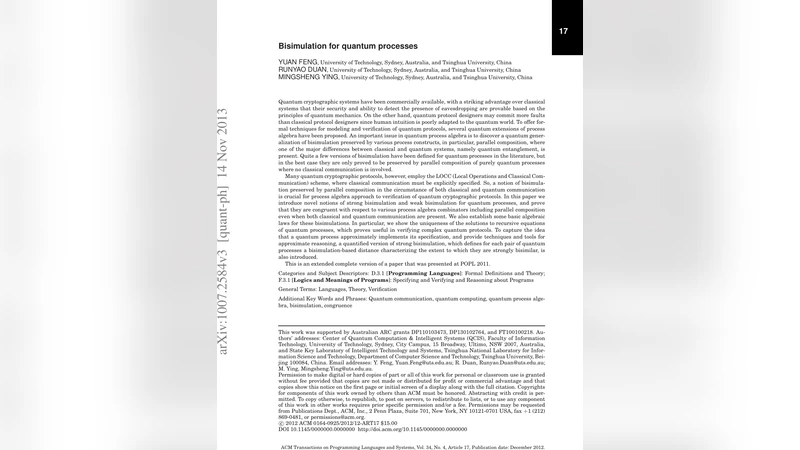
In this paper we introduce a novel notion of probabilistic bisimulation for quantum processes and prove that it is congruent with respect to various process algebra combinators including parallel composition even when both classical and quantum communications are present. We also establish some basic algebraic laws for this bisimulation. In particular, we prove uniqueness of the solutions to recursive equations of quantum processes, which provides a powerful proof technique for verifying complex quantum protocols.
💡 Research Summary
The paper introduces a new notion of probabilistic bisimulation specifically designed for quantum processes, extending classical probabilistic bisimulation to accommodate the peculiarities of quantum computation such as superposition, entanglement, and measurement-induced nondeterminism. The authors model a quantum process as a labeled transition system whose states are pairs consisting of a density matrix (representing the quantum part) and a classical valuation. Transition labels are divided into classical communication labels and quantum operation labels (unitary gates, measurements, etc.).
The core definition of “probabilistic quantum bisimulation” requires two conditions. First, for any transition from one state under a given label, there must exist a matching transition from the related state under the same label. When the label is classical, the transition probabilities must coincide; when the label is quantum, the post‑transition density matrices must have equal trace, guaranteeing that the overall quantum probability mass is preserved. Second, the probability distributions over the resulting successor states must be related by the bisimulation relation itself, mirroring the classic distribution‑matching requirement but lifted to mixed quantum states.
A major technical contribution is the proof that this bisimulation is a congruence with respect to all standard process algebra operators, most notably parallel composition. The authors show that if processes P₁ and Q₁ are bisimilar and P₂ and Q₂ are bisimilar, then the parallel compositions P₁‖P₂ and Q₁‖Q₂ remain bisimilar, even when the parallel components exchange both classical messages and quantum data. The proof exploits the tensor‑product structure of joint quantum operations and the independence of classical labels, ensuring that the combined system’s transition probabilities and trace‑preserving properties are respected component‑wise.
The paper also tackles recursive process definitions. By imposing continuity and trace‑preservation on the process‑defining functional, the authors adapt the Kleene fixed‑point theorem to the quantum setting, establishing existence and uniqueness of the least fixed point. Consequently, solutions to recursive equations such as X = F(X) are unique up to the defined bisimulation, providing a powerful tool for reasoning about infinite‑behaviour quantum protocols.
A suite of algebraic laws is derived from the bisimulation equivalence: reflexivity, symmetry, transitivity, commutativity and associativity of choice and parallel composition, and standard scope‑restriction laws. These laws enable equational reasoning in the same style as classical process algebras, but with the additional requirement that quantum operations respect trace preservation.
To demonstrate practicality, the authors apply their framework to two well‑known quantum communication protocols: BB84‑style quantum key distribution and quantum teleportation. They construct formal process models for each protocol, specify the intended security or correctness properties as reference processes, and then prove bisimilarity between the implementation and the specification. The case studies illustrate how the bisimulation handles measurement outcomes, entanglement distribution, and classical post‑processing in a unified manner.
The paper addresses several challenges inherent to quantum systems. Measurement nondeterminism is captured by enriching transition labels with probability distributions over measurement outcomes; entanglement is handled by keeping the whole system’s density matrix in the bisimulation relation, thereby avoiding the need to reason about reduced states separately. The coexistence of classical and quantum channels is managed by a clear separation of label domains, which prevents interference between the two kinds of communication during congruence proofs.
Overall, the work bridges a gap between quantum process algebras and formal verification techniques. By providing a bisimulation that is both probabilistic and quantum‑aware, and by proving its congruence properties, the authors lay a solid theoretical foundation for automated verification tools targeting quantum protocols and quantum network architectures. Future directions suggested include the development of model‑checking algorithms based on this bisimulation, extensions to error‑correcting codes, and integration with quantum programming languages to enable compositional verification of realistic quantum software stacks.
Comments & Academic Discussion
Loading comments...
Leave a Comment