DFT study of Pt-induced Ge(001) reconstructions
Pt deposited on a Ge(001) surface spontaneously forms nanowire arrays. These nanowires are thermodynamically stable and can be hundreds of atoms long. The nanowires only occur on a reconstructed Pt-Ge-surface where they fill the troughs between the dimer rows on the surface. This unique connection between the nanowires and the underlying substrate make a thorough understanding of the latter necessary for understanding the growth of the nanowires. In this paper we study possible surface reconstructions containing 0.25 and 0.5 of a monolayer of Pt. Comparison of calculated STM images to experimental STM images of the surface reconstruction reveal that the Pt atoms are located in the top layer, creating a structure with rows of alternating Pt-Ge and Ge-Ge dimers in a c(4x2) arrangement. Our results also show that Pt atoms in the second or third layer can not be responsible for the experimentally observed STM images.
💡 Research Summary
**
The paper presents a comprehensive density‑functional theory (DFT) investigation of the surface reconstructions that occur when sub‑monolayer amounts of platinum (Pt) are deposited on a germanium (Ge)(001) substrate. The motivation stems from experimental observations that Pt deposition followed by high‑temperature annealing (> 1000 K) leads to the spontaneous formation of atomically thin Pt nanowire (NW) arrays, which are found exclusively on a reconstructed Pt‑Ge surface (the so‑called β‑terrace). Understanding the atomic structure of this terrace is essential for elucidating the growth mechanism of the nanowires.
Methodology
The authors employ the projector‑augmented‑wave (PAW) method within the local‑density approximation (LDA) as implemented in VASP. A slab model consisting of twelve Ge layers separated by a ~15 Å vacuum region is used; the two central layers are fixed to mimic bulk Ge, while the outer layers are allowed to relax. A kinetic‑energy cutoff of 287 eV and a 6 × 3 Monkhorst‑Pack k‑point mesh sample the Brillouin zone of a (2 × 4) surface unit cell. Both the buckled (2 × 1) and c(4 × 2) reconstructions of the clean Ge(001) surface are first reproduced to validate the computational setup.
Construction of Candidate Structures
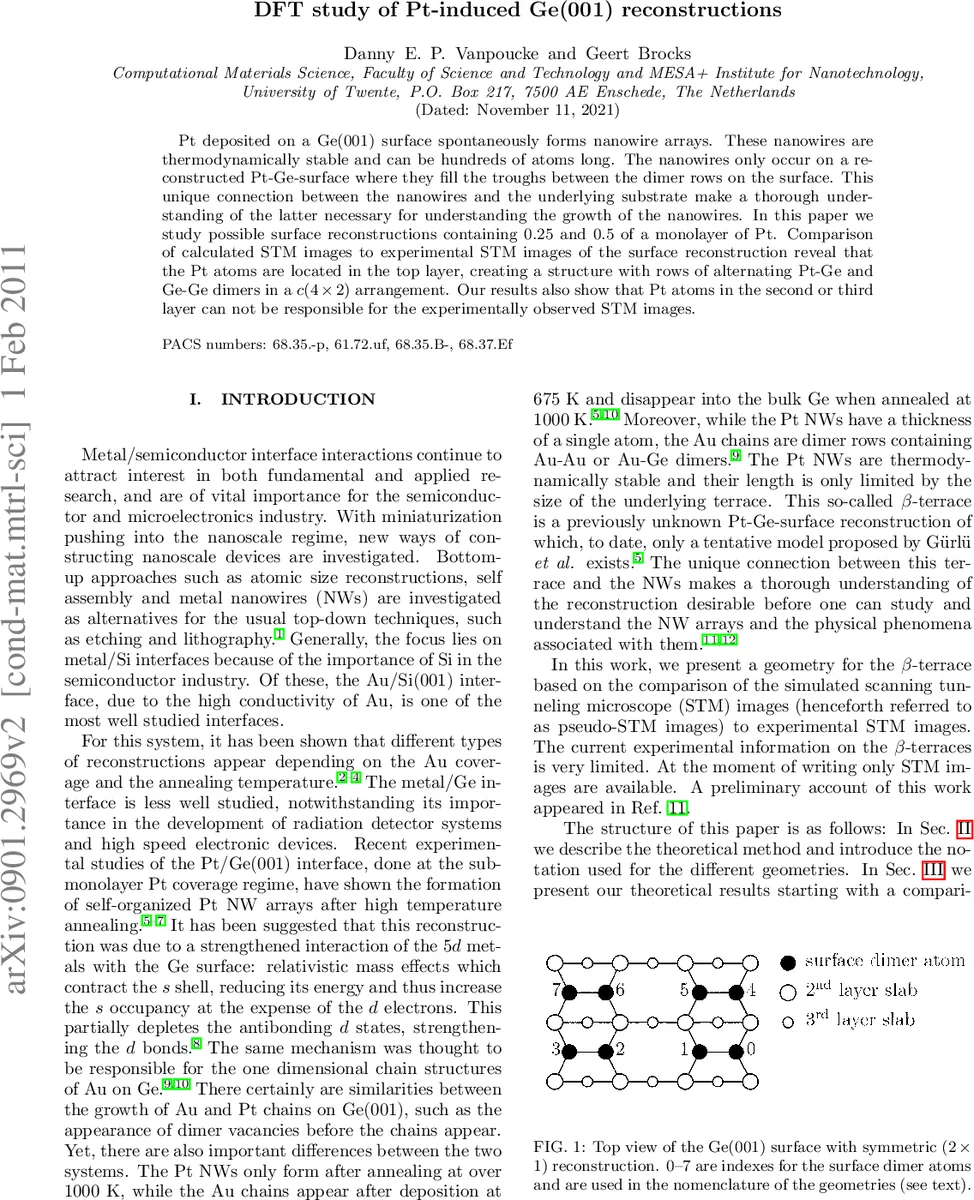
Two Pt coverages are considered: 0.25 ML (one Pt atom per surface dimer) and 0.5 ML (one Pt atom per surface atom, i.e., all dimers become Pt‑Ge). For 0.25 ML, the authors generate all non‑isomorphic configurations by substituting two surface Ge atoms in the (4 × 2) supercell of the buckled (2 × 1) reconstruction. Ignoring dimer buckling yields seven distinct geometries (β₁–β₇); when the up/down character of the dimers is taken into account, the set expands to ten (β₁ᵤd, β₂ᵤ, β₂𝑑, …, β₇ᵤd). For 0.5 ML three representative arrangements are examined: a (2 × 1) row of Pt‑Ge dimers (γ₁), a (2 × 2) checkerboard (γ₂), and a (4 × 2) pattern (γ₃).
Formation Energies and Stability
The formation energy per Pt‑containing dimer is defined as
E_f =
Comments & Academic Discussion
Loading comments...
Leave a Comment