An Axiomatization for Quantum Processes to Unifying Quantum and Classical Computing
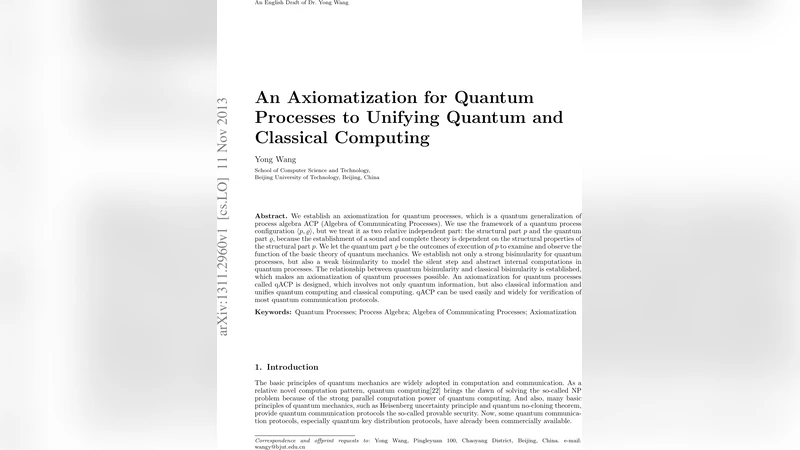
We establish an axiomatization for quantum processes, which is a quantum generalization of process algebra ACP (Algebra of Communicating Processes). We use the framework of a quantum process configuration $\langle p, \varrho\rangle$, but we treat it as two relative independent part: the structural part $p$ and the quantum part $\varrho$, because the establishment of a sound and complete theory is dependent on the structural properties of the structural part $p$. We let the quantum part $\varrho$ be the outcomes of execution of $p$ to examine and observe the function of the basic theory of quantum mechanics. We establish not only a strong bisimularity for quantum processes, but also a weak bisimularity to model the silent step and abstract internal computations in quantum processes. The relationship between quantum bisimularity and classical bisimularity is established, which makes an axiomatization of quantum processes possible. An axiomatization for quantum processes called qACP is designed, which involves not only quantum information, but also classical information and unifies quantum computing and classical computing. qACP can be used easily and widely for verification of most quantum communication protocols.
💡 Research Summary
The paper introduces qACP, a quantum generalization of the classical process algebra ACP, designed to provide a unified algebraic framework for modeling, reasoning about, and verifying systems that involve both quantum and classical computation and communication. The authors start by representing a quantum process as a configuration ⟨p, ρ⟩, where p is the syntactic process term (the “structural part”) and ρ is the quantum state (the “quantum part”). By treating these two components as relatively independent, they can apply traditional algebraic techniques to the structural part while handling the quantum part with the mathematical machinery of quantum mechanics (density operators, unitary transformations, measurements, and super‑operators).
Two notions of behavioral equivalence are defined. Strong quantum bisimilarity requires that every transition labeled by the same action leads to exactly the same quantum state, mirroring the classic strong bisimulation but enriched with quantum state equality. Weak quantum bisimilarity abstracts away internal τ‑steps and treats measurements as quantum operations rather than probabilistic branches, thereby yielding a non‑probabilistic transition system that can still capture the observable behavior of quantum protocols. The authors prove that quantum bisimilarity implies the corresponding classical bisimilarity, establishing a bridge that allows the reuse of ACP’s completeness proofs in the quantum setting.
The core of qACP consists of a hierarchy of algebraic systems. BQP A (Basic Quantum Process Algebra) introduces quantum actions as atomic operators and defines the fundamental axioms for sequential composition, choice, and parallel composition. QP AP extends BQP A with explicit parallelism and synchronization operators, while AQCP (Algebra of Quantum Communicating Processes) adds communication primitives that can carry both quantum and classical data. For each layer, the paper supplies a set of equational axioms (associativity, commutativity, identity, distributivity, etc.) and shows that these axioms are sound with respect to the operational semantics derived from the labeled transition system. Importantly, the associativity of sequential composition is justified by the associativity of quantum operations, and the behavior of the silent step τ is shown to differ from its classical counterpart because of the underlying quantum configuration.
To handle infinite behavior, the authors incorporate guarded linear recursion, and they introduce a τ‑operator to model hidden internal computation. The weak bisimulation is defined in a way that respects τ‑abstraction, enabling reasoning about processes that contain internal quantum operations invisible to an external observer.
The practical relevance of qACP is demonstrated through a formal verification of the BB84 quantum key distribution protocol. The protocol’s steps—preparing qubits, transmitting them, measuring, and performing classical post‑processing—are encoded as qACP process terms. Using the presented axioms and weak bisimulation, the authors verify essential security properties such as indistinguishability of the key from an eavesdropper’s perspective. This case study illustrates that qACP can seamlessly handle mixed quantum‑classical information flows.
Finally, the paper emphasizes the modularity and extensibility of qACP. New quantum operations or communication primitives can be added by extending the signature and supplying additional axioms, while the underlying equational logic and rewriting system remain amenable to Knuth‑Bendix completion, guaranteeing confluence and termination where needed. In summary, qACP offers a mathematically rigorous, algebraically complete, and practically applicable framework that bridges the gap between quantum information theory and classical process algebra, opening the door to systematic verification of a broad class of quantum communication and computation systems.
Comments & Academic Discussion
Loading comments...
Leave a Comment