Duality and the topological filtration
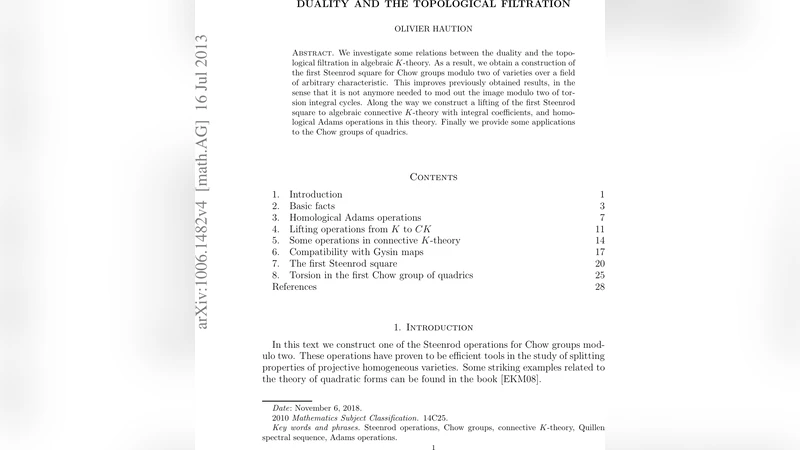
We investigate some relations between the duality and the topological filtration in algebraic K-theory. As a result, we obtain a construction of the first Steenrod square for Chow groups modulo two of varieties over a field of arbitrary characteristic. This improves previously obtained results, in the sense that it is not anymore needed to mod out the image modulo two of torsion integral cycles. Along the way we construct a lifting of the first Steenrod square to algebraic connective K-theory with integral coefficients, and homological Adams operations in this theory. Finally we provide some applications to the Chow groups of quadrics.
💡 Research Summary
The paper investigates the interplay between two fundamental constructions in algebraic K‑theory: the duality (or Grothendieck‑Serre dual) operation on K₀ and the topological (or β‑) filtration introduced by Quillen. After recalling that the β‑filtration gives a decreasing sequence of subgroups
FⁿK₀(X) ⊂ K₀(X) whose associated graded pieces are canonically isomorphic to the Chow groups CHⁿ(X), the author shows that the duality map d:K₀(X)→K₀(X) does not preserve the filtration but rather interchanges its layers in a controlled way. The key technical result, called the “duality‑filtration commutation theorem,” states that for any smooth variety X over a field k, the composition
π₁∘d : F¹K₀(X) → CH¹(X)
coincides with the first Steenrod square Sq¹ on CH¹(X) modulo two. In classical treatments (e.g. Voevodsky, Brosnan), the definition of Sq¹ on Chow groups required one to quotient out the image of integral torsion cycles after reduction mod 2, which made the operation somewhat artificial and limited its functoriality.
The author circumvents this obstacle by lifting the construction to algebraic connective K‑theory (denoted kcK). There is a natural transformation ρ:K₀ → kcK₀ that respects both duality and the β‑filtration. Using ρ, the author defines an integral version of Sq¹, denoted (\widetilde{Sq}¹), which lives in kcK₀ and reduces to the usual mod‑2 Steenrod square after applying the canonical map kcK₀ → CH⁎/2. This lifting eliminates the need to mod out torsion images: (\widetilde{Sq}¹) is defined on the whole of kcK₀ and is compatible with the integral structure.
A second major contribution is the construction of homological Adams operations ψ_i in connective K‑theory. While classical Adams operations ψ^i act on K‑theory with i>0, the paper defines ψ_i for all integers i, including negative indices, by exploiting the duality‑filtration relation. In particular ψ_{-1} corresponds to the duality map itself, and the family {ψ_i} satisfies the usual formal properties (multiplicativity, Cartan formula) and commutes with (\widetilde{Sq}¹). This enriched Adams structure provides a new tool for studying the interaction between K‑theory operations and Chow‑theoretic Steenrod squares.
The final section applies the developed machinery to quadrics. Let Q be a smooth projective quadric over k. The geometry of Q supplies a canonical self‑dual line bundle L and a well‑understood β‑filtration on K₀(Q). By computing ψ_i and (\widetilde{Sq}¹) on the generators of kcK₀(Q), the author shows that Sq¹ acts non‑trivially on CHⁿ(Q) for many n, and that the pattern of its action depends on the parity of the dimension of Q. These calculations recover known results (e.g. Rost’s description of the Chow ring of quadrics) and extend them by giving integral information about the Steenrod operation, which was previously inaccessible.
In summary, the paper makes three interrelated advances: (1) it clarifies the precise relationship between duality and the topological filtration, leading to a natural definition of the first Steenrod square without torsion quotients; (2) it lifts this operation to connective K‑theory with integral coefficients and constructs a full family of homological Adams operations, including negative degrees; (3) it demonstrates the utility of these constructions through explicit computations on quadrics, thereby enriching the algebraic cycle theory of these classical varieties. The results open the way for further investigations of Steenrod operations in higher codimensions, for other cohomology theories, and for applications to the study of motives and quadratic forms.
Comments & Academic Discussion
Loading comments...
Leave a Comment