A strange bridge by Leonardo
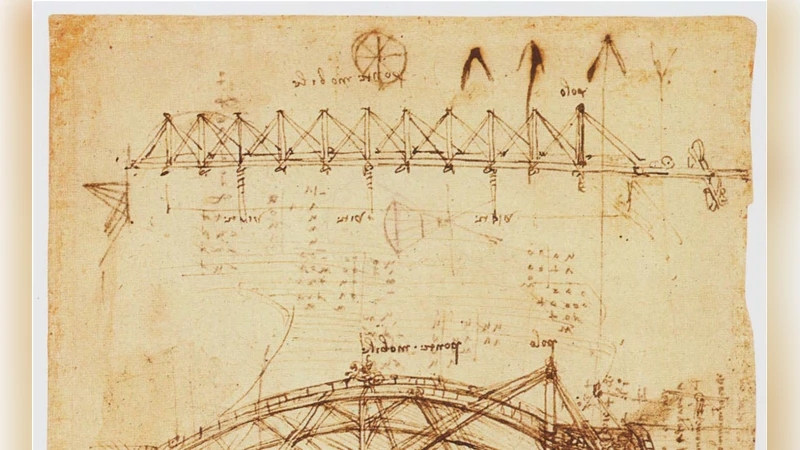
On folio 855 recto of the Codex Atlanticus, Leonardo da Vinci drew three ’easily movable’ bridges, but one of them is enigmatic: all ‘replicas’ in Leonardo museums and exhibitions come as a surprise, to say the least, to any engineer or architect whose attention is drawn to it. This is the case for models in Amboise (France), Chicago and Portland (USA), Florence (Italy) and for the one of the traveling exhibition by the Australian company ‘Grande Exhibitions’ that already visited 40 major cities in the world. All ‘replicas’ of the bridge model attributed to Leonardo have pillars standing on the deck of the bridge, while the deck is suspended by cables attached on these pillars. At first sight this problem does not catch the attention of the observer, as the bridge seems to be a mixed form of a beam and a suspension bridge, but it was not overlooked by my colleague architect-engineer Dr. Laurens Luyten (Gent, Belgium). Yet, after a TV-interview in Brussels so much pressure was exerted by some of the museum collaborators, the architect prefers to keep the silence about the engineering by these ‘scientific’ exhibitions. Yet, it is the author’s opinion the ridiculous models do not honor Leonardo, and so the present paper takes up the challenge to report about his observation in his name (with his permission). Something should be done, for sure: millions of people look at the bridge replicas that immediately embarrass any engineer.
💡 Research Summary
The paper examines Leonardo da Vinci’s “movable bridge” sketch on folio 855 recto of the Codex Atlanticus, focusing on the first of three designs that shows a bridge supported by eleven vertical pillars. The author, Dirk Huylebrouck, points out that virtually every museum replica – from Amboise (France) to Chicago, Portland, Florence and a travelling exhibition by Grande Exhibitions – misrepresents the original drawing. The common errors are a reduction of the pillar count to five or six, the placement of pillars on the bridge deck rather than in the river, and the use of cables that appear to suspend the deck but in fact carry no structural load.
Through a simple structural analysis (PowerFrame) the author demonstrates that such a configuration would leave the deck vulnerable to excessive bending moments, essentially reducing the bridge to a simple beam with no benefit from the cables. This explains why model makers have shortened the span and omitted the full eleven pillars.
Huylebrouck argues that Leonardo’s intent was not to create a modern suspension bridge but a quickly assembled, easily disassembled military bridge. He proposes that the “wheels” shown in the sketch were heavy counter‑weights (perhaps millstones) used during a cantilever construction sequence: the bridge would be built from one shore, a pillar driven into the riverbed, then two deck modules added, the process repeating until the opposite bank was reached. In this scenario the cables would assist the cantilever action, while the wheels would balance the structure during erection.
The paper acknowledges that Leonardo’s drawings are often drafts and that he was not infallible – previous research has identified genuine errors in other of his mechanical designs. Nevertheless, the author contends that the widespread mis‑interpretation of this bridge is unacceptable, especially when the goal of museum exhibitions is to inspire interest in mathematics and engineering. He calls for a correction of the displayed models to honor Leonardo’s true ingenuity and to provide the public with an accurate representation of his engineering thought.
Comments & Academic Discussion
Loading comments...
Leave a Comment