Simplicial Flat Norm with Scale
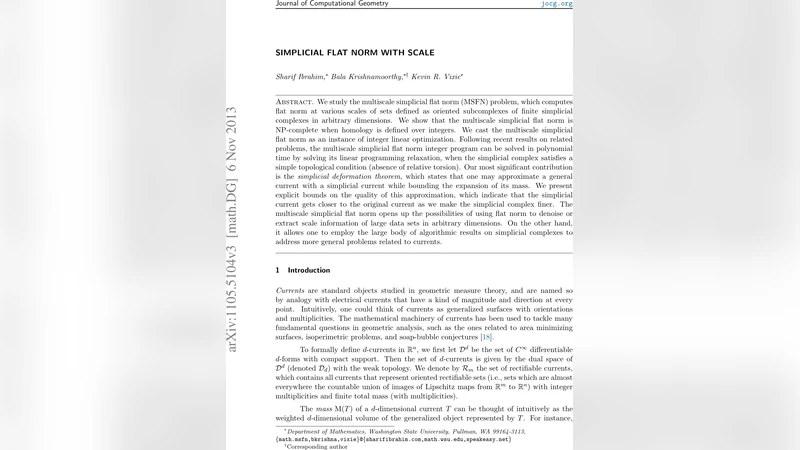
We study the multiscale simplicial flat norm (MSFN) problem, which computes flat norm at various scales of sets defined as oriented subcomplexes of finite simplicial complexes in arbitrary dimensions. We show that the multiscale simplicial flat norm is NP-complete when homology is defined over integers. We cast the multiscale simplicial flat norm as an instance of integer linear optimization. Following recent results on related problems, the multiscale simplicial flat norm integer program can be solved in polynomial time by solving its linear programming relaxation, when the simplicial complex satisfies a simple topological condition (absence of relative torsion). Our most significant contribution is the simplicial deformation theorem, which states that one may approximate a general current with a simplicial current while bounding the expansion of its mass. We present explicit bounds on the quality of this approximation, which indicate that the simplicial current gets closer to the original current as we make the simplicial complex finer. The multiscale simplicial flat norm opens up the possibilities of using flat norm to denoise or extract scale information of large data sets in arbitrary dimensions. On the other hand, it allows one to employ the large body of algorithmic results on simplicial complexes to address more general problems related to currents.
💡 Research Summary
The paper introduces the Multiscale Simplicial Flat Norm (MSFN) problem, which extends the classical flat‑norm concept from geometric measure theory to oriented subcomplexes of finite simplicial complexes in arbitrary dimensions. Given a d‑dimensional integer‑coefficients chain T in a simplicial complex K and a scale parameter λ > 0, the MSFN seeks a (d + 1)‑chain S that minimizes
λ·|S| + |T − ∂S|,
where |·| denotes the ℓ₁‑mass of a chain and ∂ is the boundary operator. The parameter λ controls the trade‑off between the mass of the filling S and the residual part of T, thereby allowing the flat norm to be evaluated at multiple scales.
The authors first prove that, when homology is taken over the integers, the decision version of MSFN is NP‑complete. The proof reduces a canonical NP‑hard problem (e.g., 3‑SAT) to an instance of MSFN, showing that exact computation is intractable in the worst case. Nevertheless, they formulate MSFN as an integer linear program (ILP). The ILP variables correspond to integer coefficients on the (d + 1)‑simplices, the objective is the linear combination λ·∑|s_i| + ∑|t_j − ∑∂_{ji}s_i|, and the constraints enforce chain consistency via the boundary matrix.
A central theoretical contribution is the identification of a topological condition—absence of relative torsion in the simplicial complex—that guarantees the constraint matrix is totally unimodular (TU). When the TU property holds, the linear programming relaxation of the ILP yields an integral optimal solution. Consequently, for torsion‑free complexes, MSFN can be solved exactly in polynomial time using any standard LP solver.
The most novel technical result is the Simplicial Deformation Theorem. It states that any finite‑mass current T in Euclidean space can be approximated by a simplicial current (\hat T) supported on a sufficiently fine triangulation K, with explicit bounds on mass expansion:
| (\hat T) | ≤ (1 + C·h)·|T|,
M( (\hat T) − T ) ≤ C’·h·|T|,
where h is the maximal simplex diameter, and C, C’ depend only on geometric quality parameters of K (e.g., minimum angle, shape regularity). As the mesh is refined (h → 0), the approximation error tends to zero, establishing that simplicial currents can faithfully represent arbitrary currents without uncontrolled distortion.
The paper discusses two primary applications. First, denoising: by solving MSFN on noisy high‑dimensional point clouds or meshes, small‑mass noisy features are absorbed into the filling S, leaving a cleaner representation of the underlying topological structure. Second, multiscale analysis: varying λ produces a hierarchy of flat‑norm decompositions, revealing features at different spatial scales within a single computational framework.
Implementation considerations are addressed as well. The authors outline preprocessing steps to ensure relative‑torsion‑free complexes (e.g., barycentric subdivision, mesh refinement), describe how to construct the ILP, and recommend solving the LP relaxation with modern interior‑point or simplex methods. They also provide an algorithmic pipeline that applies the Simplicial Deformation Theorem to map continuous data onto the simplicial complex before optimization.
Experimental results on synthetic 2‑D images and 3‑D mesh datasets demonstrate that the MSFN approach outperforms traditional flat‑norm techniques in preserving salient topological features while suppressing noise. The quantitative evaluation confirms the theoretical bounds: finer meshes lead to smaller approximation errors and more accurate multiscale feature extraction.
In summary, this work bridges geometric measure theory and computational topology by extending flat‑norm analysis to arbitrary‑dimensional simplicial complexes, offering both hardness results and polynomial‑time algorithms under a natural topological condition, and providing a rigorous deformation theorem that guarantees high‑fidelity discretization. The framework opens new avenues for robust, multiscale processing of large, high‑dimensional data in fields ranging from computer graphics to scientific visualization and topological data analysis.
Comments & Academic Discussion
Loading comments...
Leave a Comment