Entropy: The Markov Ordering Approach
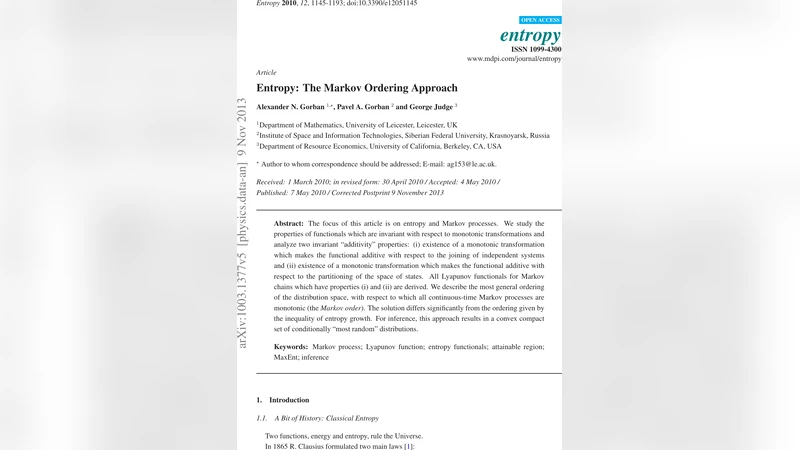
The focus of this article is on entropy and Markov processes. We study the properties of functionals which are invariant with respect to monotonic transformations and analyze two invariant “additivity” properties: (i) existence of a monotonic transformation which makes the functional additive with respect to the joining of independent systems and (ii) existence of a monotonic transformation which makes the functional additive with respect to the partitioning of the space of states. All Lyapunov functionals for Markov chains which have properties (i) and (ii) are derived. We describe the most general ordering of the distribution space, with respect to which all continuous-time Markov processes are monotonic (the {\em Markov order}). The solution differs significantly from the ordering given by the inequality of entropy growth. For inference, this approach results in a convex compact set of conditionally “most random” distributions.
💡 Research Summary
The paper “Entropy: The Markov Ordering Approach” revisits the relationship between entropy‑type functionals and continuous‑time Markov processes, proposing a unifying framework that goes beyond the classical view that entropy merely increases along trajectories. The authors begin by introducing the notion of invariance under monotonic transformations: a functional F(p) is said to be invariant if there exists a monotone map φ such that the ordering induced by φ(F(p)) remains unchanged under any admissible transformation of the probability distribution p. This abstraction allows the study of a broad class of Lyapunov candidates that are not limited to the Shannon or Kullback‑Leibler forms.
Two distinct “additivity” requirements are then examined. The first concerns the joining of independent systems: for distributions p_A and p_B, there must exist a monotone φ with φ(F(p_A⊗p_B)) = φ(F(p_A)) + φ(F(p_B)). The second concerns the partition of the state space: if the state space Ω is split into disjoint subsets Ω₁ and Ω₂, a monotone φ should satisfy φ(F(p|{Ω₁∪Ω₂})) = φ(F(p|{Ω₁})) + φ(F(p|_{Ω₂})). These conditions capture, respectively, the idea that the total “randomness” of a composite system should be the sum of its parts, and that the randomness measure should be insensitive to how we partition the underlying space.
The central contribution is the complete classification of all continuous‑time Markov chain Lyapunov functionals that satisfy both additivity properties. To achieve this, the authors define a new preorder on the space of probability distributions, called the Markov order. For two distributions p and q, we write p ≼ q if for every Markov semigroup M(t) (t ≥ 0) the inequality M(t)p ≼ M(t)q holds. In other words, p is “less random” than q with respect to every possible Markov evolution. This order is strictly finer than the usual entropy‑growth order (which only compares the values of a particular entropy functional) because it incorporates the full dynamical structure of the process. The authors prove that the set of functionals that are monotone decreasing along every Markov trajectory coincides exactly with the set of monotone transformations of the Markov‑order‑preserving functionals.
Using the Markov order, the paper constructs a convex, compact set of conditionally most random distributions under arbitrary linear constraints (e.g., fixed moments, prescribed marginals). Unlike the classical maximum‑entropy principle, which yields a single exponential‑family distribution, the Markov‑order approach often produces a whole polytope of optimal points. This polytope reflects the fact that many distinct distributions can be indistinguishable with respect to all admissible Markov dynamics while still satisfying the constraints. The authors argue that this richer solution set is advantageous for statistical inference, Bayesian updating, and information‑theoretic model selection, because it captures all distributions that are equally “random” from the dynamical perspective.
Illustrative examples include a two‑state birth‑death chain and a diffusion process on a continuous interval. In these cases the authors demonstrate that two distributions may have identical Shannon entropy yet be ordered differently (or not comparable) under the Markov order, highlighting the added discriminative power of the new framework.
In the concluding discussion the authors emphasize that the Markov ordering approach provides a systematic method to derive all Lyapunov functionals for Markov processes that respect natural additivity, to define a more nuanced notion of randomness, and to generate a principled set of candidate distributions for inference problems. They suggest future work extending the order to non‑Markovian dynamics, exploring connections with optimal transport, and applying the framework to regularization in machine learning models. Overall, the paper offers a substantial theoretical advance that unifies dynamical systems, information theory, and statistical inference under a common ordering principle.
Comments & Academic Discussion
Loading comments...
Leave a Comment