The Collatz conjecture and De Bruijn graphs
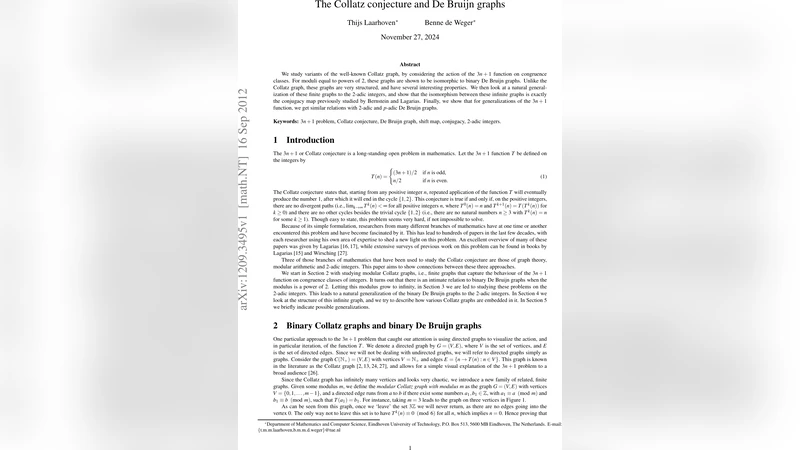
We study variants of the well-known Collatz graph, by considering the action of the 3n+1 function on congruence classes. For moduli equal to powers of 2, these graphs are shown to be isomorphic to binary De Bruijn graphs. Unlike the Collatz graph, these graphs are very structured, and have several interesting properties. We then look at a natural generalization of these finite graphs to the 2-adic integers, and show that the isomorphism between these infinite graphs is exactly the conjugacy map previously studied by Bernstein and Lagarias. Finally, we show that for generalizations of the 3n+1 function, we get similar relations with 2-adic and p-adic De Bruijn graphs.
💡 Research Summary
The paper investigates a family of finite and infinite graphs that arise from the action of the classic 3n + 1 (Collatz) map on congruence classes, and it establishes a precise connection between these graphs and De Bruijn graphs. The authors begin by restricting the Collatz map to the residue classes modulo 2^k. For a given k, each integer n is replaced by its remainder r ∈ {0,…,2^k − 1}. The induced map T_k sends r to r/2 when r is even and to (3r + 1)/2 when r is odd, both taken modulo 2^k. This defines a directed graph G_k whose vertices are the 2^k residues and where each vertex has exactly two outgoing edges, labelled “0” and “1”. By interpreting each residue as a k‑bit binary word, the authors show that T_k simply shifts the word one position to the right and inserts a new bit at the left. This operation is exactly the edge rule of the binary De Bruijn graph B(2, k), which contains all binary strings of length k and connects each string to the two strings obtained by prefixing a 0 or a 1 and discarding the last bit. Consequently, G_k and B(2, k) are isomorphic as directed graphs. The isomorphism immediately yields a highly regular structure for the finite Collatz‑type graphs: every vertex has indegree and outdegree two, the graph decomposes into disjoint cycles whose lengths are determined by the binary shift dynamics, and many combinatorial properties of De Bruijn graphs (Eulerian circuits, Hamiltonian paths, cycle covers) transfer verbatim to the Collatz setting.
Having clarified the finite case, the authors turn to the 2‑adic integers ℤ₂, which can be viewed as infinite binary sequences. Extending the Collatz map to ℤ₂ gives an infinite directed graph G_∞ whose vertices are all 2‑adic numbers and whose edges follow the same “shift‑and‑insert” rule. Bernstein and Lagarias previously introduced a conjugacy map φ : ℤ₂ → ℤ₂ that reads a 2‑adic expansion backwards. The paper proves that φ is a graph isomorphism between G_∞ and the infinite binary De Bruijn graph B(2, ∞). In other words, φ conjugates the 3n + 1 dynamics on ℤ₂ to the simple shift dynamics on the De Bruijn graph. This result shows that, at the 2‑adic level, the apparently chaotic Collatz iteration is nothing more than a deterministic shift register, and all the rich algebraic structure of ℤ₂ is reflected in the combinatorial structure of the De Bruijn graph.
The final part of the work generalises the construction to a broader class of Collatz‑type maps. For integers a and b with a odd, the map T_{a,b}(n) = (a n + b)/2^{ν₂(a n + b)} reduces to the ordinary Collatz map when (a,b) = (3,1). When the map is reduced modulo 2^k, the same binary‑shift description holds, and the resulting graph is again isomorphic to B(2, k). Moreover, the authors replace the base 2 by an arbitrary prime p. If a is coprime to p, the map T_{a,b} on the p‑adic integers ℤ_p induces a directed graph that is isomorphic to the p‑ary De Bruijn graph B(p, ∞). The key observation is that multiplication by a (mod p^k) permutes the p‑adic digits, while division by the appropriate power of p simply shifts the digit string; the addition of b inserts a new digit at the most significant position. Hence the same shift‑insert mechanism underlies all these generalisations.
Overall, the paper provides a clean algebraic‑combinatorial framework that translates the notoriously difficult dynamics of the Collatz problem into the well‑understood language of De Bruijn graphs. By establishing exact isomorphisms for both finite modulus reductions and the full 2‑adic (or p‑adic) setting, the authors open a new avenue for applying techniques from symbolic dynamics, automata theory, and graph theory to the Collatz conjecture. The work suggests several promising directions: exploiting known cycle‑decomposition results for De Bruijn graphs to study Collatz cycles, investigating whether the conjugacy map φ can be leveraged to prove convergence properties in ℤ₂, and extending the analysis to other nonlinear integer maps that admit a shift‑register interpretation. The paper thus bridges number theory and combinatorial dynamics, offering fresh insight into an old problem.
Comments & Academic Discussion
Loading comments...
Leave a Comment