On the rank of $ntimes n$ matrix multiplication
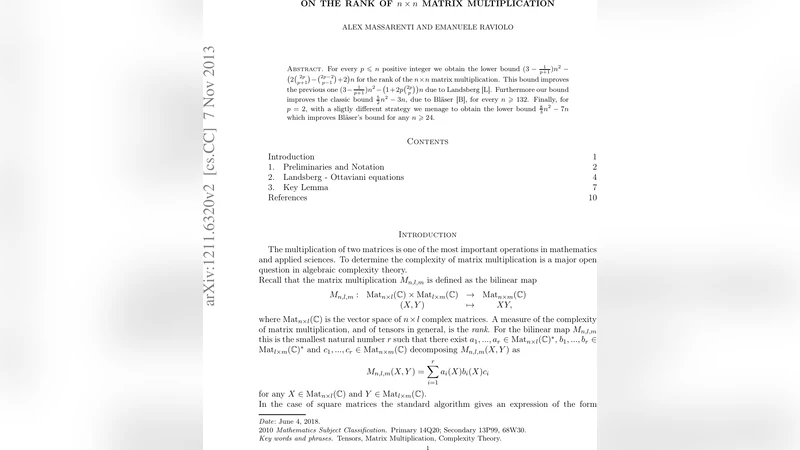
For every $p\leq n$ positive integer we obtain the lower bound $(3-\frac{1}{p+1})n^2-\big(2\binom{2p}{p+1}-\binom{2p-2}{p-1}+2\big)n$ for the rank of the $n\times n$ matrix multiplication. This bound improves the previous one $(3-\frac{1}{p+1})n^2-\big(1+2p\binom{2p}{p}\big)n$ due to Landsberg. Furthermore our bound improves the classic bound $\frac{5}{2}n^2-3n$, due to Bl"aser, for every $n\geq 132$. Finally, for $p = 2$, with a sligtly different strategy we menage to obtain the lower bound $\frac{8}{3}n^2-7n$ which improves Bl"aser’s bound for any $n\geq 24$.
💡 Research Summary
The paper addresses the long‑standing problem of establishing strong lower bounds on the tensor rank of the $n\times n$ matrix multiplication tensor $M_{\langle n,n,n\rangle}$. While the exact rank remains unknown, previous landmark results include Bläser’s classic bound $\frac{5}{2}n^{2}-3n$ (2003) and Landsberg’s bound $(3-\frac{1}{p+1})n^{2}-\big(1+2p\binom{2p}{p}\big)n$ (2013), both of which are derived from flattening techniques and the so‑called “laser method”. The present work introduces a parameter $p$ (with $1\le p\le n$) and develops a refined flattening strategy that yields a uniformly stronger bound for every admissible $p$.
Main Theorem.
For any integer $p$ satisfying $1\le p\le n$,
\
Comments & Academic Discussion
Loading comments...
Leave a Comment