On the Existence of Categorical Universal Coverings
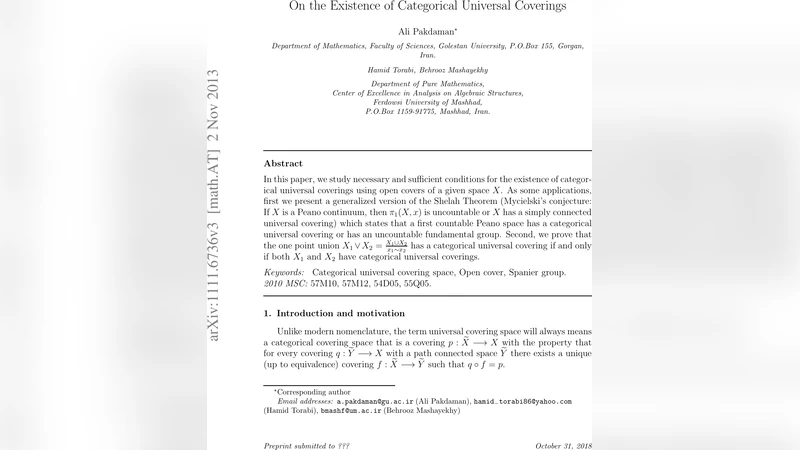
In this paper, we study necessary and sufficient conditions for the existence of categorical universal coverings using open covers of a given space $X$. As some applications, first we present a generalized version of the Shelah Theorem (Mycielski’s conjecture: If $X$ is a Peano continuum, then $\pi_1(X,x)$ is uncountable or $X$ has a simply connected universal covering) which states that a first countable Peano space has a categorical universal covering or has an uncountable fundamental group. Second, we prove that the one point union $X_1\vee X_2=\frac{{X_1}\cup {X_2}}{{x_1}\sim {x_2}}$ has a categorical universal covering if and only if both $X_1$ and $X_2$ have categorical universal coverings.
💡 Research Summary
The paper investigates the existence of categorical universal coverings for topological spaces by exploiting open covers and the so‑called Spanier groups. After recalling that classical universal covering theory requires local path‑connectedness and semi‑local simple connectivity, the authors introduce the Spanier group π_sp₁(X,x), defined as the intersection of all Spanier subgroups π(U,x) associated with open covers U of X. They then define a π‑stable open cover (one whose associated Spanier subgroup does not change under refinement) and a “semi‑locally Spanier” space (each point admits an open neighbourhood whose inclusion‑induced fundamental group lies inside π_sp₁).
The central result, Theorem 2.8, proves that for any connected, locally path‑connected space X the following are equivalent: (i) X is “covable” (i.e., for every subgroup H containing π_sp₁ there exists a covering space whose deck‑group image is H); (ii) X possesses a categorical universal covering; (iii) X admits a π‑stable open cover; (iv) X is semi‑locally Spanier; (v) X has no wild points (points for which every neighbourhood contains a loop not in π_sp₁); and (vi) π_sp₁ is an open subgroup of the full fundamental group. This theorem unifies several previously disparate criteria into a single framework and provides a purely algebraic condition (vi) for the existence of a universal covering.
Theorem 2.9 extends the classical Shelah–Mycielski theorem. It shows that if X is connected, locally path‑connected, and first‑countable, and if the quotient π₁(X,x)/π_sp₁(X,x) is countable, then X has a categorical universal covering. In particular, countability of the “Spanier quotient” suffices, weakening the usual hypothesis that the entire fundamental group be countable.
The paper also treats wedge sums. Proposition 3.17 gives a Seifert–van Kampen description of the fundamental group of a one‑point union X₁∨X₂. Using this and Theorem 2.8, Theorem 2.10 proves that X₁∨X₂ has a categorical universal covering if and only if each summand X₁ and X₂ does. This result clarifies the behavior of universal coverings under one‑point unions and explains why spaces such as the Griffiths space lack a simply connected universal cover despite each component having one.
Supporting results include a reformulation of Spanier’s classical covering classification (Theorem 3.1), several propositions about the behavior of Spanier groups under refinement, and the equivalence between “covable” spaces and the existence of the covering corresponding to π_sp₁. The authors also discuss the relationship between wild points, tame points, and the Spanier group, illustrating with the Hawaiian earring that a space can have trivial Spanier group yet fail to be coverable.
Overall, the paper provides a coherent algebraic–topological criterion for the existence of categorical universal coverings, broadening the scope beyond semi‑locally simply connected spaces. The use of π‑stable open covers and the Spanier quotient offers a practical tool for analyzing spaces with complicated local structure, although concrete computational examples and algorithmic procedures for verifying π‑stability are left for future work.
Comments & Academic Discussion
Loading comments...
Leave a Comment