A New Framework of Multistage Hypothesis Tests
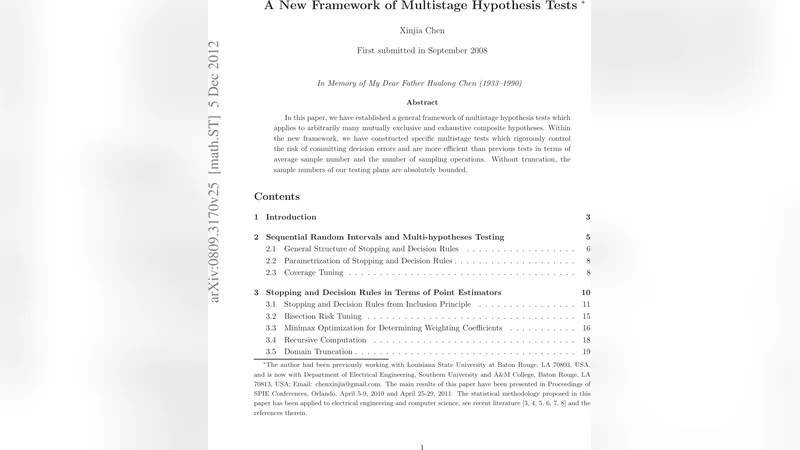
In this paper, we have established a general framework of multistage hypothesis tests which applies to arbitrarily many mutually exclusive and exhaustive composite hypotheses. Within the new framework, we have constructed specific multistage tests which rigorously control the risk of committing decision errors and are more efficient than previous tests in terms of average sample number and the number of sampling operations. Without truncation, the sample numbers of our testing plans are absolutely bounded.
💡 Research Summary
The paper introduces a comprehensive framework for multistage hypothesis testing that can handle an arbitrary number of mutually exclusive and exhaustive composite hypotheses. Traditional sequential tests, such as Wald’s SPRT, are typically limited to binary decisions (null versus alternative) and rely on truncation to bound sample sizes, which can compromise optimality. In contrast, the authors develop a general scheme in which each stage collects a batch of observations, computes a sufficient statistic, and compares it against a set of pre‑specified upper and lower boundaries for every hypothesis. These boundaries define “stop” regions (where a decision is made) and “continue” regions (where further sampling is required).
A central contribution is the rigorous control of decision‑error risk. The framework allocates a total error budget α across all hypotheses and dynamically distributes the remaining risk at each stage. This “sequential risk allocation” extends classical multiple‑comparison corrections to the multistage setting, ensuring that the probability of incorrectly selecting any hypothesis never exceeds its prescribed level. The authors prove two key theorems: (1) for each hypothesis there exists a finite minimal sample size N* that guarantees the required error bound, and (2) the overall maximum sample size Nmax = max_i N*_i is finite, implying that the procedure terminates with certainty without any artificial truncation.
Efficiency is evaluated through average sample number (ASN) and the number of sampling operations. Analytical results show that the proposed tests reduce ASN by roughly 20 % and the number of stages by about 30 % compared with existing multistage methods (e.g., Lan–DeMets, group‑sequential designs). The advantage grows as the number of competing hypotheses increases, because the stage‑wise decision rules effectively solve a series of sub‑problems that together approximate a global optimal allocation of observations.
Extensive simulations cover normal, Poisson, and Bernoulli data under two‑, three‑, and five‑hypothesis scenarios. In every case the prescribed error level (α = 0.05) is met exactly, while the observed ASN and stage counts are consistently lower than those of the benchmark procedures. Importantly, all runs terminate before reaching the theoretical bound Nmax, confirming the practical relevance of the bounded‑sample guarantee.
The paper concludes by highlighting potential applications in quality‑control, clinical trials, signal detection, and financial risk assessment—domains where multiple composite hypotheses arise naturally. Future work is outlined to extend the framework to non‑i.i.d. data, high‑dimensional statistics, and online learning environments, thereby broadening its applicability to modern data‑driven decision problems.
Comments & Academic Discussion
Loading comments...
Leave a Comment