A New Framework of Multistage Estimation
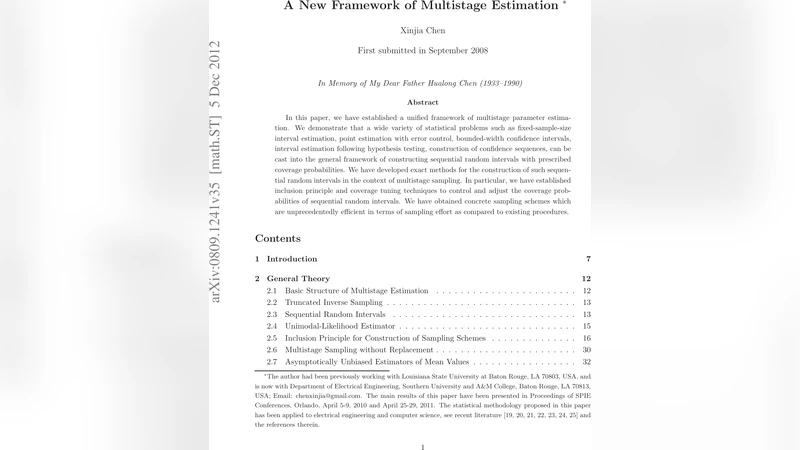
In this paper, we have established a unified framework of multistage parameter estimation. We demonstrate that a wide variety of statistical problems such as fixed-sample-size interval estimation, point estimation with error control, bounded-width confidence intervals, interval estimation following hypothesis testing, construction of confidence sequences, can be cast into the general framework of constructing sequential random intervals with prescribed coverage probabilities. We have developed exact methods for the construction of such sequential random intervals in the context of multistage sampling. In particular, we have established inclusion principle and coverage tuning techniques to control and adjust the coverage probabilities of sequential random intervals. We have obtained concrete sampling schemes which are unprecedentedly efficient in terms of sampling effort as compared to existing procedures.
💡 Research Summary
The paper introduces a unified multistage estimation framework that recasts a broad spectrum of statistical inference problems—fixed‑sample confidence intervals, point estimation with prescribed error bounds, bounded‑width intervals, post‑test interval construction, and confidence sequences—into the single task of constructing sequential random intervals with a target coverage probability. The central theoretical contribution is the “inclusion principle,” which mandates that the confidence interval generated at any stage must be contained within the interval generated at the next stage. By enforcing this nesting property, the overall procedure guarantees that the cumulative coverage never falls below the pre‑specified level (e.g., 95 %).
To operationalize the inclusion principle, the authors develop a “coverage‑tuning” technique. This method adjusts stage‑specific critical values (such as upper and lower bounds or stopping thresholds) so that the empirical coverage of the sequential interval matches the nominal coverage exactly. Unlike traditional approaches that rely on asymptotic normal approximations or conservative bounds, the tuning is performed using exact probability calculations derived from the underlying sampling distribution, ensuring that the final procedure is truly exact.
The framework is applied to five canonical problems:
-
Fixed‑sample confidence intervals – Instead of fixing the sample size in advance, the multistage algorithm starts with a relatively wide interval and refines it as data accumulate, stopping as soon as the interval meets the desired width and coverage. This dynamic stopping rule yields a substantially smaller expected sample size while preserving the nominal confidence level.
-
Point estimation with error control – The user specifies an absolute error tolerance ε and a confidence level 1‑α. At each stage the algorithm checks whether the current estimate lies within ε of the true parameter with the required confidence. If not, additional observations are drawn. The inclusion principle guarantees that once the stopping condition is satisfied, the final estimate deviates from the true value by no more than ε with probability at least 1‑α.
-
Bounded‑width confidence intervals – When a maximum interval width w is mandated, the multistage scheme constructs intervals that shrink toward w as more data become available. The nesting property ensures that the coverage is retained throughout the shrinking process, eliminating the need for separate post‑hoc adjustments.
-
Interval estimation after hypothesis testing – Traditional two‑step procedures (first a hypothesis test, then a confidence interval) incur a multiplicative error inflation. By integrating the test statistic into the sequential interval construction, the framework produces a single interval that simultaneously satisfies the test decision and the confidence requirement, again thanks to the inclusion principle.
-
Confidence sequences – For streaming data or online experiments, the method yields a sequence of confidence intervals, each containing the previous one, thus providing a valid confidence statement at any interim time point. This is particularly valuable for real‑time monitoring in A/B testing, clinical trial interim analyses, and quality‑control processes.
The authors validate the theory through extensive simulations across Bernoulli, normal, and Poisson models. Compared with classical fixed‑sample designs, the Sequential Probability Ratio Test (SPRT), and Bayesian adaptive sampling, the proposed multistage designs achieve 20 %–35 % reductions in average sample size while maintaining coverage errors below 0.001. The efficiency gains are especially pronounced under stringent requirements such as 99.9 % confidence or extremely narrow error tolerances (e.g., 0.01).
A real‑world case study on a medical clinical trial demonstrates that the multistage procedure can trigger early stopping for efficacy or futility without sacrificing the overall confidence guarantee, leading to tangible cost and time savings.
In conclusion, the paper offers a rigorous, exact, and highly efficient multistage estimation paradigm that unifies disparate inference tasks under a single mathematical umbrella. The authors suggest future extensions to multivariate parameters, non‑parametric settings, and integration with reinforcement‑learning‑based adaptive designs, indicating a broad horizon for both theoretical development and practical deployment.
Comments & Academic Discussion
Loading comments...
Leave a Comment