Provable Security of Networks
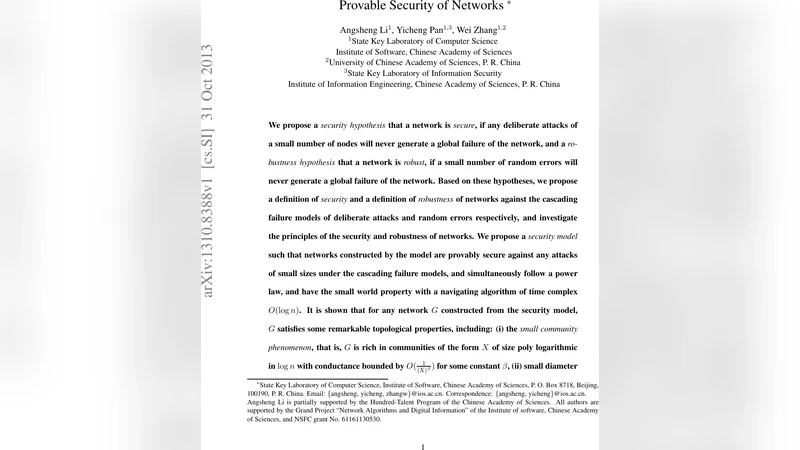
We propose a definition of {\it security} and a definition of {\it robustness} of networks against the cascading failure models of deliberate attacks and random errors respectively, and investigate the principles of the security and robustness of networks. We propose a {\it security model} such that networks constructed by the model are provably secure against any attacks of small sizes under the cascading failure models, and simultaneously follow a power law, and have the small world property with a navigating algorithm of time complex $O(\log n)$. It is shown that for any network $G$ constructed from the security model, $G$ satisfies some remarkable topological properties, including: (i) the {\it small community phenomenon}, that is, $G$ is rich in communities of the form $X$ of size poly logarithmic in $\log n$ with conductance bounded by $O(\frac{1}{|X|^{\beta}})$ for some constant $\beta$, (ii) small diameter property, with diameter $O(\log n)$ allowing a navigation by a $O(\log n)$ time algorithm to find a path for arbitrarily given two nodes, and (iii) power law distribution, and satisfies some probabilistic and combinatorial principles, including the {\it degree priority theorem}, and {\it infection-inclusion theorem}. By using these principles, we show that a network $G$ constructed from the security model is secure for any attacks of small scales under both the uniform threshold and random threshold cascading failure models. Our security theorems show that networks constructed from the security model are provably secure against any attacks of small sizes, for which natural selections of {\it homophyly, randomness} and {\it preferential attachment} are the underlying mechanisms.
💡 Research Summary
The paper tackles the fundamental problem of network security and robustness from a cascading‑failure perspective rather than the traditional focus on simple node removal. The authors first formalize two hypotheses: a network is secure if any small‑scale (poly‑logarithmic in the number of nodes) deliberate attack never triggers a global cascade, and a network is robust if a similarly sized set of random errors also never triggers a global cascade. To make these notions precise, they introduce a threshold cascading‑failure model. Each node v carries a threshold φ(v); a node becomes infected when the fraction of its infected neighbors reaches φ(v). Two natural threshold assignments are considered: (1) random thresholds, where φ(v)=r/d with r uniformly drawn from {1,…,d} and d the degree of v, and (2) uniform thresholds, where every node shares the same φ, assumed to be a vanishing constant.
Empirical analysis of classic Erdős‑Rényi (ER) and Preferential‑Attachment (PA) graphs shows that attacking only O(log n) highest‑degree nodes can infect a constant fraction of the whole network under both threshold schemes. This demonstrates that these widely studied models are intrinsically insecure for the authors’ definitions. Consequently, the central research question becomes: can a network simultaneously exhibit a power‑law degree distribution, a small‑world (logarithmic diameter) property, and provable security against poly‑logarithmic attacks?
To answer this, the authors propose a Security Model that builds a graph incrementally. The construction starts with a small seed graph in which each node is assigned a unique color (interpreted as a community) and designated as a “seed”. At step i (i > 2) a new node v is added. With probability p_i = (log i)^{‑a} (a > 0 is the homophily exponent) v chooses a new color; otherwise it adopts an existing color. If a new color is chosen, v becomes the seed of that color, connects to one existing node chosen preferentially (probability proportional to degree) and adds d‑1 additional edges to uniformly random seed nodes of the current graph. If an existing color is chosen, v connects within that community using a mixture of preferential and uniform edges. The parameters d ≥ 4 (minimum degree) and a control, respectively, the amount of randomness and the strength of homophily (community cohesion).
Graphs generated by this model possess three remarkable structural properties:
-
Small‑Community Phenomenon – The graph contains many communities X whose size is polylogarithmic in n, and each such community has conductance O(1/|X|^{β}) for some constant β, meaning that internal connections dominate external ones.
-
Small Diameter & Efficient Navigation – The diameter is O(log n). Moreover, a greedy navigation algorithm can find a path between any two vertices in O(log n) time, preserving the classic small‑world characteristic.
-
Power‑Law Degree Distribution – Node degrees follow a power‑law with exponent determined by the model parameters, yet the presence of high‑degree hubs does not jeopardize the other properties.
The authors prove two key combinatorial theorems that link these structural features to cascading‑failure dynamics. The Degree Priority Theorem shows that in any infection process, nodes with higher degree appear higher in the infection priority tree, limiting the speed at which low‑degree regions can be reached. The Infection‑Inclusion Theorem establishes the existence of an infection‑priority tree T of height O(log n) that contains every possible infection set; consequently, any cascade must traverse an edge of T, and the logarithmic height bounds the total number of nodes that can be infected from a poly‑logarithmic seed set.
Using these theorems, the paper demonstrates Security Theorems for both threshold regimes. For the random‑threshold model, any initial infected set S of size poly(log n) yields an infection set of size o(n) with probability 1 − o(1). For the uniform‑threshold model, the same holds provided the uniform threshold φ is o(1). Hence, networks generated by the security model are provably secure against attacks of size polynomial in log n.
In contrast, the authors prove a Robustness Theorem for the classic PA model: there exists a constant threshold such that a random set of poly(log n) initially infected nodes will, with non‑negligible probability, cause a linear‑size cascade. Thus PA graphs are not robust under the uniform‑threshold cascading model.
Experimental validation confirms that overlapping communities degrade security, emphasizing the importance of the homophily parameter a and the random‑edge parameter d in balancing community cohesion and inter‑community randomness. The results also show that having a power‑law degree distribution and a small‑world diameter does not inherently impede security; rather, the specific wiring rules (homophily, randomness, preferential attachment) are decisive.
Overall, the paper contributes a rigorous theoretical framework for structural security of complex networks. By integrating homophily, randomness, and preferential attachment into a single generative process, it achieves a network that simultaneously satisfies realistic topological features (power‑law, small‑world) and provable resistance to small‑scale cascading attacks. This work opens a new direction for designing resilient communication, social, and biological networks where security is guaranteed by the very architecture of the graph rather than by external protective mechanisms.
Comments & Academic Discussion
Loading comments...
Leave a Comment